1200, 1500, and 2000 kcal: how much food is that in grams
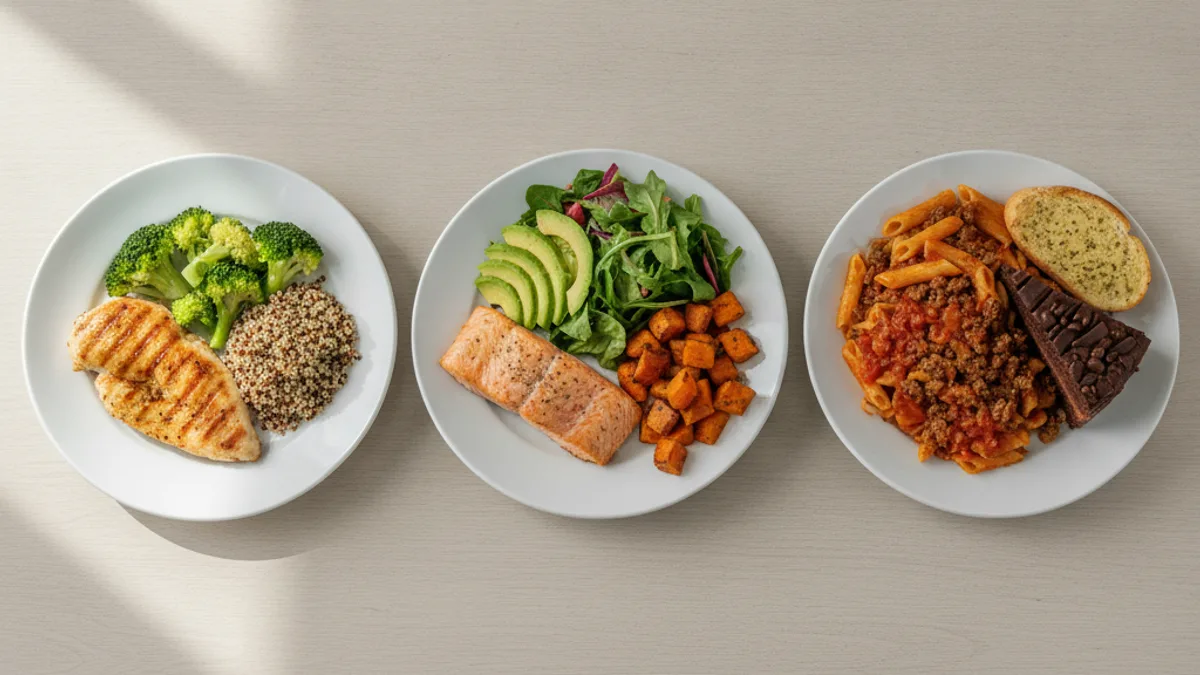
The daily calorie allowance is an abstraction until you see it in grams. 1200 kcal is about 700–800 g of regular food per day, 1500 is about a kilogram, and 2000 is around 1.3–1.5 kg. Below, these three numbers are broken down by plate, but first, a brief disclaimer on who each one is suitable for.
Who needs which number
First, a cutoff, because it is more important than the breakdowns themselves.
| Allowance | Who it usually corresponds to |
|---|---|
| 1200 kcal | The lower limit, rarely used and usually under supervision. For most adults, this is a deep deficit |
| 1500 kcal | A moderate deficit for a woman of average height with low activity |
| 2000 kcal | Maintenance for a woman or a moderate deficit for a man |
Your own number should be calculated using a formula, not chosen from this list: the calculation is broken down in the article on daily calorie requirements. The figures below are intended to help you visualize volume, not to adopt someone else's allowance.
A note on 1200: this is a common, but not universal, value. At this calorie level, it is difficult to get enough protein and micronutrients, which is why it is usually not recommended without necessity.
1200 kcal: what it looks like
Breakfast, ~300 kcal. Two eggs, a slice of whole-grain bread, a tomato.
Lunch, ~450 kcal. 120 g of chicken breast, 150 g of cooked buckwheat, a vegetable salad with a teaspoon of oil.
Dinner, ~350 kcal. 150 g of baked fish, 200 g of stewed vegetables.
Snack, ~100 kcal. An apple or 100 g of cottage cheese.
There is about 100 g of protein in this breakdown — this is the upper limit possible at this calorie level, and it is only achieved through lean sources.
1500 kcal
Breakfast, ~400 kcal. Oatmeal with milk (50 g of oats, 200 ml), an egg, a handful of berries.
Lunch, ~550 kcal. 150 g of chicken, 200 g of side dish, salad with a tablespoon of oil.
Dinner, ~400 kcal. 150 g of fish or meat, vegetables, a slice of bread.
Snack, ~150 kcal. Yogurt with a handful of nuts.
2000 kcal
Breakfast, ~500 kcal. Oatmeal with milk, two eggs, a piece of fruit.
Lunch, ~700 kcal. 180 g of meat, 250 g of side dish, salad, a slice of bread.
Dinner, ~550 kcal. 180 g of fish, potatoes, vegetables with oil.
Snacks, ~250 kcal. Yogurt, a piece of fruit, a handful of nuts.
Reference guide for these breakdowns
| Product, 100 g cooked | Kcal | Protein |
|---|---|---|
| Boiled chicken breast | ~165 | ~31 g |
| Boiled beef | ~250 | ~26 g |
| Baked lean fish | ~120 | ~20 g |
| Boiled buckwheat | ~110 | ~4 g |
| Boiled rice | ~120 | ~2.5 g |
| Boiled potatoes | ~80 | ~2 g |
| Cottage cheese 5% | ~120 | ~17 g |
| Stewed vegetables without oil | ~40 | ~2 g |
| Whole-grain bread | ~240 | ~9 g |
| Vegetable oil, 1 tsp | ~40 | 0 |
The values are approximate and given for the cooked product — this is important because dry grains absorb water when boiled, and the reference values for them are several times higher.
What most often breaks the calculation
- Cooking oil. A tablespoon is about 110 kcal, and it is usually not included in the breakdown.
- Drinks. Lattes, juice, beer — calories not perceived as food; see the analysis in the articles on coffee and juices.
- Eyeballing weight. A portion of "about 150 g" regularly turns out to be 220 — see the article on portion weight.
- Sauces and dressings. Two tablespoons of mayonnaise is about 180 kcal.
It is these four points, rather than the choice between buckwheat and rice, that determine the difference between the plan and the reality. The mechanics of systematic underestimation are analyzed in the article on calorie counting apps.
Frequently asked questions
- How much food is 1200 kcal?
- Approximately 700–800 g of regular food per day: two eggs with bread for breakfast, 120 g of chicken with a side dish and salad for lunch, 150 g of fish with vegetables for dinner, and a small snack. This layout provides about 100 g of protein, which is the upper limit of what is possible.
- Who is the 1200 kcal limit suitable for?
- This is the lower limit, which is rarely used and usually under supervision: for most adults, this caloric intake represents a deep deficit, making it difficult to obtain enough protein and micronutrients.
- How much food is in 2000 kcal?
- About 1.3–1.5 kg per day: oatmeal with eggs and fruit for breakfast, 180 g of meat with a side dish and salad for lunch, 180 g of fish with potatoes and vegetables for dinner, plus two snacks.
- Why are reference values for grains higher than in the meal plan?
- Because in reference books, they are usually given for the dry product, but it is eaten cooked. During cooking, grains absorb water roughly threefold, and the caloric content of 100 g of the finished product is lower accordingly.
- What most often breaks the calculation?
- Cooking oil—a tablespoon is about 110 kcal—drinks that are not perceived as food, estimating portion weight by eye, and sauces. These four items have a greater impact than the choice of a specific grain.
Read next
- Daily calorie intake — There is no universal norm: it depends on weight, height, age, sex, and activity level.
- How to determine portion size without a scale — Portion weight is the most inaccurate variable in any calculation, including analysis by photo.
- How to count calories in homemade food — Processed foods are counted by the label, and restaurant meals by a reference guide.
- Workplace cafeteria: how to count when the server dishes it out — None of the tricks that work at home apply in a cafeteria: there are no scales, the ingredients are unknown, and portion size is decided by someone with a ladle.
This article is for general information. It is not medical advice, a diagnosis, or a prescription for treatment or a diet, and it does not replace a consultation with your doctor. If you have a health condition, are pregnant, take medication, or follow a diet prescribed to you, decisions about food belong with your doctor.
Figures from regulations, guidelines and studies are given as they stood when this article was prepared and may since have changed; check them against the primary sources. This article is not advertising, an offer, or individual advice, and neither the author nor the site owner is responsible for decisions taken on the basis of it.