Workplace cafeteria: how to count when the server dishes it out
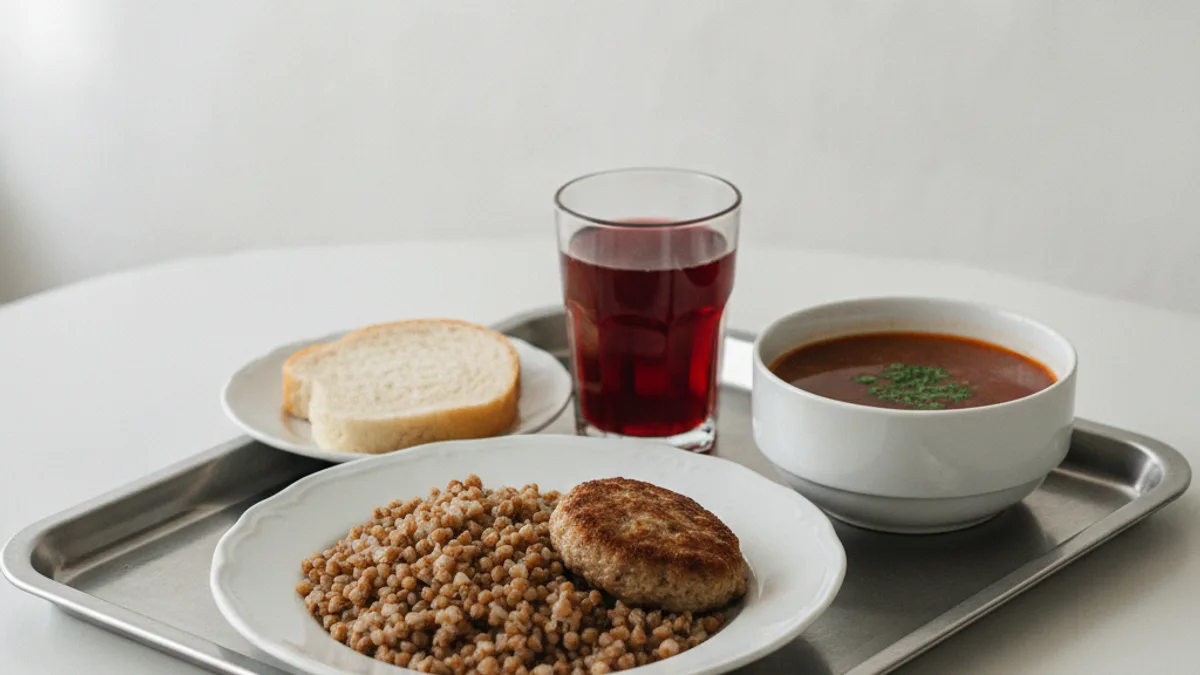
None of the tricks that work at home apply in a cafeteria: there are no scales, the ingredients are unknown, and portion size is decided by someone with a ladle. But some things here can still be calculated.
What is known for sure in a cafeteria
More than it seems. Establishments that serve food based on a pre-planned menu operate using technical cards—a document where the ingredient breakdown and portion weight in grams are recorded for each dish. The portion size is usually printed on the menu itself: "Goulash 100/50", "Buckwheat porridge 200".
These numbers are not just for show. The first number in the "100/50" pair is the weight of the main product, and the second is the sauce or side dish. If they are present, half the work is done: you have already been given the portion weight, and all that remains is to estimate the composition.
What to ask the server
The question "how many calories are in this" almost always gets the answer "I don't know". Questions that do get answered:
- "What is the portion size?" — the server sees this number on the menu and knows it by heart.
- "Is the chicken fried or baked?" — the difference between them is greater than between two different types of meat.
- "Is the patty all meat or a meat-and-filler mix?" — the latter includes bread in the recipe, which lowers the calorie count and changes the composition.
- "Does the side dish have butter?" — porridge drizzled with butter at the serving line adds 60–90 kcal beyond what is stated.
Everything else—salad, soup, compote—is predictable in composition, and the margin of error there is small.
Where the error is largest
Not in the patty. The meat portion of the lunch is almost always pre-portioned: it is served by the piece, and the variation between two identical patties is only a few dozen kilocalories.
The large variation comes from what is served with a spoon:
| Item | Stated weight | Actual variation |
|---|---|---|
| Side dish — grains, pasta, mashed potatoes | 150–200 g | Easily ±50 g, which is ±60–90 kcal |
| Salad dressing | 10–20 g | A spoonful of oil on top — plus 90–120 kcal |
| Soup | 250 ml | Solids vs. broth can double the number |
| Meat sauce | 50 g | Sour cream-based vs. mayonnaise-based varies threefold |
The practical takeaway: if you want to reduce the margin of error in one step, look not at the main course, but at what the side dish and salad are topped with.
How to estimate weight by eye
Benchmarks for a standard tray:
- A side dish occupying about a third of a 24 cm diameter plate is about 180–200 g.
- A patty the size of a palm without fingers is 90–110 g.
- A ladle of soup is 180–250 ml depending on the cafeteria.
- A slice of bread from a loaf is 25–30 g, about 70 kcal.
A detailed breakdown of this technique is in a separate article on how to determine portion weight without a scale.
A photo of the tray instead of an estimate
A tray is convenient for analysis via photo precisely because of what makes it inconvenient for eyeballing: everything is laid out on separate plates, nothing overlaps, and there are items of known size nearby. This is a significantly better shot than a single plate of homemade stew.
Two things are not visible in the photo—how much oil was used in cooking and exactly what is in the glass. The first remains an estimate, the second is easier to add manually.
If you go to the same cafeteria every day
Then it makes sense to calculate once and use the result going forward. Cafeteria menus are cyclical—usually on a two-week rotation—dishes repeat, and the portion size is set by documentation and does not fluctuate. Five or six calculated lunches cover almost the entire cycle, and after that, counting turns into selecting from a ready-made list.
The same technique works for business lunches, where the composition changes by day of the week, but the set of dishes repeats.
Frequently asked questions
- Is a cafeteria required to report the calorie content of dishes?
- No. Technical regulations require nutritional information to be listed on packaged products, but dishes prepared and served on-site do not fall under this requirement. However, the portion weight in grams is usually available on the menu.
- What does the "100/50" notation on a cafeteria menu mean?
- This is the portion yield: the first number is the weight of the main product, the second is the sauce or side dish. The portion weight has already been provided to you, so all that remains is to estimate the composition and preparation method.
- What distorts the calorie count of a cafeteria lunch the most?
- Not the meat portion, but what is served by the spoonful: the size of the side dish and the salad dressing. A spoonful of oil in a salad adds 90–120 kcal, and a side dish can easily deviate from the stated yield by 50 g.
Read next
- Business lunch: how many calories it has and how to choose the composition — A business lunch is convenient for the very reason it is inconvenient for tracking: the composition is set, the choice is limited to two or three options, and everything is served at once.
- How to determine portion size without a scale — Portion weight is the most inaccurate variable in any calculation, including analysis by photo.
- How to count calories in a restaurant and with food delivery when there is no recipe — A home-cooked meal can be calculated by its ingredients, and packaged food can be checked on the label.
This article is for general information. It is not medical advice, a diagnosis, or a prescription for treatment or a diet, and it does not replace a consultation with your doctor. If you have a health condition, are pregnant, take medication, or follow a diet prescribed to you, decisions about food belong with your doctor.
Figures from regulations, guidelines and studies are given as they stood when this article was prepared and may since have changed; check them against the primary sources. This article is not advertising, an offer, or individual advice, and neither the author nor the site owner is responsible for decisions taken on the basis of it.