Business lunch: how many calories it has and how to choose the composition
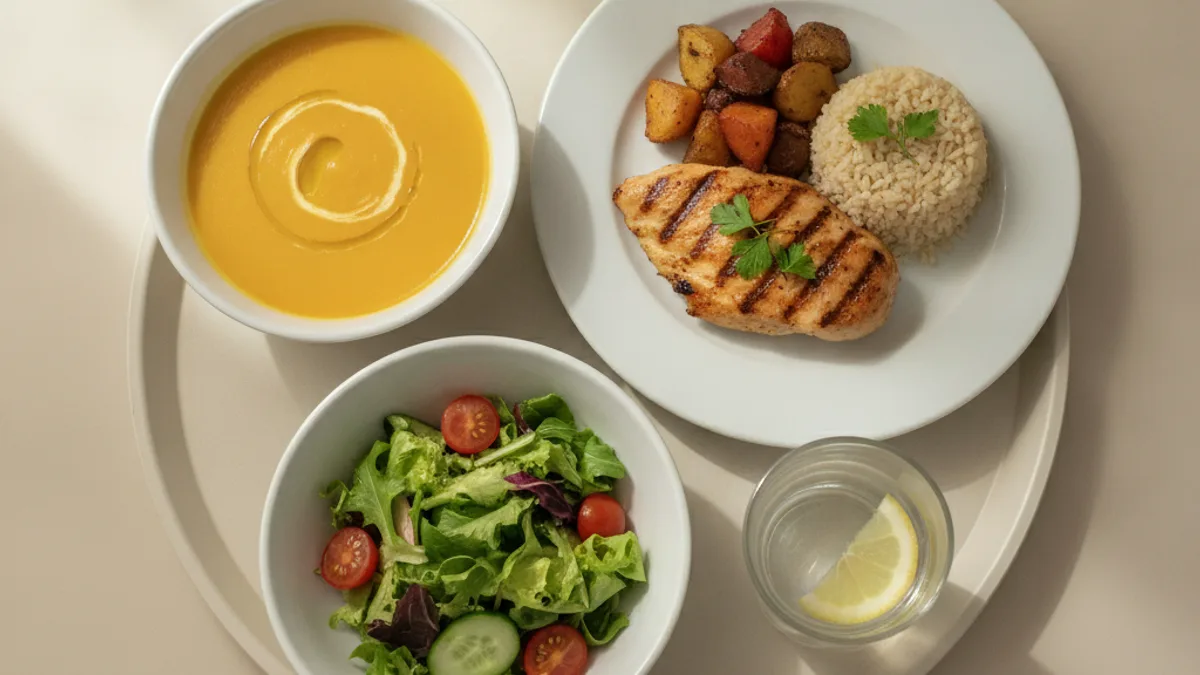
A business lunch is convenient for the very reason it is inconvenient for tracking: the composition is set, the choice is limited to two or three options, and everything is served at once. However, it repeats—five lunches a week, fifty per quarter. A lunch that happens once means nothing; a lunch that repeats defines half of your diet.
What it consists of
A typical set meal has four parts, and they contribute to the total count very unevenly:
| Part | Typical contribution | Variation |
|---|---|---|
| Salad or appetizer | small | from vegetables with oil to mayonnaise-based — a several-fold difference |
| Soup | medium | broth versus creamy soup |
| Main course with side | largest | the main part of the lunch and the main source of differences |
| Bread, drink, dessert | noticeable and unnoticed | what is not counted at all |
The last line is the main trap of a set lunch. The bread basket, fruit drink, or a "small" dessert are included as an add-on to the order, not as food, and are not remembered by evening. Yet, together they provide a significant portion of the lunch.
Where half the energy hides
Not in the portion size, but in the cooking method and the fat content.
- Side dish. Replacing french fries or mashed potatoes with butter for grains or vegetables changes the lunch more than any other decision in the set.
- Breading and deep-frying. A breaded cutlet versus the same grilled chicken is a one-and-a-half-fold difference for the same piece of meat.
- Salad dressing. Mayonnaise versus oil and vinegar — plus one hundred and fifty to two hundred kilocalories for a small plate.
- Cream-based soup. A cream soup is perceived as light, but it is not.
- Drink. A sweet fruit drink is a glass of sugar that does not satiate and is not remembered.
Restaurant food is generally fattier than the homemade version of the same dish — why this is so is analyzed in the article about calories in a restaurant.
What to change if the lunch is daily
The point is not to give up lunch, but to change what repeats. Three substitutions that do not require willpower and work every day:
- Side dish. Ask for a substitution — it is usually available and costs nothing.
- Drink. Water or unsweetened tea instead of a fruit drink. This is the only item in the set whose omission does not affect satiety at all.
- Bread. Do not remove it from the table, just do not count it as part of the default lunch.
What you should not do is skip lunch to "save" calories. A 300 kcal lunch at 1:00 PM almost always turns into a 900 kcal dinner at 9:00 PM, and in the weekly total, such savings turn out to be an overconsumption.
How to record it
It is convenient to record a set lunch as a whole rather than in parts: the composition is fixed and repeats. A practical method is to take a picture of the business lunch page once: the analysis will provide an estimate for all items at once, and then you just need to note which of the options you chose today.
Noted items are added to the daily allowance, unnoted ones remain in the record and are not counted — how this works is analyzed separately. For a daily lunch, this turns out to be the fastest way: the card is the same, marking two or three items takes a second.
The numbers remain an estimate based on the name: you cannot determine the kitchen's recipe or the exact weight of the portion from it. For a repeating lunch, this does not matter — what is important is not the third digit, but that the lunch was recorded in the diary and that it is clear how one lunch option differs from another.
In short
- The main contribution comes from the main course with a side; bread, drink, and dessert provide a noticeable share and are not remembered.
- The side dish, breading, and dressing affect the count more than the portion size.
- It is better to change what repeats every day rather than attempting a one-time refusal.
- A skipped lunch is made up for at dinner and costs more in the weekly total.
Frequently asked questions
- How many calories are in an average business lunch?
- There is no universal number: set meals vary significantly in composition and portion size, and the establishment calculates them according to its own technical specifications. It is more useful not to look for an average, but to check the composition of a specific lunch — the main part comes from the hot dish with a side, while bread, drinks, and dessert add a significant portion that is usually overlooked.
- What changes the calorie content of a business lunch the most?
- The side dish, the cooking method of the main course, and the salad dressing. Replacing potatoes with grains or vegetables, grilling instead of breading, and using oil and vinegar instead of mayonnaise-based dressings change the meal more than the portion size does.
- Should I skip lunch to eat less during the day?
- Usually, this does not work: a severely restricted lunch is compensated for in the evening, and the weekly total ends up being higher. It is more practical to change the composition of the lunch you have every day.
- How can I quickly log my daily business lunch in a food diary?
- Take a picture of the lunch menu once — the analysis will provide an estimate for all items — and then simply check off the option you chose today. The composition of the set meal is fixed and repetitive, so marking it takes only a second.
Read next
- Restaurant menu: how to add a dish and its nutritional value to your food diary with a single checkmark — Lunch at a cafe is usually where a food diary falls apart.
- How to count calories in a restaurant and with food delivery when there is no recipe — A home-cooked meal can be calculated by its ingredients, and packaged food can be checked on the label.
- How to choose dishes in a cafe based on macronutrients, not just calories — Choosing based solely on calories leads to odd decisions: a salad with dressing ends up being "heavier" than a chicken breast, and the lightest item on the menu becomes mineral water.
- How to determine the calorie content of a dish if it is not listed on the menu — Menus often list only the name and price.
This article is for general information. It is not medical advice, a diagnosis, or a prescription for treatment or a diet, and it does not replace a consultation with your doctor. If you have a health condition, are pregnant, take medication, or follow a diet prescribed to you, decisions about food belong with your doctor.
Figures from regulations, guidelines and studies are given as they stood when this article was prepared and may since have changed; check them against the primary sources. This article is not advertising, an offer, or individual advice, and neither the author nor the site owner is responsible for decisions taken on the basis of it.