How to choose dishes in a cafe based on macronutrients, not just calories
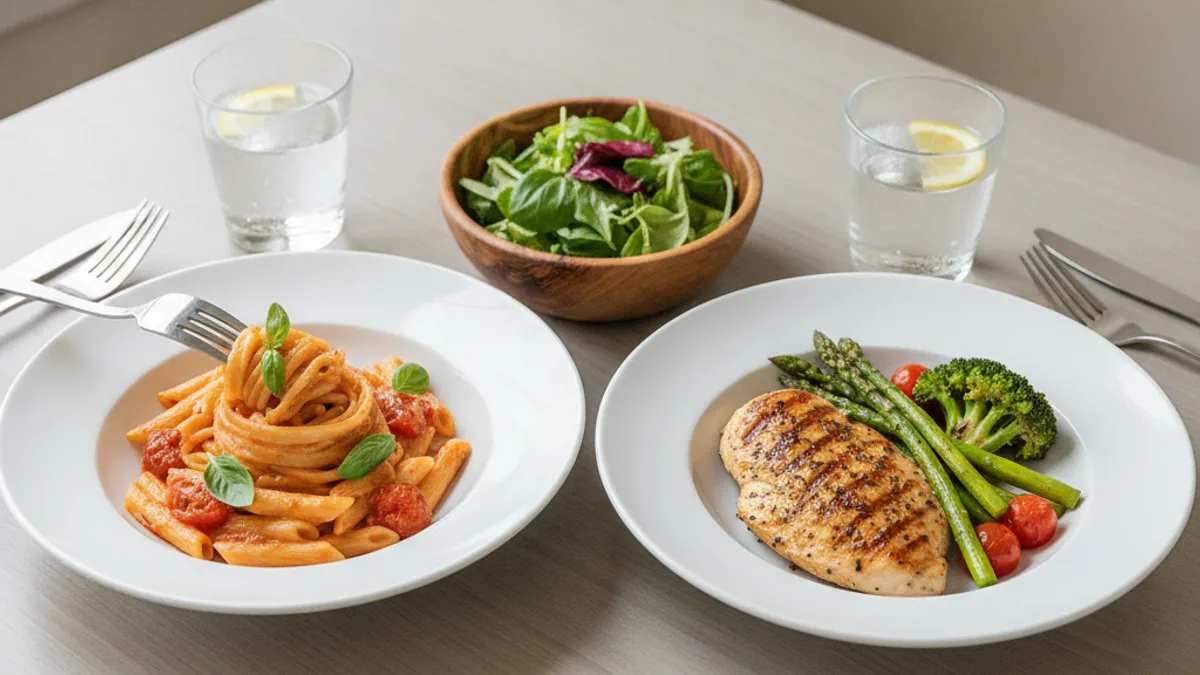
Choosing based solely on calories leads to odd decisions: a salad with dressing ends up being "heavier" than a chicken breast, and the lightest item on the menu becomes mineral water. The number of kilocalories does not describe a meal; it only describes its energy cost. Two dishes with the same calorie count can differ from each other more than two dishes with different ones.
Same calories, different lunch
A hypothetical example: two items that have the same caloric content but different compositions. The numbers here are illustrative: specific values depend on the kitchen's recipe and portion size.
| Pasta in cream sauce | Grilled chicken with grains and vegetables | |
|---|---|---|
| Calories | the same | the same |
| Protein | low: only in cheese and traces of meat | high: the base of the dish is meat |
| Fat | high: cream and butter | moderate: grilled without dressing |
| In two hours | more likely to be hungry | less likely |
In terms of calories, there is no choice between them. In terms of how the day ends, there is: after the first option, a snack is more likely, and the daily total will be higher, even though the lunch was "the same."
Why protein matters
Of the three macronutrients, protein provides the most satiety, carbohydrates less, and fat the least. This order is described in a review of the effect of high-protein diets on thermogenesis, satiety, and weight loss. A systematic review of studies with overweight participants shows the same trend, but the results do not converge in all studies—this is a tendency, not a law.
For choosing from a menu, the trend is what matters: at equal caloric content, a dish with more protein is more likely to curb hunger until evening. Protein also better preserves muscle mass when a person eats less than they burn—which is important if the goal is not just a "lower number on the scale." The mechanics are analyzed in the article on protein and muscle synthesis.
In a restaurant menu, protein is distributed unevenly, and it is easier to notice this than to calculate it:
- High protein: grilled meat and poultry, fish, seafood, cottage cheese dishes, eggs, legumes.
- Low protein with high calories: pasta without meat, pizza, potatoes in any form, pastries, salads where the main component is the dressing.
What to look for on a menu in ten seconds
- Cooking method. Grilling, baking, boiling, or stewing versus deep-frying and breading. This is the strongest difference on a menu, and it is written right in the name.
- Sauce. Creamy, cheesy, or mayonnaise-based—that's hundreds of extra kilocalories and almost no protein. "With vegetables and olive oil" is cheaper in terms of energy than "in sauce."
- What is the protein source. Does the item contain meat, fish, cottage cheese, or legumes—or is it all based on flour and oil.
- Side dish as a separate decision. Replacing french fries with vegetables or grains changes the plate more than choosing between two main dishes.
- Drink. An item that is often forgotten: a latte with syrup is comparable in calories to a side dish, and unlike a side dish, it does not provide satiety at all.
What not to do
Look for the "lightest" thing on the menu. The lightest item will always be water or tea, and that is not the answer to the question of what to order for lunch. You need to choose among food and among things that will actually make you full.
Skimp on lunch to "save for the evening." A 300 kcal lunch at 1:00 PM is a 900 kcal dinner at 9:00 PM, usually with a second helping. The deficit created by fasting during the day is almost always made up at night.
Divide food into "allowed" and "forbidden." There are no forbidden items on a menu. There are more or less suitable ones for a specific day, and one lunch does not decide anything at all: what matters is what is repeated, not what happened once.
When there are no numbers on the menu
A common situation: there are no calories, but a decision must be made. In Russia, you can ask for nutritional information—the establishment is required to provide it, and how this works is explained separately. A faster way is to take a picture of the entire menu page: an assessment will be provided for all items at once, along with protein, not just calories, and the very difference between dishes with similar caloric content will become visible.
The numbers remain an estimate based on the name: the kitchen's recipe and portion weight cannot be determined from it. For choosing between items, this is sufficient: the difference in protein between a meat dish and a flour-based dish outweighs any estimation error. More details on macronutrients and what each of the four numbers means.
In short
- Calories describe the price of the lunch, not the lunch itself.
- Protein determines whether you will be full in two hours and is visible in the name of the dish.
- The cooking method and sauce affect the number more than the product itself.
- The "lightest" thing on the menu is not the goal: you should choose among food.
Frequently asked questions
- Why do two dishes with the same calorie count make for a different lunch?
- Because the same number can represent a different composition. Pasta in a cream sauce is low in protein and high in fat, while chicken with grains and vegetables is the opposite. After the first, you are more likely to snack in two hours, and your daily total will be higher, even though the lunch had the same calorie count.
- What should I look for on the menu if the calorie count is not listed?
- Look at the cooking method (grilled and baked versus deep-fried and breaded), the sauce (cream and mayonnaise-based sauces add hundreds of kilocalories with almost no protein), the presence of a protein source in the dish, and the side dish. All of this is written directly in the item name.
- Should I choose the lowest-calorie dish on the menu?
- No. The lightest item will be water or tea, and that is not a lunch. Furthermore, a severely restricted lunch is usually compensated for in the evening: the deficit created by starving during the day is often made up for by dinner with seconds.
- How much protein should a dish have to keep me full?
- There is no universal number: the requirement depends on body weight, activity level, and the rest of your diet. A practical guideline when choosing in a cafe is to compare items with each other and prefer the one that has significantly more protein for a comparable calorie count.
Read next
- What is KBZHU — KBZHU represents four numbers that describe food: caloric content and the three macronutrients that make it up.
- How to determine the calorie content of a dish if it is not listed on the menu — Menus often list only the name and price.
- Protein and muscle protein synthesis: dose, leucine and the anabolic window — Protein comes with its own arithmetic: thirty grams per meal, a leucine threshold, a window after training.
- How to count calories in a restaurant and with food delivery when there is no recipe — A home-cooked meal can be calculated by its ingredients, and packaged food can be checked on the label.
This article is for general information. It is not medical advice, a diagnosis, or a prescription for treatment or a diet, and it does not replace a consultation with your doctor. If you have a health condition, are pregnant, take medication, or follow a diet prescribed to you, decisions about food belong with your doctor.
Figures from regulations, guidelines and studies are given as they stood when this article was prepared and may since have changed; check them against the primary sources. This article is not advertising, an offer, or individual advice, and neither the author nor the site owner is responsible for decisions taken on the basis of it.