Buckwheat and kefir diets: how many calories they provide and where the lost kilograms come from
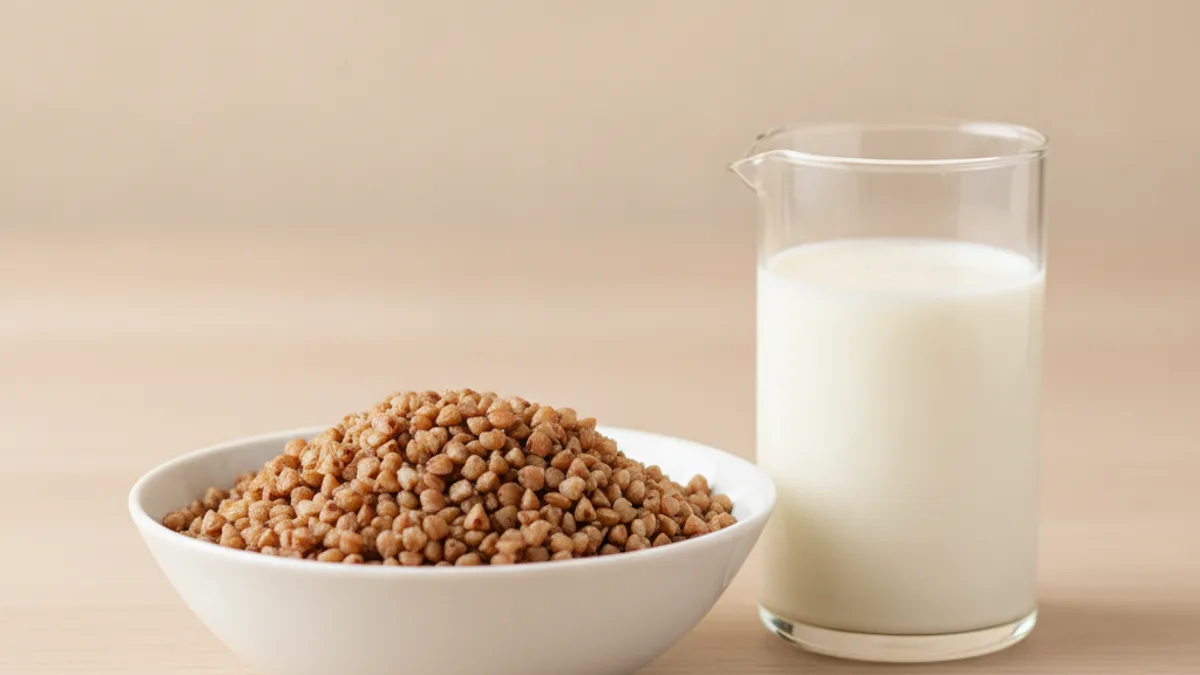
A day of buckwheat with a kilogram of 1% kefir provides about 930–1,210 kcal, and a day on one and a half kilograms of kefir about 570. If the scale shows several kilograms less after a week or three days, the arithmetic puts the fat among them at about a kilogram or less. The rest is mostly water stored with glycogen, and it comes back with ordinary meals.
How the two diets work
The buckwheat diet is usually described as a week of buckwheat soaked in boiling water without salt or oil, in any amount, plus up to a litre of low-fat kefir a day. The kefir diet is two or three days of kefir only, usually one and a half litres a day.
Both diets are calculated below from published data. For buckwheat, the USDA FoodData Central entry "Buckwheat groats, roasted, cooked" (FDC ID 170686, FoodData Central): 92 kcal, 3.38 g protein, 0.62 g fat and 19.9 g carbohydrate per 100 g of cooked groats. For kefir, the label of a product sold in Russia, Domik v Derevne 1% kefir, 1,000 g: 38 kcal, 3.2 g protein, 1 g fat and 4 g carbohydrate per 100 g, as of October 12, 2026.
Calories and protein on buckwheat with kefir
Buckwheat is not weighed on this diet, so there are two versions below: 600 g and 900 g of cooked groats a day. Both include a 1,000 g pack of kefir.
| Per day | kcal | Protein | Fat | Carbohydrate |
|---|---|---|---|---|
| Buckwheat, 600 g | 552 | 20.3 g | 3.7 g | 119.4 g |
| Buckwheat, 900 g | 828 | 30.4 g | 5.6 g | 179.1 g |
| 1% kefir, 1,000 g | 380 | 32 g | 10 g | 40 g |
| Total with 600 g buckwheat | 932 | 52.3 g | 13.7 g | 159.4 g |
| Total with 900 g buckwheat | 1,208 | 62.4 g | 15.6 g | 219.1 g |
Protein can be compared with the EFSA reference value for adults: 0.83 g per kilogram of body weight a day (EFSA summary of dietary reference values). That is 58 g for 70 kg and 75 g for 90 kg. The version with 600 g of groats falls short already at 70 kg; the version with 900 g just exceeds it at 70 kg and falls short at 90 kg. More on protein needs in the article on daily protein intake.
If you count by dry groats, use the values on their pack: the same buckwheat weighs several times more once cooked, and the two weights cannot be mixed in one calculation. How dry weight converts to cooked is covered in the article on the raw and cooked weight calculator.
What the kefir diet provides
One and a half kilograms of the same kefir, or one and a half packs, provide 570 kcal, 48 g protein, 15 g fat and 60 g carbohydrate a day. Over three days that is 1,710 kcal in total.
The kefir label gives nutrition values per 100 g, not per 100 ml. Why that matters for counting is explained in the article on grams and millilitres of dairy products.
How clinical guidelines classify this intake
The UK obesity guideline NICE NG246 calls 800–1,200 kcal diets low-energy and diets under 800 kcal very-low-energy. Buckwheat with kefir falls into the first group, three days of kefir into the second.
NICE considers low-energy diets only as part of a specialist programme with long-term support, and very-low-energy diets only when there is a clinically assessed need for rapid weight loss, such as before surgery. Both must be nutritionally complete, last no more than 12 weeks, and include clinical supervision and advice on returning to ordinary food. A self-directed week on two foods involves neither supervision nor any check that it is nutritionally complete.
Where the lost kilograms come from
There is less fat in that number than it seems. Suppose your daily expenditure is about 2,200 kcal (you can estimate your own with the article on daily calorie needs). Then:
- a week of buckwheat with kefir creates a deficit of 6,900 to 8,900 kcal, or 0.9–1.2 kg of body tissue by the 7,700 kcal per kilogram rule;
- three days of kefir create a deficit of about 4,900 kcal, or about 0.6 kg.
The rest on the scale is mostly water. Glycogen is stored in the liver and muscles together with water: according to Kreitzman and colleagues (1992), each part of glycogen is held with three to four parts of water. When food is scarce, the store is used up and the water goes with it.
How large the water share can be was shown by a study by Yang and Van Itallie (1976): six people with obesity spent 10-day periods on 800 kcal a day. On a mixed diet, water made up 37% of the loss; on a low-carbohydrate diet, 61%. In carbohydrate, the kefir diet, at about 60 g a day, is closer to the second case, and the buckwheat diet, at 160–220 g, to the first.
A small part comes from changes in the gut. In a study by Cummings and colleagues (1992), median stool weight in British adults was about 106 g a day, and it rose with the amount of fibre in the diet. Kefir contains no fibre, so gut contents shrink on the kefir diet. There is about 24 g of fibre in 900 g of cooked buckwheat according to the same USDA entry, so on the buckwheat diet this effect may even work the other way.
What happens after you return to ordinary food
With the first ordinary meals, glycogen is restored, and the water with it. The Kreitzman paper is titled accordingly: "illusions of easy weight loss, excessive weight regain". Within a few days the scale gives back most of the drop, even though no fat is gained.
The tissue lost, those 0.6–1.2 kg, does not come back by itself. It comes back if you eat more after the diet than before it. How a sharp restriction affects hunger on the following days is covered in the article on fasting days.
At very low intakes, fat-free mass is lost too. In a trial by Vink and colleagues (2016), fat-free mass made up 8.8% of the weight lost by people who spent five weeks on 500 kcal a day. In the group that spent 12 weeks on 1,250 kcal, it was 1.3%. The more fat-free mass participants lost, the more weight they regained later.
When to see a doctor first
- Diabetes, if you take insulin or tablets that increase insulin release (sulfonylureas, meglitinides). NIDDK lists too little carbohydrate, skipped meals and fasting while taking such medicines as causes of low blood glucose. Doses for a changed diet are set by a doctor.
- Gallstone disease or past gallstones. According to NIDDK, very low-calorie diets and rapid weight loss raise the risk of gallstones.
- Pregnancy and breastfeeding.
- Stomach, bowel, kidney or liver conditions for which a doctor has set your diet: a single-food week replaces it entirely.
- Medicines that must be taken with food or that affect blood glucose or blood pressure.
- Being under 18.
- A current or past eating disorder. In that case, discuss any strict regimen with a specialist beforehand; the signs are described in the article on calorie counting and eating disorders.
Kefir is a dairy product, so if you are lactose intolerant, see the article on lactose intolerance.
If you simply like buckwheat and kefir
Both fit easily into an ordinary diet: buckwheat as a side dish, kefir as a snack. Record them in your diary by weight, like any other food. How buckwheat differs from rice is covered in "Buckwheat or rice", and how different diets have been compared with each other in the article on types of diets.
Frequently asked questions
- How many calories a day are on the buckwheat diet?
- With 600 g of cooked buckwheat and 1 kg of 1% kefir, about 930 kcal; with 900 g of buckwheat, about 1,210 kcal. The calculation uses USDA data for cooked buckwheat (92 kcal per 100 g) and a kefir label (38 kcal per 100 g).
- How much weight do you lose on the buckwheat diet in a week?
- At an expenditure of about 2,200 kcal, the weekly deficit is 6,900–8,900 kcal, or 0.9–1.2 kg of body tissue. Anything the scale shows beyond that is mostly water stored with glycogen, and it returns after the diet.
- How many kilograms do you lose on a 3-day kefir diet?
- One and a half kilograms of 1% kefir provide about 570 kcal a day. At an expenditure of about 2,200 kcal, three days add up to a deficit of about 4,900 kcal, or roughly 0.6 kg of body tissue. The rest of the drop on the scale is mostly water and a little gut content.
- Is there enough protein on buckwheat with kefir?
- It depends on your weight and how much buckwheat you eat. The EFSA reference value is 0.83 g of protein per kilogram of body weight: 58 g for 70 kg. 600 g of buckwheat and 1 kg of kefir provide about 52 g; with 900 g of buckwheat, about 62 g.
- Why does weight come back so quickly after the diet?
- Ordinary food restores glycogen and the water stored with it: each part of glycogen is held with three to four parts of water. That is not fat. Fat comes back if you eat more after the diet than before it.
- Who should avoid buckwheat and kefir diets?
- Discuss them with a doctor first if you have diabetes and take insulin or sulfonylureas, have gallstone disease, are pregnant or breastfeeding, have a digestive, kidney or liver condition, take medicines, are under 18, or have an eating disorder.
Read next
- Types of diets — When comparing diets in studies, an inconvenient result emerges: the difference between them is smaller than the difference between the people who follow them and those who do not.
- Fasting day: what it provides and what it doesn't — A fasting day is a 24-hour period with sharply reduced calorie intake, usually consisting of a single food item.
- Buckwheat or rice: which is higher in calories and how do they really differ — In their cooked form, both grains provide about a hundred kilocalories per 100 grams: buckwheat is approximately 110, white rice is approximately 120.
This article is for general information. It is not medical advice, a diagnosis, or a prescription for treatment or a diet, and it does not replace a consultation with your doctor. If you have a health condition, are pregnant, take medication, or follow a diet prescribed to you, decisions about food belong with your doctor.
Figures from regulations, guidelines and studies are given as they stood when this article was prepared and may since have changed; check them against the primary sources. This article is not advertising, an offer, or individual advice, and neither the author nor the site owner is responsible for decisions taken on the basis of it.