Fitness trackers and calorie expenditure: why they measure heart rate but estimate calories
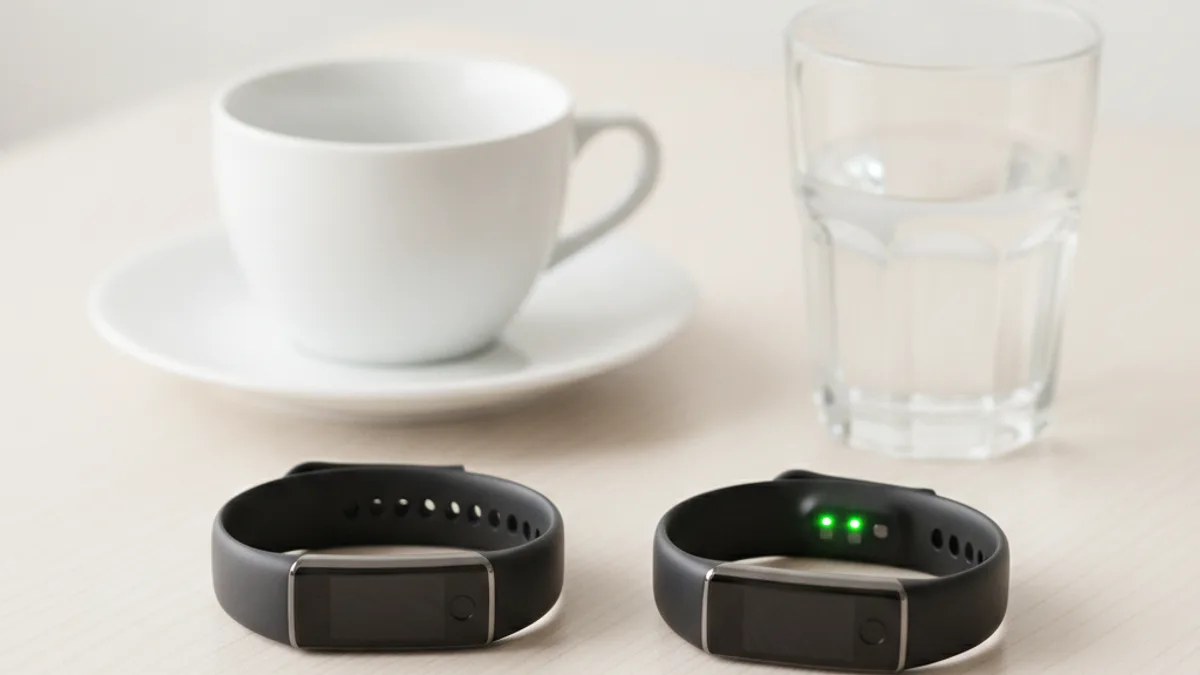
On a tracker screen, three numbers look equally reliable: heart rate, steps, and "calories burned." They are obtained in fundamentally different ways. The first is measured, the second is counted, and the third is derived from the first two using a formula that incorporates assumptions about your body. Their accuracy also differs by an order of magnitude.
What the fitness tracker actually measures
The sensor on the bottom of the device shines a green LED into the skin and monitors how much light is reflected back. The volume of blood in the vessels under the skin fluctuates with each heartbeat, and light absorption changes at the same frequency. The heart rate is derived from this oscillation. This method is called photoplethysmography, and it is a true measurement of a physical quantity, not an estimate.
The second sensor is an accelerometer, which records the device's acceleration along three axes. Steps are identified from the characteristic pattern of these accelerations. This is not a measurement, but pattern recognition: stirring a spoon in a pot or driving on a dirt road also produce rhythmic vibrations, and some of these are counted as steps. How many steps it makes sense to take is the subject of our article on the daily step count.
None of these sensors can detect energy expenditure. It is calculated.
How "burned calories" are calculated
The process works roughly like this: the basal metabolic rate is estimated using a formula based on height, weight, age, and sex. An activity allowance is added, derived from heart rate and movement data based on models built from a sample of people in a laboratory. The result is displayed on the screen as a fact.
There are two weak points in this chain, and neither is the sensor itself.
The basal metabolic rate is estimated by a formula. Equations predict it quite well for a group, but there is significant variance for an individual. This is discussed in more detail in our article on daily calorie requirements.
The relationship between heart rate and energy expenditure is individual. At the same heart rate, a trained and an untrained person burn different amounts of energy; heart rate is also affected by caffeine, lack of sleep, temperature, stress, and dehydration. The model does not account for this.
What the tests showed
The difference between the two types of metrics has been measured directly. In a study comparing three trackers against laboratory standards with 22 participants, the mean absolute percentage error for heart rate ranged from 1% to 8% depending on the device and activity level. For energy expenditure, the error for the same devices and participants reached up to 62%. The authors' conclusion is straightforward: heart rate readings can be used, but calories should be treated with caution, as they can be significantly overestimated or underestimated.
A larger study with seven devices and sixty participants reached the same conclusion: heart rate is measured acceptably, while the energy expenditure estimate deviates from the standard much more significantly and does not follow the accuracy of the heart rate.
Pay attention to the structure of the result. It is not that "trackers are bad": the part they measure is measured well. The conversion of the measured data into energy is what works poorly, and this is a property of the task, not a specific model.
Where the error is greatest
| Situation | What happens to the estimate |
|---|---|
| Walking and running | The most accurate case: movement is rhythmic, and models are built primarily on it |
| Strength training | High heart rate, little movement — expenditure is usually overestimated |
| Cycling, rowing | Wrist is almost stationary, steps are not counted — expenditure is underestimated |
| Desk work | Fidgeting and gesturing are counted as movement — slight overestimation |
| Stress, coffee, heat | Heart rate increases without an increase in expenditure — overestimation |
It is also worth noting that tattoos and dark skin affect the absorption of green light, causing signal quality to drop. A loosely fastened strap degrades the signal for everyone.
Why this is more dangerous than it seems
An inaccurate number by itself is harmless. The harm begins when it enters a food diary: the app adds the "burned" calories to the daily allowance, the person eats those extra calories, and the deficit disappears. Two errors compound in the same direction: overestimated expenditure and underestimated intake, which is discussed in our article on calorie counting apps.
Then follows a familiar story: the calculations match, the weight stays the same, and the conclusion is drawn about a plateau or a damaged metabolism. Even though the cause is purely arithmetic.
How to use a fitness tracker effectively
- Look at trends, not absolute values. The systematic error is consistent from day to day, so "today is more than yesterday" is a meaningful statement, while "2740 kcal burned" is not.
- Do not add "burned" calories to your daily allowance. Or add half, if you really want to add them.
- Treat heart rate and steps as the primary metrics. This is what the device does well: resting heart rate, its trend, and total movement volume for the week.
- Check with a scale, not the screen. Weight trends over two to three weeks are the only feedback that accounts for everything at once, including what the tracker cannot see.
It is also worth remembering that regular movement is beneficial in itself, not because of the number on the screen: what is known about a sedentary lifestyle and its consequences is covered in a separate article on a sedentary lifestyle.
Frequently asked questions
- How accurately does a fitness tracker count calories?
- Noticeably worse than heart rate. In tests, the average heart rate error was a few percent, while energy expenditure on the same devices reached over sixty percent. The reason is that expenditure is not measured, but calculated using a formula based on assumptions about your body.
- Why does the tracker measure heart rate well, but not calories?
- Heart rate is a physical quantity that the sensor captures directly by measuring changes in light absorption in the blood vessels. Energy expenditure is not observed by any sensor: it is derived from heart rate, movement, height, weight, and age using a model built on other people.
- Should I eat back the calories burned during a workout?
- It is better to be cautious and not do this. Overestimated expenditure combines with underestimated calorie intake, and the calculated deficit turns out to be larger than the real one. If you do add them, add only a portion and verify the result by tracking your weight trends.
- In which activities does the tracker make the biggest errors?
- During strength training, it usually overestimates: heart rate is high while movement is minimal. On a bicycle or rowing machine, it underestimates: the wrist is almost motionless. Walking and running are the most accurate cases, as the models are built on these activities.
- What should I do if my heart rate fluctuates or isn't being read?
- Tighten the strap and wear the tracker slightly above the wrist bone: a loose fit is the main cause of noise. A tattoo under the sensor and very dark skin reduce signal quality because the method is based on the absorption of green light.
Read next
- Calorie counting apps: how they work and where they go wrong — A calorie counter looks like a calculator, and people expect calculator-like precision from it.
- Smart scales: what bioimpedance actually measures — Smart scales display body fat percentage, water percentage, muscle mass, bone mass, and "metabolic age.
- How many steps should you walk per day — Everyone knows the number 10,000, but almost no one knows its origin.
- Heart rate variability: what the number in your app means — HRV is the variation in the time intervals between heartbeats.
This article is for general information. It is not medical advice, a diagnosis, or a prescription for treatment or a diet, and it does not replace a consultation with your doctor. If you have a health condition, are pregnant, take medication, or follow a diet prescribed to you, decisions about food belong with your doctor.
Figures from regulations, guidelines and studies are given as they stood when this article was prepared and may since have changed; check them against the primary sources. This article is not advertising, an offer, or individual advice, and neither the author nor the site owner is responsible for decisions taken on the basis of it.