Heart rate variability: what the number in your app means
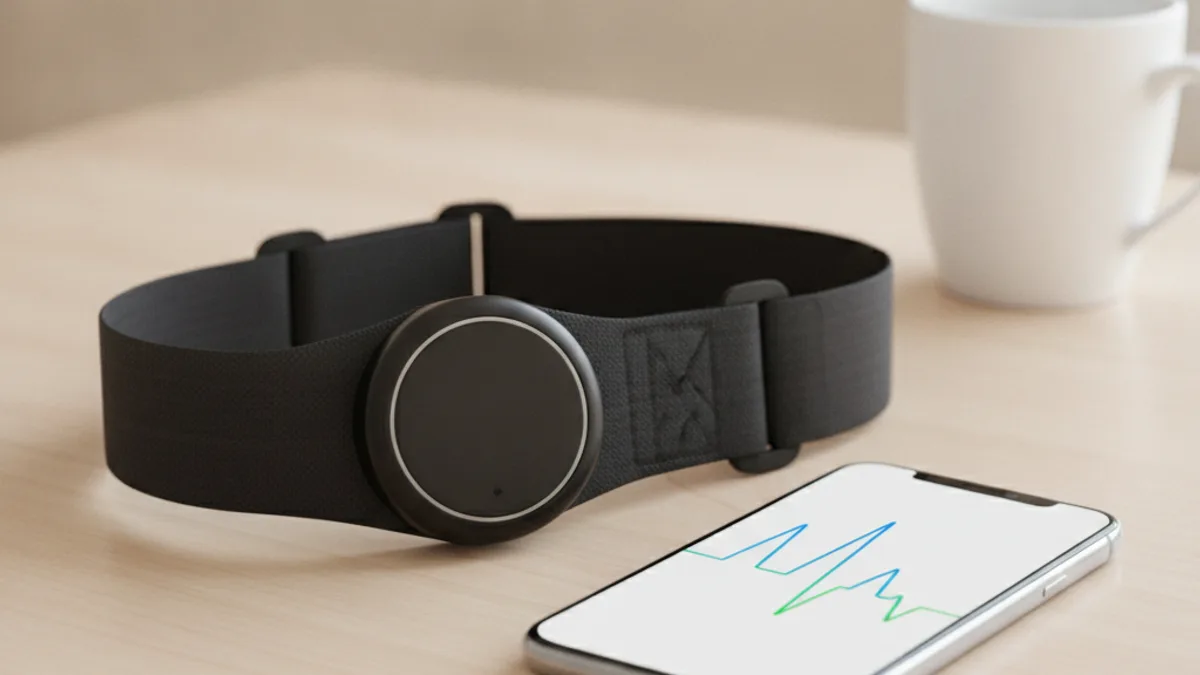
HRV is the variation in the time intervals between heartbeats. A healthy heart does not beat like a metronome: the pauses between beats are constantly changing slightly. Apps convert this variation into a single number and label it as "recovery." There are several assumptions between the interval variation and recovery, and each of them can be violated.
What exactly is measured
Dozens of metrics can be calculated from the sequence of beat-to-beat intervals. Practically, three or four are used.
- RMSSD — the root mean square of successive differences between adjacent intervals. It is robust to short recordings, and applications most often display it.
- SDNN — the standard deviation of all intervals. It requires a long recording, usually 24-hour.
- HF-power — the high-frequency component of the spectrum, associated with breathing.
- lnRMSSD — the logarithm of RMSSD; this is done because the original value is asymmetrically distributed.
Different applications display different metrics under the same "HRV" label, and some even scale them to their own 1 to 100 range. Comparing a number from one application to a number from another is meaningless.
Why the number fluctuates
HRV is more sensitive to measurement conditions than to what it supposedly reflects.
- Breathing. Breathing rate and depth directly change the metric: slow breathing increases it within a minute.
- Body position. Lying down and sitting yield different values. Transitioning from a lying to a standing position changes them sharply.
- Measurement time. There is a diurnal variation. A measurement immediately after waking up and half an hour later is not the same.
- What happened the day before. Alcohol, late dinner, heat, illness, vaccination.
- Recording length and acquisition method. A chest strap records an electrocardiogram signal, while an optical sensor on the wrist records a pulse wave; these are different measurements with different accuracy during movement.
The interpretation rule here is the same as for any self-measurement: a single data point means nothing; what matters is the deviation from one's own moving average. For how to distinguish signal from noise in your own data, see the article on self-experiments.
Training based on the morning number
The most tested claim is that training distributed according to morning HRV is better than a pre-planned schedule. A methodological systematic review with meta-analysis gathered such trials. The result: HRV-guided training surpassed conventional training in the increase of HRV metrics themselves (standardized effect 0.50), but not in resting heart rate (0.04).
For practical outcomes, the effects were small and statistically insignificant: maximal oxygen consumption — 0.20, work capacity at the second ventilatory threshold — 0.26, endurance metrics — 0.20. The authors specifically note that basic methodological questions — which metric to use, in what position to measure, how to calculate the baseline — remain unresolved. Review in International Journal of Environmental Research and Public Health.
Separate trials on runners showed a similar picture: shifts in autonomic metrics are reproducible, but there is no effect on performance — Physiology and Behavior. The first work of this kind was published back in 2007 — European Journal of Applied Physiology.
"Low HRV" is not a diagnosis
The range of values between individuals is enormous and highly dependent on age. For two healthy people of the same age, RMSSD can differ by several times. Therefore, the number itself does not allow one to say that a person is "overtrained" or "stressed"; comparison only makes sense with one's own range.
Separately: an application that provides a readiness score every morning creates an effect, described separately in self-monitoring studies — the number changes behavior regardless of what it measures. For a similar effect in nutrition, see the article on calorie counters.
Three degrees of confidence
Confidently: HRV reflects autonomic cardiac regulation and decreases with acute stress, illness, lack of sleep, and alcohol. Uncertainly: that structuring training based on daily HRV provides a significant gain in results. Not established: that optimizing the morning number itself improves health.
Frequently asked questions
- What does heart rate variability measure?
- The variation in intervals between heartbeats. It reflects autonomic cardiac regulation and decreases with acute stress, illness, lack of sleep, and after alcohol.
- Why does HRV fluctuate so much?
- The metric is sensitive to measurement conditions: breathing rate and depth, body position, time of day, recording length, and sensor type. A single measurement says little; what matters is the deviation from one's own moving average.
- Does morning HRV help in planning workouts?
- In a meta-analysis, this approach outperformed standard planning in terms of HRV metric improvements (effect size 0.50), but the effects on maximal oxygen consumption and endurance were small and statistically insignificant (0.20).
- Can I compare my HRV with someone else's?
- Practically no. The variation between individuals is large and depends heavily on age, and different applications show different metrics under the same label, normalizing them to their own scales.
- Does a low HRV mean I am overtrained?
- The number itself does not show this. It is interpreted only relative to one's own normal range, and a decrease can be explained by lack of sleep, alcohol, illness, or measurement conditions.
Read next
- Testing it on yourself: telling an effect apart from noise — Trying something on yourself is the only available way to find out whether it works for you specifically.
- Fitness trackers and calorie expenditure: why they measure heart rate but estimate calories — On a tracker screen, three numbers look equally reliable: heart rate, steps, and "calories burned.
- How sleep loss affects appetite and weight — Sleep usually turns up in the last paragraph of a weight-loss article, phrased vaguely enough to be safe.
This article is for general information. It is not medical advice, a diagnosis, or a prescription for treatment or a diet, and it does not replace a consultation with your doctor. If you have a health condition, are pregnant, take medication, or follow a diet prescribed to you, decisions about food belong with your doctor.
Figures from regulations, guidelines and studies are given as they stood when this article was prepared and may since have changed; check them against the primary sources. This article is not advertising, an offer, or individual advice, and neither the author nor the site owner is responsible for decisions taken on the basis of it.