Calorie counter: what it actually counts
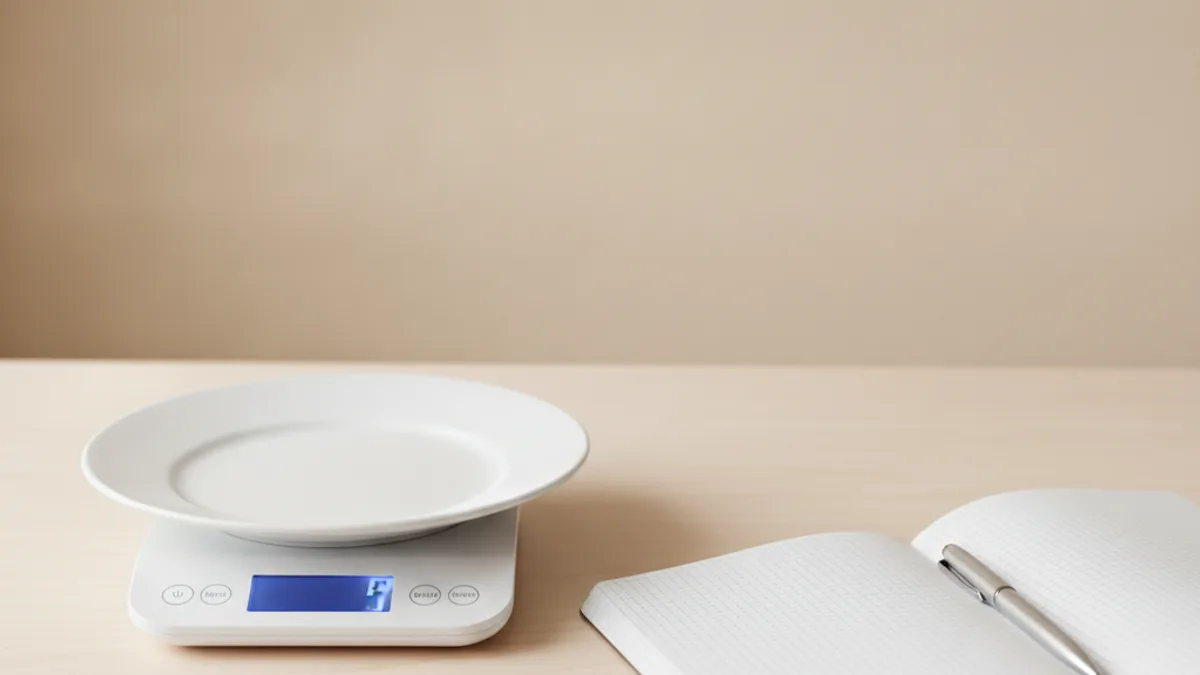
A calorie counter does not measure calories. It adds up what a person has entered based on a database that did not come from where the food was prepared. Understanding how the final number is compiled explains both its utility and its limitations—as well as why precision down to the kilocalorie is meaningless here.
What the number consists of
In any tracker — from a notebook to an app — there are three components at work, and the error of each affects the final result.
- What you ate. Determined by the person. This includes missed items: oil from the pan, a bite from the table, a sip of juice.
- How much you ate. Portion weight. Either a scale or an estimation by eye.
- How much energy is in it. A number from a database. Not a measurement of your specific plate, but an average based on other samples.
The first two components introduce error in one direction more often than the other. The third does so in both, but with a wider variance. Where the numbers in databases come from and why they differ between apps is analyzed in the article on food databases.
How much people underestimate
This has been measured objectively using the doubly labeled water method, which determines actual energy expenditure regardless of what a person records. A review of traditional dietary assessment tools describes them as prone to inaccuracies and points to a systematic underreporting of intake. Review in Frontiers in Nutrition.
Underreporting is not about honesty. It stems from forgotten trifles, underestimating portion sizes, and a shift in behavior itself: people eat differently on days they keep a diary. A validation study of the Goldberg method, which classifies people as under- or over-reporters, compared questionnaires and 24-hour recalls with doubly labeled water — European Journal of Clinical Nutrition.
The number in a tracker is almost always lower than actual intake. The magnitude of the gap varies for everyone, but it is fairly constant, and it is this consistency that makes the tracker useful.
Why it still works
A tracker is useful not for its accuracy, but because it makes two of your days comparable. If you hit 1900 on Monday and 2600 on Thursday, the difference is real, even if both numbers are underestimated by the same proportion.
The second point is the act of recording itself. In a randomized study with three self-monitoring schemes in an app, all three groups lost a similar amount of weight over three months: −2.7, −2.4, and −2.8 kg; there were no differences between the schemes. In other words, the act of keeping records mattered, not the order in which data was entered. Trial in JMIR mHealth and uHealth.
The third point is the link between consistency and results. An analysis of the relationship between self-monitoring and weight change in weight loss programs describes this dependency separately — Health Psychology.
What the tracker doesn't know
It doesn't know your expenditure. The "burned" number in an app is an estimate based on a formula plus an activity estimate, and both have their own margin of error. What happens when this estimate is taken as truth is analyzed in the article on calorie calculators.
It doesn't know what happened to the food during cooking. How much oil was absorbed by the patty, how much water evaporated from the meat, how much fat dripped onto the grill — none of this is in any database. More on this in the article on calories in home-cooked food.
It doesn't know how well the numbers on the packaging match the contents. In an analysis of common snack products, metabolizable energy exceeded the label claim by an average of about 4.3%, accounting for variations in portion weight — publication in Obesity. More details in the article on nutritional labels.
Why kilocalorie-level accuracy is harmful
It creates a false sense of control. When the daily total is shown as 1847 kcal, it is natural to decide that 1847 is a fact, while 1900 is already too much. Given the real uncertainty of tens of percent, such a distinction is meaningless.
Moreover, the pursuit of accuracy is a well-known path to abandoning the tracker. A review on defining adherence to self-monitoring in mobile apps examines how regularity is measured and why it is more important than the completeness of every entry — Journal of the Academy of Nutrition and Dietetics.
Consistency instead of accuracy
Consistency. One database, one method of estimating portions, one habit of recording before eating rather than from memory in the evening. Then the systematic error remains constant, and the difference between weeks begins to mean what it should.
A photo of the plate solves exactly this problem faster than manual entry: the dish and portion weight are estimated by a model rather than reconstructed from memory. Where such an estimate goes wrong is covered in the article on confidently stated incorrect numbers.
Frequently asked questions
- How accurate is a calorie tracker?
- It does not measure calories; it sums up entries based on reference values. Objective measurements using the doubly labeled water method show a systematic underreporting of intake. The magnitude of this gap is individual, but it remains fairly consistent for any given person.
- Why track if the numbers are inaccurate?
- A constant error does not prevent you from comparing your days against each other. Furthermore, in a randomized trial with three different tracking methods, all groups lost a similar amount of weight over three months: the act of tracking itself was what mattered.
- Does the app calculate expenditure correctly?
- Expenditure in an app is an estimate based on a formula plus an estimate of activity, each with its own margin of error. It is not a measurement, and it should not be treated as an exact number.
- Does the energy on the label match the actual value?
- In an analysis of common snack foods, the metabolizable energy exceeded the stated value by approximately 4.3% after adjusting for portion weight deviations. This is within acceptable limits, but it consistently trends in one direction.
- Do I need to weigh everything to the gram?
- Accuracy down to the kilocalorie, given an uncertainty of tens of percent, adds no value and more often leads to people abandoning the tracking process. Consistency is more important: use one database, one method for estimating portions, and record entries before eating.
Read next
- Calorie counting apps: how they work and where they go wrong — A calorie counter looks like a calculator, and people expect calculator-like precision from it.
- Calories and macros on the label: why the numbers don't match reality — The same buckwheat in three different apps gives three different calorie counts, and the package shows a fourth.
- How to determine portion size without a scale — Portion weight is the most inaccurate variable in any calculation, including analysis by photo.
This article is for general information. It is not medical advice, a diagnosis, or a prescription for treatment or a diet, and it does not replace a consultation with your doctor. If you have a health condition, are pregnant, take medication, or follow a diet prescribed to you, decisions about food belong with your doctor.
Figures from regulations, guidelines and studies are given as they stood when this article was prepared and may since have changed; check them against the primary sources. This article is not advertising, an offer, or individual advice, and neither the author nor the site owner is responsible for decisions taken on the basis of it.