Testing it on yourself: telling an effect apart from noise
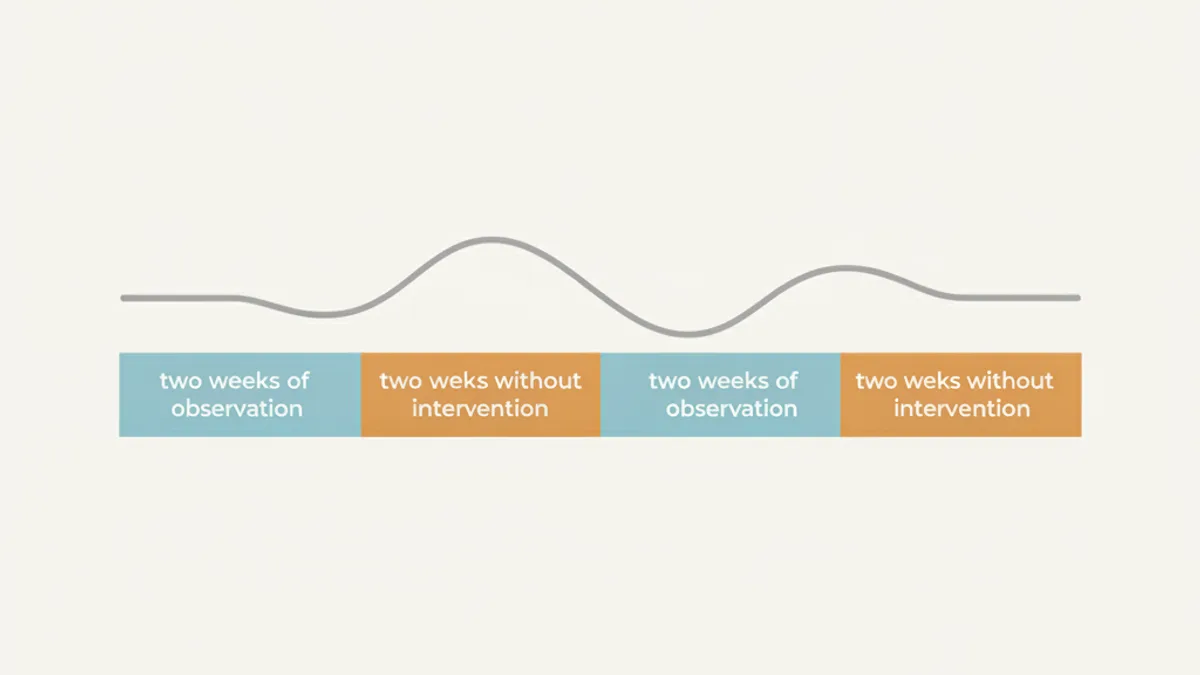
Trying something on yourself is the only available way to find out whether it works for you specifically. The catch is that people are poor instruments for measuring their own changes: they start observing at the worst moment, change several things at once, and remember confirmations better than misses.
Why "I tried it and it helped" means little
Not because anyone is lying. Because several effects converge in self-observation, each capable of producing an improvement with no intervention at all.
- Regression to the mean. People start changing things during a bad patch — sleeping badly, dragging at work, weight creeping up. Bad patches end on their own, and the ending coincides with the start of the protocol.
- Expectation. It moves everything subjective: alertness, appetite, how sleep is rated. Without a placebo it cannot be separated from the intervention.
- More than one thing changed. Starting a protocol usually comes with going to bed earlier, eating more attentively and drinking less. The credit goes to the protocol.
- Selective memory. The days it worked are remembered; the days it did not get explained away.
This applies well beyond supplements. It is exactly how people become convinced about eating patterns, techniques and devices.
Noise inside numbers that look precise
| Measure | Its own variation |
|---|---|
| Morning weight | ±1–2 kg within a day from water, glycogen and gut contents |
| Eyeballed food intake | Systematic underestimate, often by a quarter or more |
| Sleep stages from a wristband | Inferred from pulse and movement; total sleep time is more reliable than structure |
| Calories burned per a tracker | Disagreement with laboratory measurement reaches tens of per cent |
| Self-rated wellbeing | Depends on time of day and on what the rater expects to find |
If the expected effect is smaller than a measure's own variation, self-observation cannot see it. That is a matter of resolution, not of effort. More on instrument error in fitness trackers and smart scales.
How a decent single-person experiment is built
The format exists in medicine, where it is called an n-of-1 trial. A methodological review of randomised trials of this type sets out what separates them from plain observation: alternating intervention and control periods, an outcome defined in advance and, where feasible, blinding.
None of that transfers home completely, but three parts of it do.
- One variable. Exactly one thing changes. If sleep and diet both changed, the experiment ended before it started.
- The outcome named first. Not "I felt better" but a specific number: average weight over a week, sets completed at a given load, average sleep rating. An outcome chosen afterwards is always found.
- Alternating blocks. Two weeks on, two weeks off, then repeat. A single switch-on is indistinguishable from regression to the mean.
How long to run it
For body weight, no less than three or four weeks, comparing weekly averages rather than individual mornings. Weekly averaging removes most of the water-driven variation; comparing single days lets noise swamp any realistic effect.
For subjective outcomes — sleep, alertness, appetite — the same duration applies, with the caveat that you cannot blind yourself, so the result stays open to question. That is a limit of the method, not a flaw in the execution.
For anything that changes slowly, a home experiment is simply the wrong tool: a month will show nothing.
Where almost every home experiment breaks
Not at the device and not at discipline, but at food accounting. Most of the protocols people test affect appetite one way or another, while the person continues to believe they are eating "about the same". Underestimating intake is the most stubborn error in the whole field, and on its own it can explain both the success and the failure of any experiment.
So the first step of an honest experiment is not choosing the intervention but establishing the baseline: how much is eaten when nothing has changed yet. The method of recording matters less than using the same method before and after — otherwise the comparison is between counting methods rather than between periods. What goes wrong most often is covered in counting calories in home cooking.
Knowing when to stop
A pre-set duration also gives the experiment an ending. Without one it turns into an untested habit: someone keeps doing something for months on the strength of how the first week felt.
A reasonable statement at the start sounds roughly like this: "if after four weeks the weekly average weight has not moved by more than this much, I stop." It is uncomfortable precisely because it makes failure visible. That is what it is for.
Frequently asked questions
- Why can I not trust the feeling that something helped?
- Because self-observation combines regression to the mean, expectation, several simultaneous changes and selective memory. Each of those can produce an apparent improvement with no intervention at all.
- How much does body weight fluctuate on its own?
- By one to two kilograms within a day, from water, glycogen and gut contents. That is why weekly averages are the sensible comparison rather than individual mornings.
- How long should a self-experiment run?
- For body weight, at least three to four weeks, with alternating periods on and off the intervention. A single switch-on is indistinguishable from a natural return to the mean.
- Can several things be changed at once?
- They can, but then the result cannot be attributed to any of them. If the goal is to learn what works, exactly one variable changes at a time.
- What ruins these experiments most often?
- Food accounting. Most tested protocols affect appetite, and eyeballed intake is systematically underestimated, so the change in calories goes unnoticed and gets credited to the protocol.
Read next
- Fitness trackers and calorie expenditure: why they measure heart rate but estimate calories — On a tracker screen, three numbers look equally reliable: heart rate, steps, and "calories burned.
- Smart scales: what bioimpedance actually measures — Smart scales display body fat percentage, water percentage, muscle mass, bone mass, and "metabolic age.
- Weight loss plateau: why weight stalls and what to do about it — The weight has stayed at the same number for the third week in a row, even though the diet hasn't changed — and the first instinct is usually the same: to cut even more.
- Heart rate variability: what the number in your app means — HRV is the variation in the time intervals between heartbeats.
This article is for general information. It is not medical advice, a diagnosis, or a prescription for treatment or a diet, and it does not replace a consultation with your doctor. If you have a health condition, are pregnant, take medication, or follow a diet prescribed to you, decisions about food belong with your doctor.
Figures from regulations, guidelines and studies are given as they stood when this article was prepared and may since have changed; check them against the primary sources. This article is not advertising, an offer, or individual advice, and neither the author nor the site owner is responsible for decisions taken on the basis of it.