PFAS in the kitchen: pans, cups, and fast food boxes
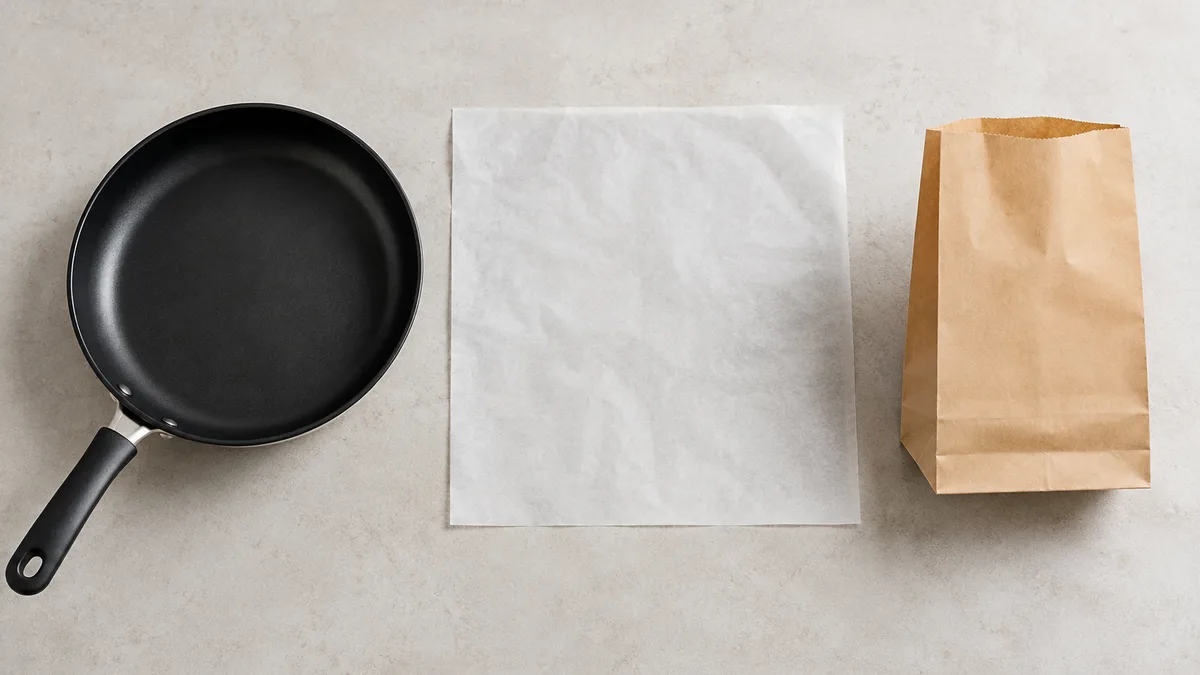
The main pathway of PFAS into the body is not packaging, but fish and eggs, according to estimates by the European food safety agency. The packaging component has been closed over the past five years by regulations on both sides of the Atlantic, and it makes sense to start exploring the issue from there.
what pfas are
Per- and polyfluoroalkyl substances are a family of thousands of compounds in which a carbon chain is densely surrounded by fluorine. The carbon-fluorine bond is one of the strongest in organic chemistry, and it is precisely this bond that gives rise to both properties for which these substances are manufactured: they are neither wetted by water nor fat and almost do not degrade.
The second property earned them the nickname "forever chemicals." In nature, they do not break down within a reasonable timeframe, are eliminated from the body over years rather than days, and accumulate along the food chain.
The most famous compound, perfluorooctanesulfonic acid (PFOS), was included in the Stockholm Convention on Persistent Organic Pollutants by a 2009 conference of the parties decision: its production and use are banned, except for specified cases. In 2019, perfluorooctanoic acid (PFOA) was also added to the convention.
where they get into food
The 2020 EFSA scientific opinion is the most detailed assessment to date. Three things are worth remembering from it.
A group tolerable weekly intake has been established: 4.4 nanograms per kilogram of body weight per week for the sum of four compounds (PFOA, PFOS, PFNA, PFHxS). A nanogram is one billionth of a gram; for a person weighing 70 kg, the weekly dose is about 0.3 micrograms.
Fish and eggs contribute the most, rather than packaging—this is how the agency itself puts it.
A portion of the European population exceeds this dose, and the agency calls this a health concern. The critical effect chosen for the assessment is the impact on the immune system—a decrease in antibody production after vaccination in children.
Hence the first practical conclusion: the choice of frying pan affects this picture less than the water in which the fish grew. There is no personal lever for the reader there—the lever is regulatory.
what is already banned
| Where | What has been done | Starting from year |
|---|---|---|
| Denmark | PFAS are banned in paper and cardboard contacting food unless there is a barrier layer | 2020 |
| EU | Maximum levels of PFAS in eggs, fish, mollusks, meat, and offal | 2023 |
| USA | Grease-resistant coatings with PFAS are no longer sold to packaging manufacturers | 2024 |
| EU | Maximum levels of PFAS in food-contact packaging itself | 2026 |
The last two rows are worth detailing.
USA, February 2024. The FDA announced that the voluntary phase-out by manufacturers of grease-resistant coatings containing PFAS is complete: such substances for wrappers and boxes are no longer sold in the country. The agency's wording: this eliminates the primary source of dietary exposure to PFAS among authorized food-contact uses.
EU, August 2026. The Packaging Regulation (EU) 2025/40 entered into application on August 12, 2026, and sets three thresholds for food-contact packaging: 25 billionths for an individual non-polymer substance, 250 for the sum, and 50 millionths for total organic fluorine. The third threshold also captures polymeric fluorine compounds that targeted analysis does not see.
Maximum levels in food itself—not in packaging—have been in effect in the EU since January 1, 2023, under Regulation (EU) 2023/915. For eggs, for example, this is 1.0 µg/kg for PFOS and 1.7 µg/kg for the sum of four. A product where the threshold is exceeded cannot be sold.
All listed rules apply each in their own market: the European threshold is mandatory for packaging sold in the EU and says nothing about a box manufactured and sold outside of it.
frying pan: what is known and what is not known
Non-stick coating is most often polytetrafluoroethylene, PTFE, known by the trade name Teflon. It belongs to the PFAS family, but to its polymer part: the molecule is large and is not absorbed in the intestine.
Two things are constantly confused here.
PFOA gave the subject a bad reputation, not the coating itself. It was used as an auxiliary substance in polymerization—that is, it was not in the pan, but in production—and it was this substance that entered the Stockholm Convention in 2019.
Danger is caused by overheating, not cooking. Instructions for coated cookware usually cite a limit of about 260 °C: above this, the coating begins to degrade, and the decomposition products from severe overheating cause polymer fume fever in humans—a flu-like indisposition that resolves on its own. Normal frying does not reach this point; an empty pan on maximum heat reaches it in a couple of minutes.
Hence a practical rule, useful even without any chemistry: do not preheat empty cookware and do not leave it on high heat without oil. Which oil is suitable for the pan in this case is a separate analysis by smoke point.
What is not known: exactly how much PTFE enters food from a scratched coating and what this means for health. Estimates differ by orders of magnitude, and there is no confident answer at present. Scratches are a reason to replace the pan for domestic reasons, not because of an established risk.
where else they were encountered
Grease resistance helps identify the place of application: paper that does not get soaked by fat in half an hour is treated with something for this purpose. Historically, these were PFAS.
- Wrappers and boxes for burgers, fries, and pastries.
- Microwave popcorn bags: fat, high temperature, paper.
- Paper baking molds and liners for fatty ready-to-eat food.
- Disposable cups and salad bowls with a water-repellent layer.
The word "historically" is significant here. Following the US waiver in 2024 and European thresholds in 2026, this pathway is largely closed in both markets. A consumer cannot check a specific package in a store: there is no PFAS labeling, and nothing about it is written on the packaging—neither good nor bad. What labels on a package actually mean is analyzed separately.
what can be done and what cannot
The list is short, and this is more honest than a long one.
- Do not overheat coated cookware and replace it when the coating comes off. The only item where the connection to personal action is direct.
- Transfer hot fatty food from packaging to a plate rather than eating from the box. Migration from packaging to product increases with temperature and fat content—this is a general property of contact materials, not just PFAS.
- Pop popcorn in a pot or pan if it is regularly in your diet: the microwave bag is the hottest and fattiest paper in the kitchen.
- Keep in mind that the main contribution is fish and eggs, and that you do not need to give them up because of this: their benefits in the diet are established better than the harm from trace amounts.
What not to do: throw away entire cookware and change your diet based on this article. The order of magnitude here is nanogram, and dietary decisions are made not by the name of a substance, but by the product's contribution to the diet as a whole.
The topic is adjacent to microplastics, but the mechanism is different: there it is particles of material, here soluble compounds. What is known about microplastics in food is in a separate material. How packaging affects the product itself and its shelf life is covered in the analysis on freshness.
Frequently asked questions
- Are non-stick frying pans dangerous?
- During normal cooking, the coating does not break down: cookware instructions state a limit of about 260 °C, and frying temperatures do not reach that level. The risk comes from overheating an empty pan over high heat. PFOA, which gave the topic its bad reputation, was a processing aid rather than a component of the pan itself, and was added to the Stockholm Convention in 2019.
- Where do PFAS mostly enter the body from?
- According to EFSA estimates, fish and eggs contribute the most to dietary intake, rather than packaging. There is no need to give them up because of this: maximum limits have been in effect for them in the EU since 2023, and the benefits of these foods in the diet are better established than the harm from trace amounts.
- Is it possible to tell from packaging whether it contains PFAS?
- No. There is no PFAS labeling, and manufacturers do not disclose this information. An indirect sign of places where they have historically been used is grease-resistant paper: burger wrappers, microwave popcorn bags, and baking liners.
Read next
- Microplastics in food: what is known and what is not — Microplastics are discussed in two ways: 'we eat a credit card a week' and 'there is no evidence of harm.
- Packaging and freshness: what vacuum, modified atmosphere, and inflated bags do — Packaging does more than just hold a product—it is part of the shelf life.
- Food packaging symbols: what each one actually means — Only two symbols are mandatory on packaging: the glass and fork, and the Mobius loop with a material code.
- Cooking oil: smoke point and what matters more — The smoke point is usually cited as the main criterion for choosing a cooking oil.
This article is for general information. It is not medical advice, a diagnosis, or a prescription for treatment or a diet, and it does not replace a consultation with your doctor. If you have a health condition, are pregnant, take medication, or follow a diet prescribed to you, decisions about food belong with your doctor.
Figures from regulations, guidelines and studies are given as they stood when this article was prepared and may since have changed; check them against the primary sources. This article is not advertising, an offer, or individual advice, and neither the author nor the site owner is responsible for decisions taken on the basis of it.