Food packaging symbols: what each one actually means
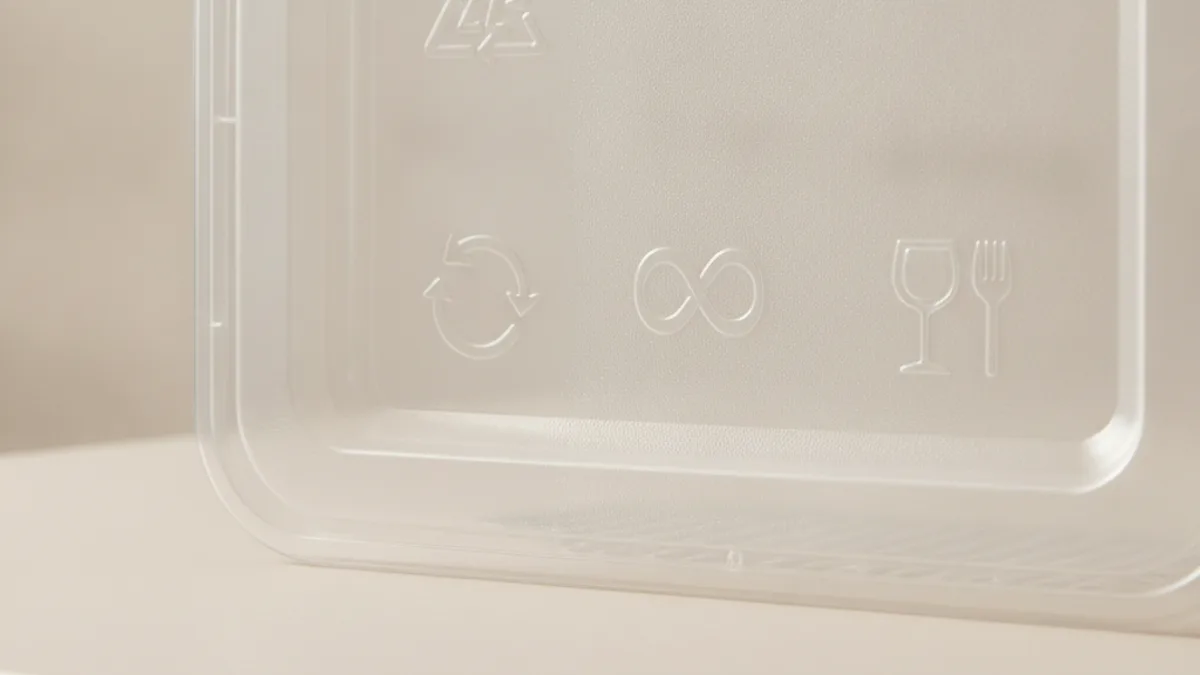
Only two symbols are mandatory on packaging: the glass and fork, and the Mobius loop with a material code. Everything else — snowflakes, leaves, microwave icons — is added voluntarily, and nobody checks what stands behind it. The difference matters: the first two support a conclusion, the rest do not.
Two symbols are required, the rest are optional
Marking of the packaging itself — the container, not the food — is set by the Customs Union technical regulation "On the safety of packaging", TR CU 005/2011. Article 6 states that marking must contain a numeric code and/or a letter abbreviation for the material according to Annex 3, and symbols according to Annex 4: figure 1 for packaging intended for contact with food, figure 2 for the Mobius loop. Text of TR CU 005/2011 and its amendments on the Eurasian Economic Commission site. Its marking requirements have not changed since 2016: the latest amendment, from September 2024, left Article 6 and Annexes 3 and 4 untouched.
The list is closed. Snowflakes, microwave waves, green leaves, "eco" and arrows around a number are not mentioned in it. That does not make them lies — it means no definition and no verification stands behind them, and they cannot be read as a guarantee.
The glass and fork: what the packaging is for, not that it was tested
The symbol means exactly one thing: the container is intended for contact with food. The regulation allows it with or without a frame — round, square, any shape.
What it does not mean: that this particular batch was tested by anyone. Conformity of packaging is confirmed by declaration, that is, by a statement from the manufacturer, and the symbol itself is a marking on the side, not a certificate. In the European Union the same symbol appears in Annex II to Regulation 1935/2004, where it is likewise one of three equal ways to state the intended use: the symbol, the words "for food contact", or a specific indication such as "wine bottle". Summary of Regulation 1935/2004 on EUR-Lex.
The practical conclusion is single and dull: if a container you plan to transfer food into has no glass and fork, it is not for food. If it has one, it is for food, and that is everything you have learned.
The triangle with a number is a plastic grade, not a promise of recycling
This is the most common misreading on packaging. The number inside the triangle names the material, and only that. It does not say the item will be recycled, and it does not even say your town accepts it.
Codes from Annex 3 to TR CU 005/2011:
| Code | Letters | Material |
|---|---|---|
| 1 | PET, PETE | Polyethylene terephthalate |
| 2 | PE-HD, HDPE | High-density polyethylene |
| 3 | PVC, V | Polyvinyl chloride |
| 4 | PE-LD, LDPE | Low-density polyethylene |
| 5 | PP | Polypropylene |
| 6 | PS | Polystyrene |
| 7 | O, OTHER | Other plastics |
| 20–22 | PAP | Corrugated board, board, paper |
| 40, 41 | FE, ALU | Steel, aluminium |
| 50, 51 | FOR | Wood, cork |
| 60, 61 | TEX | Cotton, jute |
| 70–72 | GL | Clear, green and brown glass |
| 80–99 | C/ plus the main material code | Composite materials |
The last row explains why a juice carton cannot be recycled with cardboard: it carries a composite marking — the letter C with the main material code, or a number from the 80–99 range where paper and board are paired with plastic and aluminium. Separating those layers takes a dedicated plant.
That the number promises no recycling is stated outright by the body that publishes the standard for these codes. The description of the American standard ASTM D7611 for coding plastic articles puts it this way: resin identification codes are not "recycle codes", though they are an aid to recycling; the use of such a code on an article does not imply that the article is recycled or that systems exist to process it for reclamation or re-use. ASTM D7611/D7611M-21 standard.
One more detail from the same Annex 3 that is easy to miss: the numeric code or letter abbreviation is not applied in the absence of the Mobius loop. The code and the loop are a pair, not two independent marks.
The Mobius loop and the Green Dot are not the same thing
The Mobius loop is the familiar triangle of three arrows, and under the regulation it indicates that used packaging can be recovered. The material code sits inside it and the mark itself below: that is how the note to Annex 3 describes it.
The Green Dot — two interlocking arrows in a circle, one light and one dark — looks similar but does not appear in TR CU 005/2011 at all. It is the licence mark of Der Grüne Punkt, a private German waste-collection scheme, and it says that the producer participates in that scheme. It says nothing about the properties of the pack itself, or whether it will be accepted for recycling outside that scheme.
Letters next to the date: EXP, MFG, BB, LOT
Two things need separating here. The Russian requirement for a date on food is TR CU 022/2011, and its wording is in Russian: "best before", "use by", "date of manufacture". Latin abbreviations arrive with imports, and each follows its own rules.
| Abbreviation | What it means | Where it comes from |
|---|---|---|
| BB, BBE, Best before | Date of minimum durability: after it the food may be worse, but not necessarily unsafe | EU Regulation 1169/2011, Annex X |
| Use by | Applied to highly perishable food; after this date it should not be eaten | Same regulation, Article 24 |
| LOT, or L before a number | Batch number — for product recalls, not for the shopper | EU Directive 2011/91/EU |
| EXP, MFG, MFD, PROD | "Expires" and "manufactured" | Convention, not a requirement |
The first three rest on texts you can cite. Regulation 1169/2011 sets the format of the date of minimum durability in Annex X and separately provides that the date is accompanied, where needed, by the storage conditions without which the stated period does not hold. Directive 2011/91/EU requires the lot indication to be preceded by the letter L, except where it is clearly distinguishable from other markings. Text of Directive 2011/91/EU.
EXP and MFG, by contrast, are defined in neither EAEU nor EU food law. They are abbreviations from pharmaceutical and Asian practice that migrated onto food. You can read them; you cannot rely on a single format, because one pack follows EXP with day-month-year and another with month-year, and the only way to tell which you are holding is whether the date has three numbers or two.
"Store at no more than 25 °C" is not a suggestion but part of the shelf life: the period was calculated for that temperature. How "best before" differs from "use by" is covered in the article on expiry dates.
EAC: a mark of circulation, not of quality
The letters EAC stand for Eurasian Conformity: the product has passed the conformity assessment procedures under every EAEU technical regulation that applies to it. The design of the mark and the rules for using it were approved by Customs Union Commission decision No. 711 of 15 July 2011. Decision No. 711 on the EAEU legal portal.
For most food products, conformity assessment means declaration — a statement by the manufacturer on its own responsibility. The mark says the paperwork exists, not that anyone visited the factory. The letters GOST and TU follow similar logic, covered separately in the article on GOST and TU.
Symbols with nothing behind them
A snowflake usually means the food can be frozen, but no regulation defines its content, and different manufacturers use it differently: "suitable for freezing", "keep in the freezer", "has been frozen". The same goes for microwave waves: the line of text beside the icon is more useful than the icon.
A separate category is green leaves, trees, planets and the word "eco" on a grassy background. They have no definition, no threshold and no one checking. Which front-of-pack wording means anything at all is covered in the article on packaging claims.
The open-jar symbol with a figure such as 12M is the period after opening, familiar from cosmetics. On food it is rare and is not among the required marks: the same information appears there as the plain phrase "once opened, use within … days".
What to look at in the shop
Three things, all on the back.
- The date and the storage condition beside it. A date without a temperature guarantees nothing.
- The material code, if you intend to heat or freeze food in that packaging. Not as a promise of recycling, but as an answer to what you are heating.
- The ingredients list. The only part of the label where the manufacturer must say what is inside rather than what it thinks about it. What to look for there is covered in reading a label in ten seconds.
Front-of-pack symbols read faster and mean less. That is precisely why they are put there.
Frequently asked questions
- What does the glass and fork symbol mean on packaging?
- That the packaging is intended for contact with food. It is one of two symbols named directly in Annex 4 to TR CU 005/2011, and it appears in Annex II to EU Regulation 1935/2004. The symbol states the intended use and does not mean that a particular batch was tested: conformity is confirmed by the manufacturer’s declaration.
- Does a triangle with a number mean the packaging will be recycled?
- No. The number names the material — 1 is polyethylene terephthalate, 5 is polypropylene. Whether it can be recycled depends on what your area accepts. The ASTM D7611 standard says so directly: using the code does not imply that the article is recycled or that systems exist to process it.
- What does EXP mean on a food package?
- It is short for expiry — the date after which the food should not be eaten. Neither EAEU nor EU food law defines the abbreviation, and it has no single format: one pack follows it with day-month-year, another with month-year. EU law requires the words "best before" or "use by" instead.
- What does the letter L before a number on packaging mean?
- The batch number. Under EU Directive 2011/91/EU the lot indication is preceded by the letter L unless it is otherwise clearly distinguishable from other markings. The number exists so products can be recalled and tells the shopper nothing about quality.
- Is the EAC mark a quality mark?
- No. EAC stands for Eurasian Conformity: the product has passed conformity assessment against the EAEU technical regulations that apply to it. For most foods that assessment is a declaration, that is, a statement by the manufacturer on its own responsibility.
Read next
- Expiration dates: "best before" and "use by" are not the same — The date on packaging is perceived as a boundary between "safe" and "unsafe," although it means different things for different products.
- "Sugar-free," "fitness," "eco": what these labels actually mean — The front of a package speaks in short words: "light," "fitness," "sugar-free," "eco.
- GOST and TU: what is actually behind these letters — GOST is often read as a mark of quality, while TU is seen as permission to do whatever one wants.
- Chestny Znak and the square code on the packaging: what it shows — Next to the familiar stripes on packaging, there is increasingly a small square made of dots.
This article is for general information. It is not medical advice, a diagnosis, or a prescription for treatment or a diet, and it does not replace a consultation with your doctor. If you have a health condition, are pregnant, take medication, or follow a diet prescribed to you, decisions about food belong with your doctor.
Figures from regulations, guidelines and studies are given as they stood when this article was prepared and may since have changed; check them against the primary sources. This article is not advertising, an offer, or individual advice, and neither the author nor the site owner is responsible for decisions taken on the basis of it.