Dried fruit and candied fruit: finding added sugar
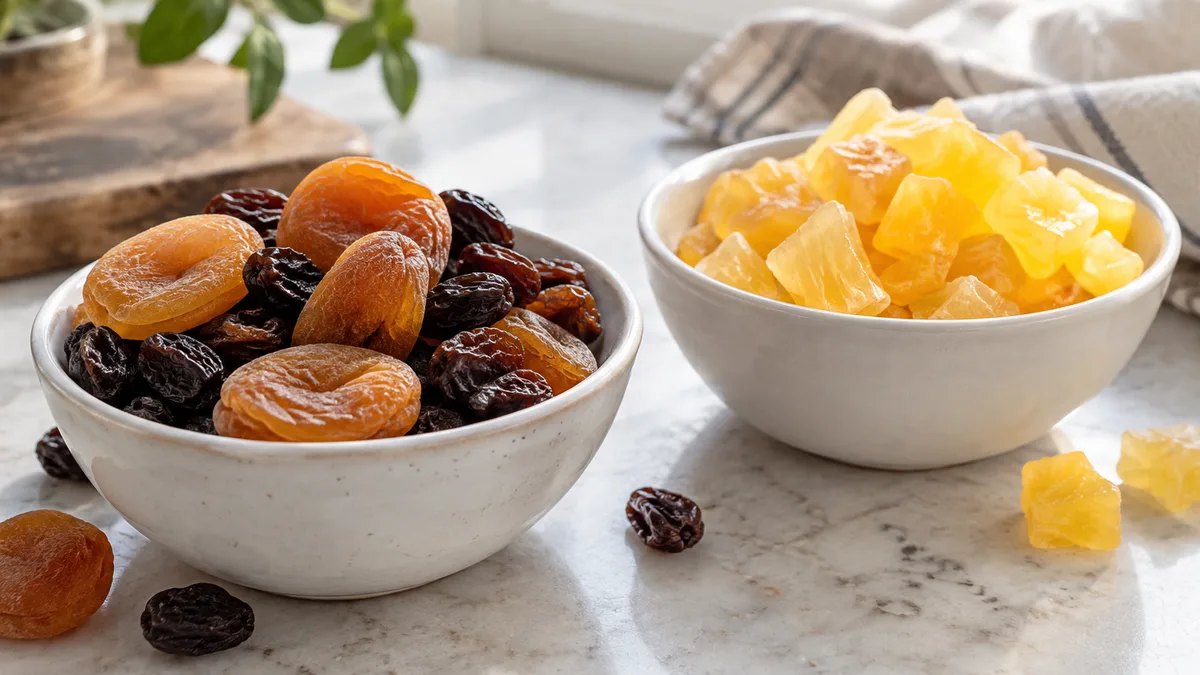
To choose dried fruit without added sugar, read the ingredients: “dried” on the front is not enough. Check syrups, oil, coatings and preservatives separately, then calculate the portion you plan to eat.
Three packs, three different recipes
These examples were checked against sellers' product listings on October 9, 2026. They show differences between specific products; compare the listing with the ingredients on the pack before buying.
| Product and source | Listed ingredients | What to check |
|---|---|---|
| VkusVill dried pineapple, 35 g | Dried pineapple | One fruit ingredient |
| Delikateska candied pineapple, 300 g | Pineapple 51%, cane sugar 47.77%, citric acid, sulphur dioxide, colours | Added sugar and a preservative |
| BONVIDA dark raisins, 500 g | Raisins, refined sunflower oil, sulphur dioxide | Oil and a preservative are listed |
For “fruit without added sugar”, the first row gives a direct answer from the declared ingredients. For “candied fruit for baking”, a different recipe may suit you. Do not use one generic dried pineapple entry for both purchases: match it to the label first.
“No added sugar” differs from “sugar free”
Under the Eurasian regulation TR CU 022/2011, Annex 5, which applies in Russia, “no added sugars” means neither mono- and disaccharides nor foods containing them were added for sweetness. If naturally occurring sugars are present, the label must state their natural origin.
Do not log zero carbohydrates just because a pack says “no added sugar”. Use the nutrition table for your diary. If comparing added sugar specifically, the ingredients tell you whether it is present, but do not always give its quantity.
Look for sugar, glucose syrup and other sweet ingredients, including inside the parentheses for a filling or coating. Ingredient names are explained in finding hidden sugar. If the website lacks the information you need, request a photo of the label before ordering.
Read oil and coating ingredients alongside the fruit
The raisin ingredient list above identifies oil. It does not give an exact amount, so do not calculate grams from its position in the list. Use the finished product's declared nutrition values to log fat.
For fruit covered in chocolate or confectionery coating, read the full coating ingredients. If you need to avoid a particular ingredient, check both the fruit and coating. Colour, shine or a product photo cannot show the full recipe.
In your diary, choose the finished coated product. If the table describes the whole item, do not add chocolate again. For a mixture of dried fruit and nuts, find the mixture's figures: values for raisins alone do not describe everything in the bag.
What to do when sulphur dioxide is listed
Two of the ingredient lists above include sulphur dioxide. Compare the actual label wording if choosing a product without that declared additive. Do not infer its presence or absence from how dark dried apricots are or how uniform raisins look.
If you have an established sensitivity to sulphites, follow your doctor's advice and clarify incomplete labels with the manufacturer. Allergy UK describes different levels of sensitivity, so there is no single selection rule for everyone. If your doctor advised avoiding sulphites, choose a product accordingly and do not substitute home rinsing for checking the ingredients.
For loose fruit, ask to see the original package's label. Record or photograph its name, manufacturer and ingredients for your own reference. If this information is unavailable, a product with accessible labelling makes checking allergens easier.
Calculating a portion without a generic “handful”
Place a bowl on the scales, tare them and add as much as you plan to eat. The same formula works for every value: amount per 100 g × portion weight ÷ 100. A 25 g portion is one quarter of 100 g, so divide every table value by four. This is a calculation example, rather than a recommended serving size.
If adding dried fruit to porridge, log it as a separate ingredient using its weight before adding it. For homemade baking, enter it in the whole recipe; do not add the same ingredient again to a finished portion.
When scanning a barcode, check the fruit type, additions and pack weight. If an entry describes candied fruit but yours has no added sugar, find your pack or enter the label manually. See comparing two products on the same basis for the full table comparison process.
Frequently asked questions
- How do I choose dried fruit without added sugar?
- Read the complete ingredient list for your pack. Look for sugar and syrups, including inside the coating parentheses. The word “dried” alone cannot answer the question.
- Does fruit without added sugar contain carbohydrates?
- Check its nutrition table. No added sugar does not mean no naturally occurring sugars or zero carbohydrates.
- Can raisins contain oil?
- Yes. The BONVIDA raisin listing used here declares sunflower oil. For logging fat, use the finished product’s nutrition table.
- Can I determine dried apricot ingredients by colour?
- Read the label to check additives. Colour cannot replace a complete ingredient list and manufacturer information.
- How do I log chocolate-covered dried fruit?
- Use the finished coated product’s figures and enter the weight eaten. If the coating is already included in the table, do not add chocolate again.
Read next
- Hidden sugar: under what names it appears in ingredients — The word "sugar" appears in ingredients less often than sugar itself does in a product: it has a dozen legal names, and the manufacturer has every right to use any of them.
- How to compare two products by their labels: six steps with a worked example — Two nutrition tables are comparable only when they describe the same weight, the same state of the product and the same units.
- What to look for in an ingredient list in ten seconds — Reading an entire ingredient list at the shelf is impossible: the print is small, and there is no time.
- How to read the nutrition facts table: per 100 g or per serving — To compare products, use the “per 100 g” column, but calculate how much you’ve eaten based on the actual weight of the portion consumed.
This article is for general information. It is not medical advice, a diagnosis, or a prescription for treatment or a diet, and it does not replace a consultation with your doctor. If you have a health condition, are pregnant, take medication, or follow a diet prescribed to you, decisions about food belong with your doctor.
Figures from regulations, guidelines and studies are given as they stood when this article was prepared and may since have changed; check them against the primary sources. This article is not advertising, an offer, or individual advice, and neither the author nor the site owner is responsible for decisions taken on the basis of it.