Potassium in food: how much you need a day and what beats a banana
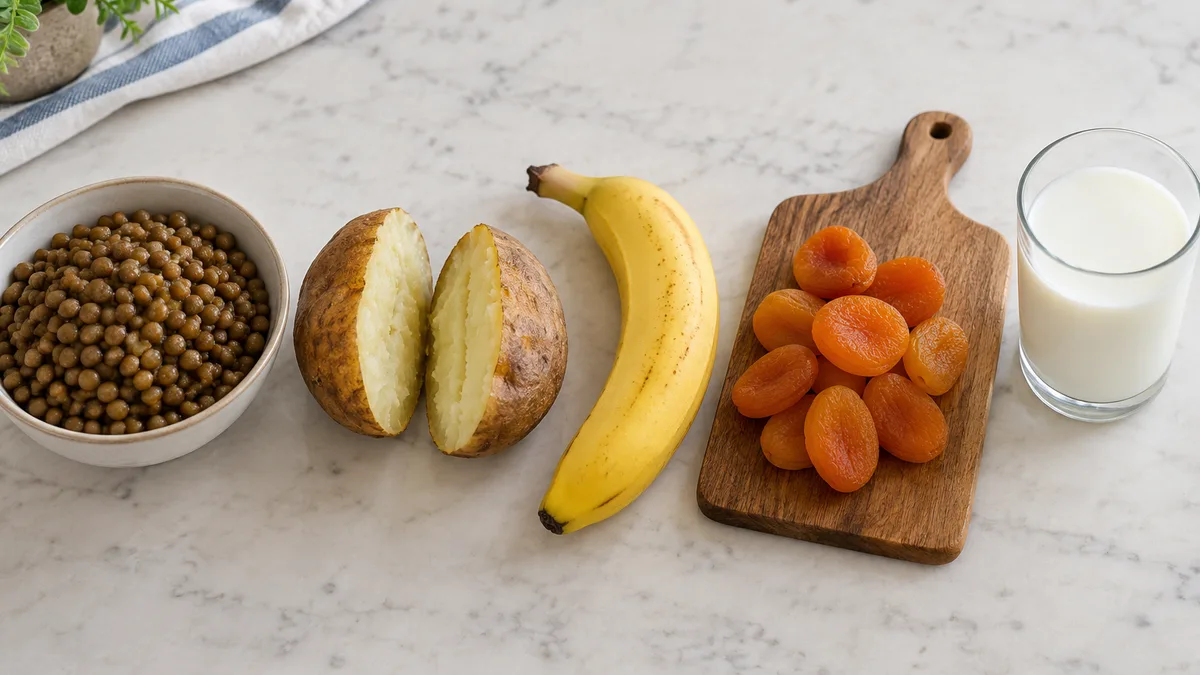
Adults are advised about 3500 mg of potassium a day, by Rospotrebnadzor and by the European agency EFSA alike. The banana is not the leader: a medium banana gives 422 mg, a cup of cooked lentils 731 mg, a baked potato 610 mg.
How much potassium you need a day
Four sources give similar numbers, but each number means something different.
| Source | Adults | What the number is |
|---|---|---|
| Rospotrebnadzor, MR 2.3.1.0253-21 | 3500 mg | Physiological requirement for people over 18 |
| EFSA, 2016 | 3500 mg | Adequate intake: the data did not allow an average requirement to be derived |
| WHO, 2012 | at least 3510 mg | A conditional recommendation, aimed at lowering blood pressure and the risk of cardiovascular disease and stroke |
| NASEM, US, 2019 | 3400 mg for men, 2600 mg for women | Adequate intake for ages 19 and over |
Sources: MR 2.3.1.0253-21 on the Rospotrebnadzor site, EFSA, the WHO guideline, the NIH Office of Dietary Supplements fact sheet.
All of these describe healthy people. They do not apply to anyone whose body clears potassium poorly because of illness or medication, as explained below. A healthy person does not need to count potassium in milligrams every day: the figure is there to show the scale, not to check against each dinner.
Where there is more: numbers per serving
The values come from the NIH fact sheet and are given per serving, not per 100 g, because 100 g of dried fruit and 100 g of cooked lentils differ too much in water content to compare.
| Food and serving | Potassium, mg |
|---|---|
| Dried apricots, ½ cup | 755 |
| Lentils, cooked, 1 cup | 731 |
| Acorn squash, mashed, 1 cup | 644 |
| Prunes, ½ cup | 635 |
| Raisins, ½ cup | 618 |
| Potato, baked, flesh only, 1 medium | 610 |
| Kidney beans, canned, 1 cup | 607 |
| Orange juice, 1 cup | 496 |
| Soybeans, boiled, ½ cup | 443 |
| Banana, 1 medium | 422 |
| Milk, 1 %, 1 cup | 366 |
Three things stand out. Beans and potatoes give more than a banana, and every shop sells them. Dried fruit tops the list, but the serving is small in volume and noticeably higher in calories than the fresh fruit. A cup of milk gives 366 mg, not far below the banana.
EFSA names the main dietary sources as starchy roots and tubers, vegetables and fruit, whole grains, dairy products and coffee. Potassium comes from an ordinary mix of foods, not from one special product.
What cooking does to potassium
Potassium dissolves in water, and boiling moves some of it from the food into the pot. In a laboratory test with white potatoes, tubers boiled as cubes lost about 50 % of their potassium and shredded tubers about 75 %. Soaking without heat did not reduce it significantly. Bethke and Jansky, Journal of Food Science, 2008.
The practical meaning is modest. The baked potato in the table keeps its 610 mg. The same potato cut small and boiled in plenty of water has about half of what it had raw. In soup, the potassium stays in the broth as long as you drink it.
When "more potassium" is a bad idea
Healthy kidneys clear surplus potassium quickly, so ordinary food does not produce an excess in a healthy person. That stops being true in several situations.
- Chronic kidney disease.
- Taking ACE inhibitors, angiotensin receptor blockers or potassium-sparing diuretics. NIH notes that with such drugs blood potassium can rise even on intakes below the usual recommendation.
- Type 1 diabetes, heart failure, adrenal insufficiency, liver disease.
If any of this applies to you, the amount of potassium from all sources is something to settle with a doctor or dietitian, and the table above is not a plan. Do not stop or change your medication on your own.
Supplements and salt substitutes are a separate matter. Large amounts of potassium supplements or potassium-based salt substitutes can exceed what the kidneys handle, even in a healthy person, and cause an acute rise of potassium in the blood. Salt substitutes are covered in the article on low-sodium salt.
Low potassium: usually not about the menu
Low blood potassium rarely comes from a poor diet alone. According to NIH, it more often results from losses through diarrhea and vomiting. So cramps, weakness or an irregular heartbeat are not something to treat blindly with foods from a list: a doctor finds the cause by examination and a blood test. This matters most if the symptoms began after vomiting or diarrhea.
What it looks like over a day
Add four rows of the table: a cup of lentils (731), a baked potato (610), a banana (422) and a cup of milk (366). That makes 2129 mg, about 60 % of 3500. In an ordinary diet the rest comes from other vegetables, fruit, whole grains and coffee.
A healthy person usually has no reason to log potassium in a food diary; it is enough that vegetables, fruit, legumes or whole grains turn up through the day. On other minerals, see magnesium and calcium. A diet rich in potassium, and who it does not suit, is discussed in the article on the DASH diet.
Frequently asked questions
- How much potassium does an adult need a day?
- Rospotrebnadzor (MR 2.3.1.0253-21) and EFSA give 3500 mg a day, WHO at least 3510 mg. The US NASEM figures are 3400 mg for men and 2600 mg for women. These numbers apply to healthy people.
- What has more potassium than a banana?
- According to NIH, a medium banana has 422 mg, while a cup of cooked lentils has 731 mg, a medium baked potato 610 mg and a cup of canned kidney beans 607 mg. Dried fruit leads: ½ cup of dried apricots has 755 mg.
- Does potassium disappear when you boil food?
- Partly. In a potato experiment, tubers boiled as cubes lost about 50 % of their potassium and shredded ones about 75 %. Soaking without heat barely removed any. In soup, the potassium stays in the broth.
- Do I need potassium tablets?
- A healthy person is usually covered by food, and a supplement is a decision for a doctor. Large amounts of potassium supplements and salt substitutes can cause a dangerous excess even in healthy people.
- Who should not raise potassium without a doctor?
- People with kidney disease or taking ACE inhibitors, angiotensin receptor blockers or potassium-sparing diuretics, and people with type 1 diabetes, heart failure, adrenal insufficiency or liver disease. The amount is set by a doctor or dietitian.
Read next
- Magnesium-rich foods: where to find them and how to use the list — People often look for magnesium in a supplement bottle, though everyday foods contain it too.
- Calcium: how much a day, and where to get it without dairy — Adults are advised 1000 mg of calcium a day in Russia and 950 mg by EFSA.
- DASH diet: foods, servings, and a week-long menu — DASH is an eating plan designed to lower blood pressure: plenty of vegetables, fruits, and whole grains; low-fat dairy; and limited salt and sweets.
- Low-sodium salt: what replaces sodium, and who should be careful? — Low-sodium salt usually replaces some sodium chloride with potassium chloride.
This article is for general information. It is not medical advice, a diagnosis, or a prescription for treatment or a diet, and it does not replace a consultation with your doctor. If you have a health condition, are pregnant, take medication, or follow a diet prescribed to you, decisions about food belong with your doctor.
Figures from regulations, guidelines and studies are given as they stood when this article was prepared and may since have changed; check them against the primary sources. This article is not advertising, an offer, or individual advice, and neither the author nor the site owner is responsible for decisions taken on the basis of it.