Low-sodium salt: what replaces sodium, and who should be careful?
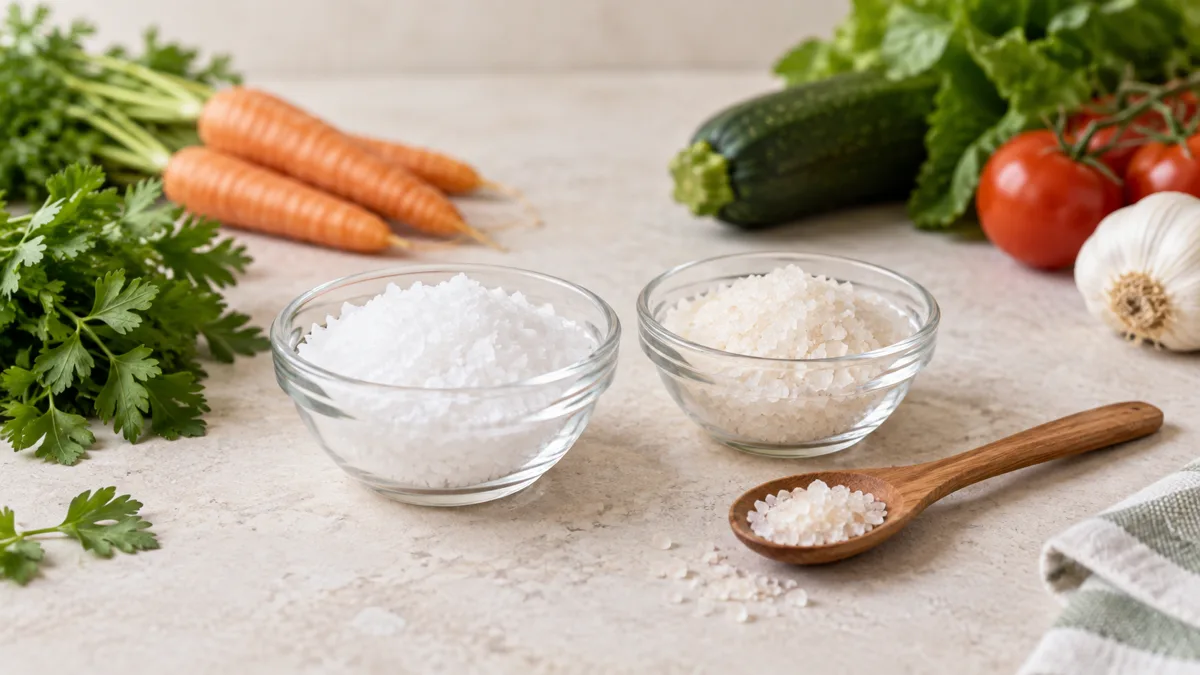
Low-sodium salt usually replaces some sodium chloride with potassium chloride. At the same weight, it provides less sodium but more potassium. For many adults it can be a useful substitute for table salt; people with kidney disease or taking certain medicines should discuss it with a clinician first.
What is being replaced?
Regular table salt is sodium chloride. The WHO's 2025 guideline describes lower-sodium salt substitutes as products in which some sodium chloride is replaced with another salt, usually potassium chloride. Formulations differ. Check the ingredients for potassium chloride and compare the sodium content at the same product weight.
As a reference point, 1 g of regular salt contains about 400 mg of sodium. A mix that is 75% sodium chloride and 25% potassium chloride would contain about 300 mg of sodium per gram. That is a calculation for this particular mix, not a figure for every product labelled “low sodium.”
Potassium is a substantial ingredient here, not a trace mineral. Less sodium per gram does not mean you should add more salt. The WHO recommends less than 2,000 mg of sodium per day for adults, counting all foods. Our article on hidden sources of salt covers what comes from outside the salt shaker.
What did the trial show?
In the SSaSS trial, 600 rural Chinese villages were assigned either regular salt or a substitute containing 75% sodium chloride and 25% potassium chloride. The trial enrolled 20,995 people who had had a stroke or were at least 60 years old with high blood pressure. Over an average 4.74 years of follow-up, the stroke rate was 29.14 versus 33.65 events per 1,000 person-years. This is evidence about replacing salt in a higher-risk group, not proof of the same effect for everyone or for every substitute formula.
Serious events attributed to high blood potassium were not statistically more frequent in the substitute group. That finding should not be extended to people whose bodies have difficulty clearing potassium: the WHO recommendation explicitly excludes them.
Who needs to be careful?
The WHO suggests a potassium-containing substitute for adults who choose to use table salt, but its conditional recommendation does not apply to children, pregnant women, or people with kidney impairment or other conditions that compromise potassium excretion.
If you have chronic kidney disease, have been told your blood potassium is high, or take medication that affects potassium, ask your healthcare professional before using the substitute. The National Kidney Foundation warns against potassium-based salt substitutes in kidney disease without medical advice. It also notes that ACE inhibitors, ARBs, and some other medicines can raise blood potassium. Bring the product's ingredient list and your medication list to the conversation.
How to choose and use it
- Read the ingredients. Potassium chloride means the product adds potassium while reducing sodium. Ingredient percentages or a nutrition table help compare brands.
- Compare sodium at the same weight. A figure per 100 g can be compared with the same figure on another product. Salt and sodium are different units: 1 g of salt corresponds to roughly 400 mg of sodium.
- Keep the amount similar. The substitution lowers sodium when it replaces a comparable amount of regular salt. Sauces and prepared foods still contribute sodium.
- Check whether it is iodized. The WHO recommends that salt consumed be iodized. A lower-sodium label does not tell you whether iodine has been added. Read more about iodine and salt.
Frequently asked questions
- What is low-sodium salt made of?
- It usually contains sodium chloride mixed with potassium chloride. The proportions vary, so check both the ingredient list and sodium amount on the package.
- Does it lower stroke risk?
- In the SSaSS trial, the stroke rate was lower among 20,995 participants who had had a stroke or were at least 60 with high blood pressure when they used a 75% sodium chloride and 25% potassium chloride mix instead of regular salt. The result does not establish the same benefit for every person or formula.
- Can people with kidney disease use it?
- A potassium-based salt substitute should be used with kidney disease only if your healthcare professional says it is safe. The same caution applies if you take medicines that raise blood potassium.
- Can I use more than I would of regular salt?
- No. The mix still contains sodium, and the rest of your food contains it too. Using more of the mix also increases your potassium intake.
Read next
- Salt in processed food: where it is most abundant and why the salt shaker is not the culprit — The WHO recommendation is less than five grams of salt per day, but the actual intake is about twice that.
- Iodine: how much is needed and why it is added to salt — Iodine is necessary for the thyroid gland to synthesize hormones, and the daily requirement is measured in micrograms—but it is not always easy to obtain from a standard diet.
- "Sugar-free," "fitness," "eco": what these labels actually mean — The front of a package speaks in short words: "light," "fitness," "sugar-free," "eco.
This article is for general information. It is not medical advice, a diagnosis, or a prescription for treatment or a diet, and it does not replace a consultation with your doctor. If you have a health condition, are pregnant, take medication, or follow a diet prescribed to you, decisions about food belong with your doctor.
Figures from regulations, guidelines and studies are given as they stood when this article was prepared and may since have changed; check them against the primary sources. This article is not advertising, an offer, or individual advice, and neither the author nor the site owner is responsible for decisions taken on the basis of it.