Dubai chocolate: calories, ingredients and the weight of a piece
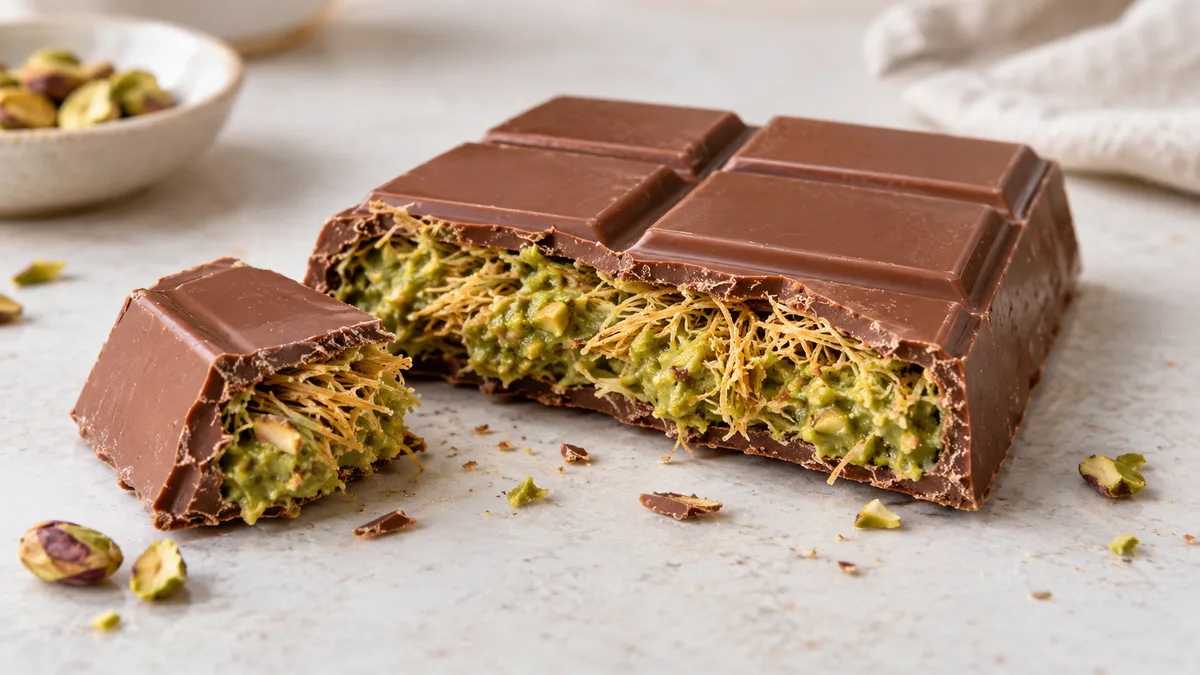
The VkusVill milk chocolate with pistachios and kataifi examined here contains 557 calories per 100 g. A 20 g piece provides about 111 calories; the 180 g bar provides 1,003. For another brand, use its own label and weight.
How many calories are in Dubai chocolate?
The name Dubai chocolate does not specify a single nutritional value. For a concrete calculation, consider the milk chocolate with pistachios and kataifi in VkusVill's official product listing. On 3 October 2026, the listing shows 557 calories, 11 g protein, 35.8 g fat and 47.7 g carbohydrates per 100 g. The bar weighs 180 g.
These figures apply to one product. If you bought a bar from another manufacturer, read its package. A similar green filling and the same name do not establish an identical recipe. If the ingredients change, the current package takes priority over a saved app entry.
| Chocolate weight | Calories | Protein, g | Fat, g | Carbohydrates, g |
|---|---|---|---|---|
| 10 g | 56 | 1.1 | 3.6 | 4.8 |
| 20 g | 111 | 2.2 | 7.2 | 9.5 |
| 30 g | 167 | 3.3 | 10.7 | 14.3 |
| Whole 180 g bar | 1,003 | 19.8 | 64.4 | 85.9 |
Portion values are calculated from the label and rounded. For example, 20 × 557 ÷ 100 = 111.4 calories. The whole bar contains 180 × 557 ÷ 100 = 1,002.6 calories. The table converts the value per 100 g into a serving; it does not recommend a piece size.
What is in the pistachio filling?
The listing identifies milk chocolate, roasted ground pistachios, kataifi pastry, white chocolate and salt. Its kataifi contains wheat flour, water, corn starch, milk, liquid egg and salt. Both chocolates list sugar, cocoa butter, milk powder, soy lecithin and vanilla; the milk chocolate also contains cocoa mass.
This list describes the verified product. It cannot be applied to every bar bearing the same name: yours may use different chocolate or a different filling. When comparing a purchase, check the ingredients and nutritional values together. The word pistachio in the name does not replace either field.
The listing does not specify the grams of pistachios, pastry and chocolate in each serving. Do not estimate the filling's nutritional values from a photograph of a broken bar, or infer the percentage of nuts from its colour. A picture shows the layers; the finished product's total nutritional values already provide the basis for counting it.
How much does one piece weigh?
Put the piece on a scale and use its weight in the formula. A square is an awkward unit for thick filled chocolate: pieces can contain different amounts of shell and filling. If you break the bar by hand, similar surface areas may have different thicknesses.
You do not need to weigh every crumb. Weigh the serving you plan to eat together with its small broken pieces. If the bar has identical factory segments and you know their combined weight, a fraction of the bar provides an approximate calculation. For example, exactly one sixth of a 180 g bar is 30 g, or about 167 calories using this label.
One sixth is a mathematical example, not a claim that this particular bar has six squares. With another mould pattern or uneven filling, scales provide a clearer result. Other approaches to serving size are described in our portion guide.
Comparing two bars
First compare calories per 100 g, using the same product weight. Then calculate the piece you actually eat. Finally, check the weight of the entire package. A smaller bar can contain fewer calories overall even if its value per 100 g is higher.
For the second brand, copy four label values: calories, protein, fat and carbohydrates. Do not add a separate pistachio entry to packaged Dubai chocolate. The filling is already included in the product's nutritional values. Counting it twice overestimates the result, just as adding cocoa butter separately to an ordinary bar would.
If an entry says Dubai chocolate, one piece, check whether it means a whole bar or a small segment and how many grams it represents. Save the brand and product name with the package data. Reading those fields is covered in our nutrition label article.
Check allergens on your own package
The verified product contains milk, pistachios, wheat flour, egg and soy lecithin. The listing also states that the facility uses peanuts, cereals containing gluten, sesame, milk, nuts, soy and eggs. The ingredient list and the manufacturing warning are separate fields. Read both if allergens matter to you.
With a food allergy, do not choose chocolate from the filling colour or a photograph. Check your actual package and the restrictions agreed with your clinician. Replacing milk chocolate with dark chocolate alone does not establish that the finished product is free from milk or other allergens.
Calculate homemade chocolate from its recipe
For homemade chocolate, record every ingredient weight: the shell, pistachio paste, kataifi and any oil used for frying. Take nutritional values from each package and add the calories and macros. After preparing the chocolate, weigh the entire batch without its mould, then weigh your serving.
Save the complete recipe and update the weights next time. The packaged bar's figure of 557 calories does not apply to your homemade recipe. The calculation follows the homemade food method: divide the batch calories by its actual finished weight, then multiply by the serving weight.
Frequently asked questions
- How many calories are in Dubai chocolate?
- The examined VkusVill milk chocolate with pistachios and kataifi contains 557 calories per 100 g according to its listing on 3 October 2026. Other brands may differ.
- How many calories are in one piece?
- A 20 g piece of the examined product contains about 111 calories; 30 g contains about 167. Weigh your own serving first.
- Should the pistachio filling be counted separately?
- For packaged chocolate, no: it is already included in the finished product values. Count every ingredient for a homemade recipe.
- Is Dubai chocolate suitable for someone with a nut allergy?
- The examined product contains pistachios. Check your own package ingredients, the manufacturing warning and the restrictions agreed with your clinician.
Read next
- How to determine portion size without a scale — Portion weight is the most inaccurate variable in any calculation, including analysis by photo.
- Calories and macros on the label: why the numbers don't match reality — The same buckwheat in three different apps gives three different calorie counts, and the package shows a fourth.
- How to count calories in homemade food — Processed foods are counted by the label, and restaurant meals by a reference guide.
This article is for general information. It is not medical advice, a diagnosis, or a prescription for treatment or a diet, and it does not replace a consultation with your doctor. If you have a health condition, are pregnant, take medication, or follow a diet prescribed to you, decisions about food belong with your doctor.
Figures from regulations, guidelines and studies are given as they stood when this article was prepared and may since have changed; check them against the primary sources. This article is not advertising, an offer, or individual advice, and neither the author nor the site owner is responsible for decisions taken on the basis of it.