The alcohol calorie calculator: grams of ethanol and a standard drink of 8, 10 or 14 g
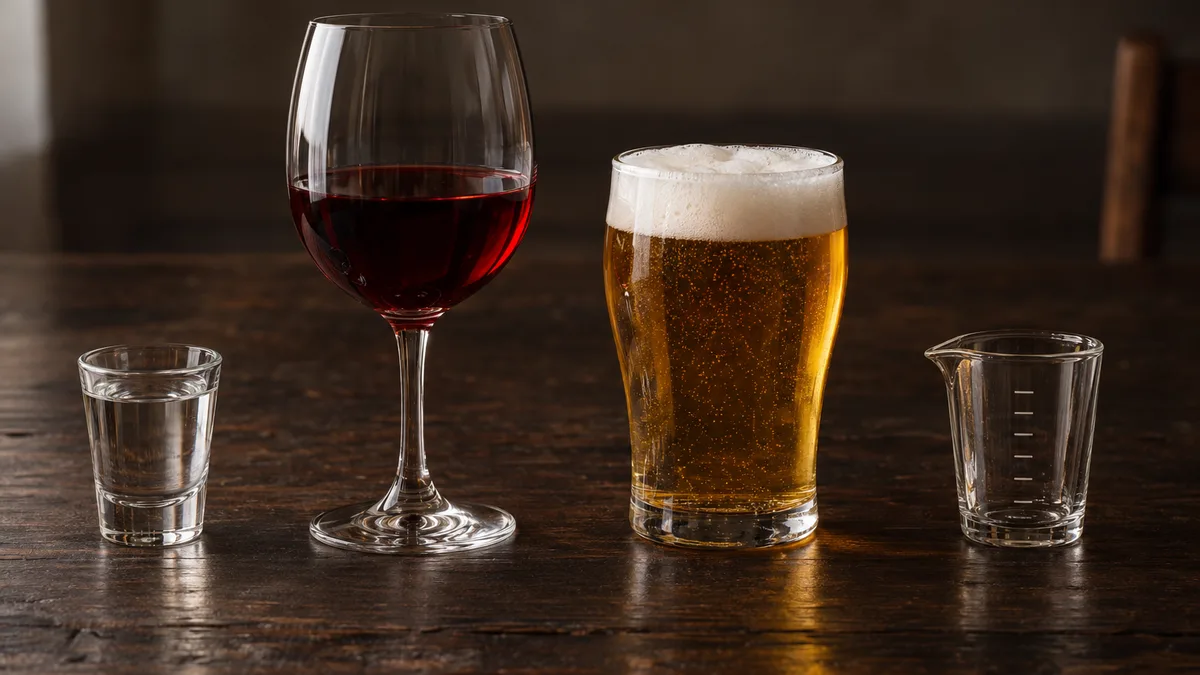
The alcohol calorie calculator shows two numbers: the energy in what you drank and the grams of pure ethanol. Grams are the same in every country, a "drink" is not: in the United Kingdom it is 8 g of alcohol, in the United States 14 g, and most often worldwide 10 g. So the same glass of wine counts as 1.1 or 2 drinks depending on the definition.
What goes in and what comes out
You pick one of 20 drinks from the table or choose "My own drink". For a drink from the table, strength and calories per 100 ml are known, and choosing it fills in a typical volume, for example 150 ml for a glass of wine or 500 ml for a mug of beer. You can change the volume and the number of servings (up to 50). For your own drink you enter the strength in percent and, if you know it, the carbohydrates per 100 ml.
The answer has three parts: the calories in what you drank, the grams of pure ethanol, and the number of standard drinks under three definitions, 8, 10 and 14 g.
Grams of ethanol: the formula and an example
Grams of alcohol equal the volume in millilitres times the strength (as a fraction) times 0.789, the density of ethanol in grams per millilitre. A 50 ml shot of vodka at 40%: 50 × 0.4 × 0.789 = 15.8 g.
The calories in alcohol are counted at 7 kcal per gram. That is the factor in the FAO report on food energy conversion factors (29 kJ/g, 7.0 kcal/g, 6.9 unrounded). For the same shot: 15.8 × 7 ≈ 110 kcal.
One drink: 8, 10 or 14 grams
There is no single definition of a standard drink. The review by Kalinowski and Humphreys in Addiction (2016) collected the government definitions of the 37 countries that have one: the most common is 10 g of pure ethanol, and the range is 8 to 20 g. The calculator shows the three values you meet most often.
| Definition | Grams of alcohol | What it is |
|---|---|---|
| United Kingdom, NHS | 8 g | One "unit" of alcohol: 10 ml of pure alcohol |
| Most common worldwide | 10 g | Most common in a review of 37 countries; range 8–20 g |
| United States, NIAAA | 14 g | For example 355 ml of 5% beer: 355 × 0.05 × 0.789 = 14.0 g |
Sources: NHS on alcohol units, NIAAA on the standard drink, the review of definitions in 37 countries.
Here is how the three definitions read the same drinks:
| Drink and volume | Alcohol, g | At 8 g | At 10 g | At 14 g |
|---|---|---|---|---|
| Vodka 40%, 50 ml | 15.8 | 2.0 | 1.6 | 1.1 |
| Dry red wine 13.5%, 150 ml | 16.0 | 2.0 | 1.6 | 1.1 |
| Regular beer 5%, 0.5 L | 19.7 | 2.5 | 2.0 | 1.4 |
A glass of wine and a shot of vodka hold almost the same amount of alcohol, and half a litre of beer holds about 4 g more. The word "drink" means something different in each of these rows, while the grams stay the same. So when you compare your result with someone else's recommendation or article, first find out how many grams are in their drink.
Where the calories come from: alcohol and everything else
The same amount of alcohol gives the same 7 kcal per gram, but a drink has other sources of energy. In beer it is carbohydrates, in wine and liqueurs sugar, and in cream liqueur fat as well. Calories from the drink table at roughly the same amount of alcohol:
| Drink and volume | Alcohol, g | Total, kcal | Of which alcohol, kcal |
|---|---|---|---|
| Vodka, 50 ml | 15.8 | 110 | 110 |
| Dry red wine, 150 ml | 16.0 | 114 | 112 |
| Gin and tonic, 200 ml | 17.4 | 170 | 122 |
| Regular beer, 0.5 L | 19.7 | 215 | 138 |
| Ready-made sweet mulled wine, 200 ml | 15.8 | 260 | 110 |
| Cream liqueur, 50 ml | 6.7 | 153 | 47 |
Vodka and dry wine are almost pure alcohol: dry wine has about 0.2 g of sugar per 100 ml. In the gin and tonic the tonic adds 48 kcal, in the beer 77 kcal come from everything else, mostly carbohydrates, and in the ready-made mulled wine 150 kcal come from sugar. The liqueur has 2.4 times less alcohol than the shot of vodka and 1.4 times more calories.
Per equal volume the picture reverses: 100 ml of vodka has 219 kcal and 100 ml of beer 43 kcal, because vodka has eight times more alcohol. Drinks can be fairly compared at the same amount of alcohol or the same serving, not at the same volume. For calories by drink group, see the article on calories in alcohol.
An example: your own drink
Say a craft beer label shows 5.5% and 4 g of carbohydrates per 100 ml, and you drank 200 ml. Alcohol: 200 × 0.055 × 0.789 = 8.7 g, which is 61 kcal. Carbohydrates: 2 × 4 g = 8 g, which is 32 kcal. In total about 93 kcal and 8.7 g of alcohol.
For a drink from the table the formula is simpler: the calculator takes the calories per 100 ml from the table and multiplies by the volume, and it counts grams of alcohol from the strength of that entry.
What it is useful for
- Grams of alcohol are comparable across drinks and countries. A number from a British article or an American recommendation converts to grams, and the calculator shows the grams straight away.
- You can see the difference between a 0.5 L mug and a 0.33 L can, between a 4% and an 8% beer: volume and strength go into the formula together.
- The calories of a drink are recorded as the same kind of number as the calories of food and go into your daily calorie count.
Where the calculator goes wrong
The reference values are averages. The table has one row per type of drink: dry red wine is recorded at 13.5%. If your bottle says 15%, the grams of alcohol are 11% higher than the calculator shows. In that case choose "My own drink" and enter the strength from the label. Sweetness is averaged too: brut sparkling wine is 73 kcal per 100 ml in the table, medium-sweet 84.
The strength on a label has a tolerance. EU Regulation 1169/2011 (Annex XII) allows the stated strength to be off by 0.5% vol for beer up to 5.5% and for still grape wines, by 1% vol for stronger beer and sparkling wines, and by 0.3% vol for other drinks. A beer labelled 5% may contain 4.5 to 5.5%: in 0.5 L that is 17.8 to 21.7 g of alcohol.
You enter the carbohydrates. The field is optional, and an empty value is read as zero. For 50 ml of a 17% liqueur without carbohydrates you get about 47 kcal, while the cream liqueur in the table gives 153. Without that number the calculator undercounts sweet drinks.
The factor of 7 kcal per gram is rounded. The same FAO report gives 6.3 kcal/g for one of its calculation systems, 10% less. The calculator uses 7, the value adopted in Codex Alimentarius and in the EU.
Cocktails and mixers. The table has two mixed drinks: gin and tonic and mulled wine. For others, enter the strength and carbohydrates of the mix in "My own drink".
Only the drink is counted. A snack, a sauce, the dinner next to it are separate lines of the count. How alcohol relates to appetite and sleep is covered in a separate article; the calculator does not estimate it.
What WHO says
In a statement published in The Lancet Public Health in January 2023, WHO says that no level of alcohol consumption is safe for health: the risk to health starts with the first drink.
With alcohol dependence, pregnancy, breastfeeding or medication, questions about alcohol are for a doctor. If cutting back on alcohol has become hard, that is also a question for a doctor, not for a calculator.
You can count the calories and grams of alcohol in your own drink in the alcohol calorie calculator.
Frequently asked questions
- How many grams of alcohol are in a standard drink?
- There is no single definition. In the United Kingdom a "unit" is 8 g of pure alcohol (NHS), in the United States a standard drink is 14 g (NIAAA). A review of the definitions in 37 countries found 10 g most common, with a range of 8 to 20 g.
- How do I calculate grams of pure alcohol in a drink?
- Multiply the volume in millilitres by the strength as a fraction and by 0.789 (the density of ethanol, g/ml). A 50 ml shot of vodka at 40%: 50 × 0.4 × 0.789 = 15.8 g.
- How many calories are in a gram of alcohol?
- 7 kcal by the general factor given by FAO (6.9 unrounded). To that you add the carbohydrates of the drink at 4 kcal per gram: in beer, wine with residual sugar, liqueurs and cocktails.
- Why does beer have more calories than vodka for the same amount of alcohol?
- Beer has carbohydrates besides alcohol. Half a litre of regular beer has 19.7 g of alcohol and 215 kcal in total: 138 kcal from the alcohol and the other 77 kcal mostly from carbohydrates. Vodka with the same amount of alcohol has about as many calories as the alcohol itself.
- How accurate is the alcohol calorie calculator?
- For a drink from the table it uses average values, for your own drink the strength and carbohydrates you enter. The strength on a label has a tolerance, for example ±0.5% vol for beer up to 5.5% under EU rules, so the grams of alcohol can differ by several percent.
Read next
- Calories in alcohol: how many calories are in beer, wine, and spirits — Alcohol is the only category that almost everyone skips when counting calories.
- The FoodGPT calorie calculator: how it works and where it goes wrong — The calorie calculator works out basal metabolism with the Mifflin–St Jeor equation, multiplies it by an activity factor from 1.
- Non-alcoholic beer: how much alcohol, calories, and sugar does it contain — A beverage is called non-alcoholic not when the alcohol content is zero, but when it does not exceed 0.
- The FoodGPT caffeine calculator: how it works and where it gets it wrong — The caffeine calculator adds up milligrams from a table of average values per drink and compares the total with the EFSA level: up to 400 mg a day for an adult, up to 200 mg in pregnancy and breastfeeding, and 3 mg per kilogram of body weight for a child or teenager.
This article is for general information. It is not medical advice, a diagnosis, or a prescription for treatment or a diet, and it does not replace a consultation with your doctor. If you have a health condition, are pregnant, take medication, or follow a diet prescribed to you, decisions about food belong with your doctor.
Figures from regulations, guidelines and studies are given as they stood when this article was prepared and may since have changed; check them against the primary sources. This article is not advertising, an offer, or individual advice, and neither the author nor the site owner is responsible for decisions taken on the basis of it.