Rice paper: sheet weight and how to log spring rolls
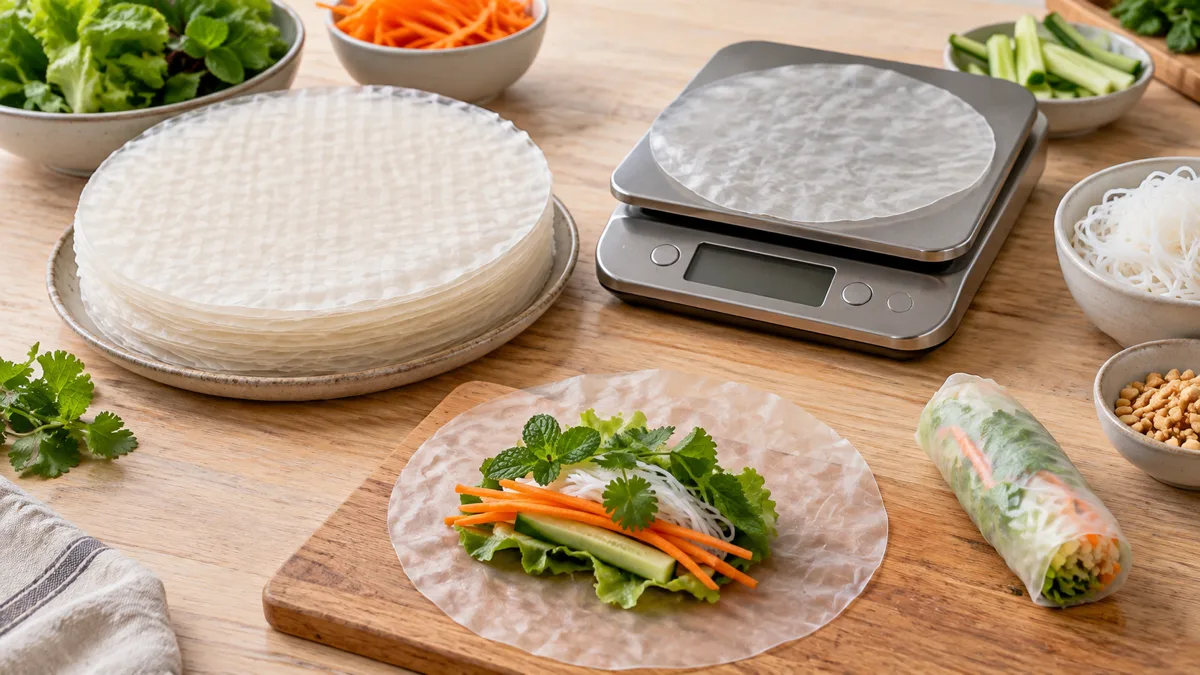
Log rice paper by the dry sheet. In a 240 g pack containing 28 sheets, one sheet weighs about 8.6 g and provides roughly 28–29 kcal. Soaking makes it heavier with water but does not add calories.
How much one rice paper sheet weighs
There is no universal sheet weight: diameter, thickness, and ingredients vary. One manufacturer lists a 240 g pack containing 28 sheets. Dividing the net weight by the sheet count gives 8.6 g per sheet, which can be rounded to 9 g for a food diary.
Another product may differ. If the pack gives a sheet count, divide its net weight by that number. If it does not, weigh several dry sheets together and divide by the number weighed.
Calories in one rice paper sheet
The Norwegian Food Composition Table lists 326 kcal per 100 g of rice paper. At 8.6 g, that works out to about 28 kcal per sheet. The manufacturer in the example lists 340 kcal per 100 g, or about 29 kcal for one of its sheets.
| Dry sheets | Example weight | Calories from the manufacturer data |
|---|---|---|
| 1 | about 8.6 g | about 29 kcal |
| 2 | about 17 g | about 58 kcal |
| 3 | about 26 g | about 87 kcal |
| 4 | about 34 g | about 117 kcal |
Use the nutrition label on your pack when available because recipes differ. The calculation is: calories per 100 g × sheet weight ÷ 100.
Dry or soaked weight
Enter the dry sheet. Rice paper absorbs water during soaking and becomes heavier, but water contributes no calories. There is no need to recalculate its food energy from the soaked weight.
Applying a dry rice paper value per 100 g to the weight of soaked sheets counts the absorbed water as if it were more rice paper. The same accounting issue appears with grains and pasta; our guide to raw and cooked weights explains it in detail.
How to log fresh spring rolls
Count the wrapper, filling, and dipping sauce separately. For four rolls, enter four dry sheets, all filling ingredients, and the amount of sauce actually eaten. When making one bowl of filling, total the entire recipe first and divide it by the number of rolls.
- Count the dry sheets and use the nutrition data from their pack.
- Weigh the filling ingredients, such as noodles, meat or tofu, and vegetables.
- Add the dipping sauce separately; its portion is unrelated to the wrapper weight.
- Add everything and divide by the number of rolls if the filling was distributed evenly.
If several people assemble rolls and the filling is uneven, weigh the completed batch and your portion. The method is covered in our guide to counting a homemade dish.
How to log fried spring rolls
Fried rolls add cooking oil to the wrappers and filling. A generic entry per 100 g cannot show how much oil a particular batch absorbed. At home, weigh the oil before cooking and what remains afterward. The difference is an upper estimate for oil used in the dish because some may remain on the pan or paper towel.
If you cannot estimate the oil, use a database entry for a prepared fried spring roll and do not add oil a second time. Our article on calories from cooking oil covers the home calculation.
A short food-diary formula
- Fresh roll: dry wrapper + filling + dipping sauce eaten.
- Fried roll: dry wrapper + filling + cooking oil + dipping sauce eaten.
- Restaurant roll: use menu information or estimate the whole dish; the dry wrapper weight usually cannot be reconstructed.
There is no need to reweigh soaked wrappers. For a repeated home recipe, save the whole batch once and change only the number of rolls eaten.
Frequently asked questions
- How much does one rice paper sheet weigh?
- In the example of a 240 g pack with 28 sheets, one dry sheet weighs about 8.6 g. Products vary, so divide the net weight of your pack by its sheet count when possible.
- How many calories are in one rice paper sheet?
- An 8.6 g sheet provides about 28–29 kcal using values of 326 and 340 kcal per 100 g from two sources. Use your own product label for another brand.
- Should rice paper be logged dry or soaked?
- Log the dry sheet. Soaking increases its weight with water but does not change the number of calories in the sheet.
- How do I count calories in spring rolls?
- Add the dry wrappers, all filling ingredients, and the dipping sauce eaten. For fried rolls, include cooking oil, then divide the batch total by the number of rolls if they are evenly filled.
Read next
- Raw or cooked weight: how to count grains, pasta, and meat — "100 g of buckwheat" can mean 346 kcal or 92, depending on the state of the grain.
- How to count calories in homemade food — Processed foods are counted by the label, and restaurant meals by a reference guide.
- How many calories does frying add — The cooking method adds more calories to a dish than any choice between "healthy" and "unhealthy" foods.
This article is for general information. It is not medical advice, a diagnosis, or a prescription for treatment or a diet, and it does not replace a consultation with your doctor. If you have a health condition, are pregnant, take medication, or follow a diet prescribed to you, decisions about food belong with your doctor.
Figures from regulations, guidelines and studies are given as they stood when this article was prepared and may since have changed; check them against the primary sources. This article is not advertising, an offer, or individual advice, and neither the author nor the site owner is responsible for decisions taken on the basis of it.