How many calories are in Olivier salad with sausage or chicken?
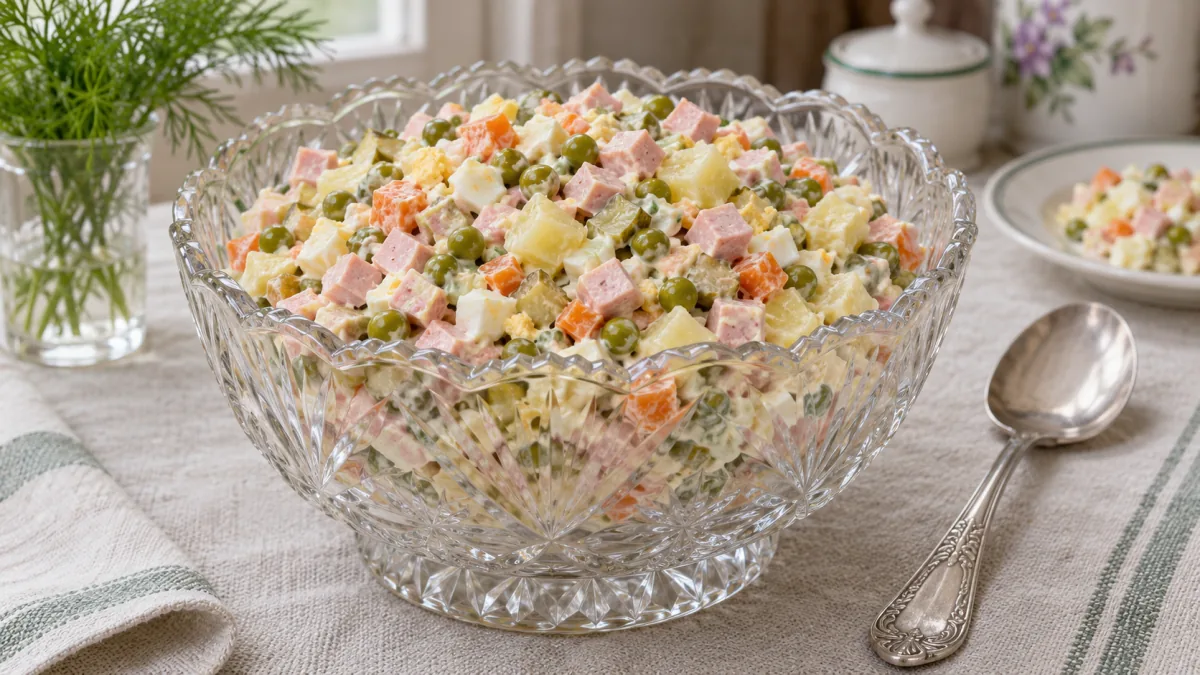
A 150 g serving of Olivier salad has about 275 calories with sausage or 215 with chicken in two recipes from the Russian grocer VkusVill. Several ingredients account for the 60-calorie difference, including how much mayonnaise goes into each bowl.
Calories and macros for two serving sizes
VkusVill uses five potatoes and 300 g of mayonnaise in its sausage Olivier salad. Its roast chicken version calls for three potatoes and 200 g of mayonnaise. Both recipes give nutrition figures per 100 g of finished salad. Multiply each figure by 1.5 for a 150 g serving.
| Olivier salad | Weight | kcal | Protein, g | Fat, g | Carbs, g |
|---|---|---|---|---|---|
| With sausage | 100 g | 183 | 4 | 15 | 9 |
| With sausage | 150 g | 275 | 6 | 22.5 | 13.5 |
| With chicken | 100 g | 143 | 9 | 8 | 7 |
| With chicken | 150 g | 215 | 13.5 | 12 | 10.5 |
What changes if you swap just the meat?
Suppose you make a kilogram of salad with 200 g of Klinskiy Doktorskaya sausage, a mild cooked sausage with 196 kcal per 100 g. That brings 392 kcal to the bowl. The same weight of poached chicken breast at 116 kcal per 100 g adds 232 kcal.
Keep the vegetables, eggs and dressing the same and the difference comes to 160 calories for the whole kilogram, or 24 calories per 150 g serving. Weigh the cooked chicken when it is ready to dice.
Mayonnaise in the bowl or on your plate
The label on this 67% fat mayonnaise lists 625.8 kcal per 100 g. An extra 10 g spooned onto your plate adds about 63 calories to your meal. Stir the same 10 g into the bowl and those calories are shared among everyone who takes a serving.
Start with a kilogram of dressed salad containing 1,830 calories. Mixing in another 10 g of mayonnaise gives you 1,893 calories in 1,010 g, or about 281 calories in a 150 g helping. If you take 150 g of the original salad first and add the 10 g of mayonnaise to your plate, you have 160 g of salad and about 337 calories.
How to calculate a homemade batch
- Weigh the empty mixing bowl. Drain the peas, shell the eggs and weigh each ingredient as it goes in. For the potatoes, carrots and meat, use their cooked weights.
- Multiply the weight of each ingredient in grams by its calories per 100 g and divide by 100. Use nutrition entries for cooked potatoes and cooked chicken. Weigh the dressing too.
- Add up the calories. Weigh the finished salad and subtract the weight of the bowl. Divide the total calories by the salad weight in grams, then multiply by the grams on your plate.
If someone else made the salad and you have no recipe, choose the closest match in the table and adjust for the size of your helping. Record any other dishes on the plate separately. See the guide to estimating calories in a holiday meal.
Frequently asked questions
- How many calories are in 200 g of sausage Olivier salad?
- At 183 kcal per 100 g, a 200 g helping has about 366 calories. For a packaged salad, double the calorie figure per 100 g on the label.
- Can you tell how much mayonnaise is in a salad from a photo?
- Once the salad is mixed, some of the dressing sits between the pieces. A photo can help estimate the portion. Weighing the dressing as you add it gives you its actual weight.
- How do I count the salad if everyone adds their own dressing?
- Calculate the calories in the undressed mixture and weigh your helping. Add the calories for the amount of dressing you put on your plate.
Read next
- Holiday table: where do the calories in Olivier and herring under a fur coat come from — Olivier salad does not have one correct number: one cook's version may have twice as many calories as another's, despite using the same ingredients.
- How to count calories in homemade food — Processed foods are counted by the label, and restaurant meals by a reference guide.
- How to determine portion size without a scale — Portion weight is the most inaccurate variable in any calculation, including analysis by photo.
This article is for general information. It is not medical advice, a diagnosis, or a prescription for treatment or a diet, and it does not replace a consultation with your doctor. If you have a health condition, are pregnant, take medication, or follow a diet prescribed to you, decisions about food belong with your doctor.
Figures from regulations, guidelines and studies are given as they stood when this article was prepared and may since have changed; check them against the primary sources. This article is not advertising, an offer, or individual advice, and neither the author nor the site owner is responsible for decisions taken on the basis of it.