Nuts and seeds: count a handful, spoonful or mixed portion
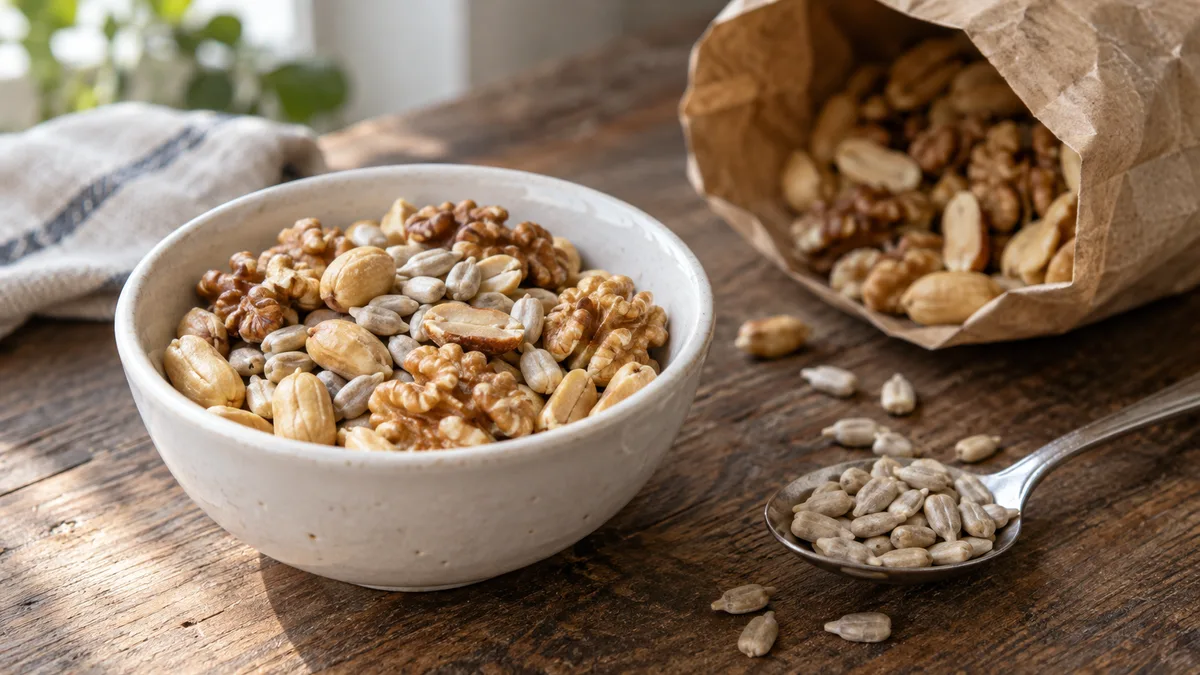
Calculate the calories in a handful of nuts from its weight and the values on that particular pack. A handful has no fixed weight: you can measure a personal reference on a scale, or divide a pack into portions. For a homemade mix, you also need the ingredient proportions.
Start with the product on the pack
Write down what is actually in the bowl: roasted peanuts, walnut halves or dried sunflower kernels. Select the matching diary entry and use the calories on the label. The name "nuts" does not supply the information needed for the calculation.
The examples below use three specific products sold in Russia. The values were checked on October 9, 2026. Check the current label on your own pack.
| Product | kcal per 100 g | Calculated for 20 g |
|---|---|---|
| VkusVill roasted salted peanuts, supplier Kemikal Treyding LLC | 601.4 | 120.3 kcal |
| VkusVill mountain walnuts (Kyrgyzstan) | 669.8 | 134.0 kcal |
| VkusVill dried sunflower kernels | 600.9 | 120.2 kcal |
Twenty grams is used for comparison, not as a suggested snack size. For any weight, use portion weight × kcal per 100 g ÷ 100. For these kernels, 20 × 600.9 ÷ 100 = 120.18 kcal; the table rounds the result.
The peanut card lists different suppliers with different values. This example uses the Kemikal Treyding LLC entry. Match the manufacturer on your own pack before using the number in your diary.
Measure your own handful
Place a bowl on a kitchen scale, reset it to zero and pick up your usual handful. Pour it into the bowl and record the weight. Return the food and repeat several times, picking it up as you normally would when eating.
Save the range of weights and a photo of one portion. Make the note specific: for example, "my loose handful of these sunflower kernels". You can use this reference at work or while travelling without a scale. Other methods are covered in the article on estimating portion weight.
If later handfuls differ noticeably in size, the saved weight no longer describes them. Replacing large walnut halves with small pieces also calls for a new measurement. Your result applies to how you pick up that particular food; it does not give every handful the same weight.
Measure a spoon with the same filling
For seeds added to porridge, a reference for your own tablespoon may be more useful. Reset the bowl to zero, add several equally filled spoonfuls, weigh them together and divide by the number of spoonfuls. Use the same spoon you will later use for the food.
As a hypothetical example, if five level spoonfuls weigh 45 g together, each averages 9 g. Two such spoonfuls would weigh about 18 g. This is an arithmetic example, not a measurement we performed or a universal tablespoon conversion. Measure a separate reference if you use a heaped spoon.
Without a scale, divide a full pack
A 100 g pack of shelled nuts can be divided into four approximately equal portions of about 25 g. For the peanuts in the table, 25 × 601.4 ÷ 100 = 150.35 kcal, or about 150 kcal. Empty the pack and divide its contents between matching bowls. A quarter of the bag's height does not by itself represent a quarter of its weight.
This method gives an estimate. Weigh each portion if you need an exact entry. If several people ate from the same pack, its original weight does not tell you how much each person had. A partially used pack cannot be divided as though it were full: first determine the remaining weight or account for what has already been taken.
Calculate a homemade mix by ingredient
Suppose you combine 50 g of peanuts, 30 g of walnuts and 20 g of sunflower kernels from the table. Calculate that batch.
- Peanuts: 50 × 601.4 ÷ 100 = 300.7 kcal.
- Walnuts: 30 × 669.8 ÷ 100 = 200.94 kcal.
- Sunflower kernels: 20 × 600.9 ÷ 100 = 120.18 kcal.
The total is 100 g of mix containing 621.82 kcal, rounded to 622 kcal per 100 g. A 25 g portion with the same proportions contains about 155 kcal. Taking a simple average of the three label values would be incorrect for this recipe because the ingredient weights differ.
Mix the contents before dividing them. If you pick out almost all the walnuts, the recipe's average becomes less representative of what remains. When you know the separate ingredient weights in your portion, calculate them individually. Use a purchased mix's own label, and add any raisins or chocolate you include at home as separate entries.
What to add to a photo analysis
Photograph your portion in a bowl and provide any known weight, nut varieties and mixture proportions. If you estimated the weight as a quarter of a pack, say so: approximately 25 g from a 100 g pack. A photo alone does not confirm grams or reveal ingredients below the top layer.
For food in shells, see calculating the edible portion. Energy absorption is covered separately in the article on nut calorie content. All the examples here use the published product values.
Frequently asked questions
- How many grams are in a handful of nuts?
- A handful has no fixed weight. Weigh your usual handful of a particular food several times and save the range as a personal reference.
- How many calories are in a tablespoon of sunflower kernels?
- Measure the weight of the kernels in your spoon, multiply it by the calories per 100 g on the pack and divide by 100. Measure level and heaped spoonfuls separately.
- Can I count a quarter of a pack as 25 g?
- Yes, if a full 100 g pack of shelled food is divided into four portions of equal weight. When you divide it by eye, 25 g remains an estimate.
- How do I calculate the calories in a nut mix?
- Multiply each ingredient weight by its calories per 100 g, divide by 100 and add the results. Calculate a portion by its share of the total weight if its composition matches the mixture.
- Do I need the nut proportions in a purchased mix?
- Use the total calories on the mix label and your portion weight. Ingredient proportions are needed when you make a mix yourself or separately count ingredients picked out of it.
Read next
- How to determine portion size without a scale — Portion weight is the most inaccurate variable in any calculation, including analysis by photo.
- Nuts: why they have fewer calories than stated — The calorie content of nuts in reference books is calculated, not measured, and for nuts, the calculation is systematically overstated.
- Bone-in chicken, watermelon with rind, nuts in the shell: log only what you ate — Log the weight of what you ate, not what was on the plate.
This article is for general information. It is not medical advice, a diagnosis, or a prescription for treatment or a diet, and it does not replace a consultation with your doctor. If you have a health condition, are pregnant, take medication, or follow a diet prescribed to you, decisions about food belong with your doctor.
Figures from regulations, guidelines and studies are given as they stood when this article was prepared and may since have changed; check them against the primary sources. This article is not advertising, an offer, or individual advice, and neither the author nor the site owner is responsible for decisions taken on the basis of it.