Doshirak calories per pack and prepared serving
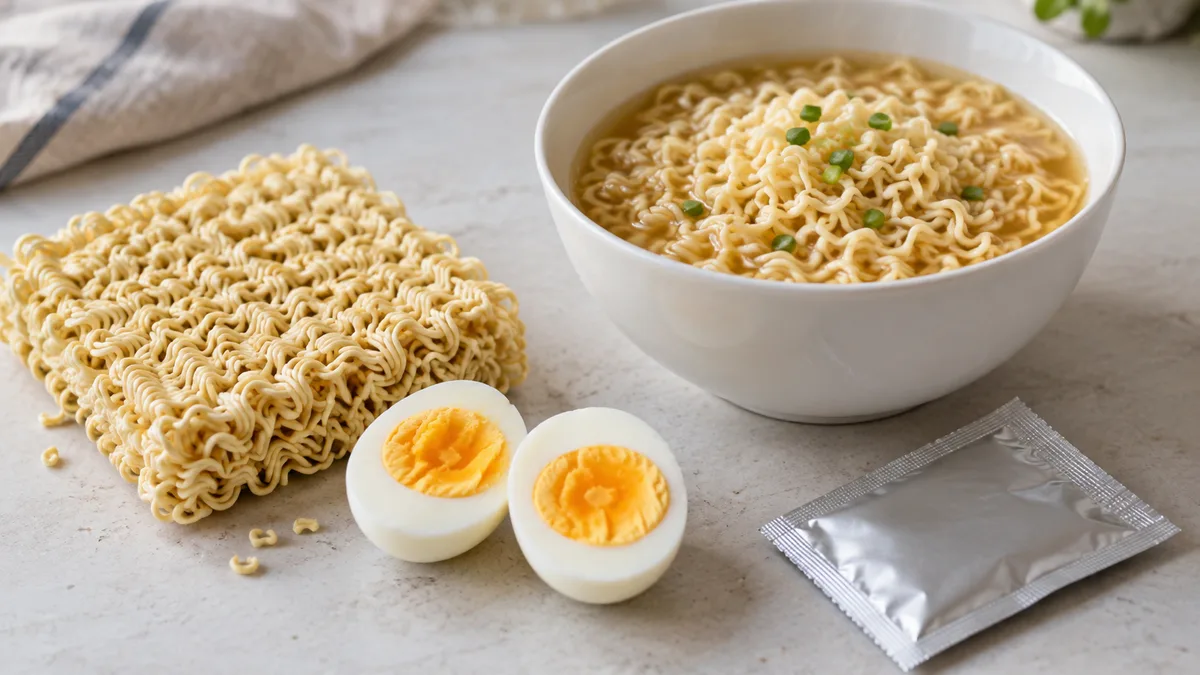
A 90 g chicken-flavor Doshirak tray contains 414 kcal according to the manufacturer. Water increases the weight of the meal without adding calories. Other packs need their own calculation: 70 g Kvisti and 105 g Doshirak Plus have different values.
Calories in three specific packs
Doshirak lists calories per 100 g separately from pack weight. Calculate the whole pack as pack calories = kcal per 100 g × net weight ÷ 100. The figures below were checked on October 9, 2026. Compare them with the pack you bought, because recipes and pack sizes can change.
| Product | Net weight | Kcal per 100 g | Whole pack |
|---|---|---|---|
| Kvisti, mushroom flavor | 70 g | 400 | 400 × 0.7 = 280 kcal |
| Doshirak tray, chicken flavor | 90 g | 460 | 460 × 0.9 = 414 kcal |
| Doshirak Plus, chicken flavor | 105 g | 480 | 480 × 1.05 = 504 kcal |
These are three specific products, not a calorie range for every noodle pack sold under the brand. Do not use mushroom Kvisti figures for another flavor or one generic Doshirak entry for every purchase. The manufacturer lists mayonnaise sauce among the Plus ingredients. If you use the entire contents, do not log the included sauce again.
The tray's 460 kcal figure refers to 100 g of product, not its 90 g pack. With a pack weighing more than 100 g, logging just the per-100-g figure would instead miss some of the contents.
Why prepared noodles have fewer calories per 100 g
Take the 414 kcal tray. Suppose the entire edible contents weigh 390 g after adding water. This is an illustrative measured yield, not a manufacturer specification. The prepared meal would contain 414 ÷ 390 × 100, or about 106 kcal per 100 g. The whole serving still contains 414 kcal.
If more water brings the yield to 490 g, the figure becomes about 84 kcal per 100 g. The same pack contents are spread through a greater weight. Comparing those figures without portion weights does not describe how much you ate.
For a whole pack, it is simpler to log the dry product weight shown on the label. For part of a prepared meal, you can use the calculated calories per 100 g if you prepared all the contents and ate a proportional share. Half of the well-mixed first example weighs 195 g and contains about 207 kcal. That calculation does not apply when you eat all the noodles but leave half the liquid.
Add egg and oil separately
Each addition has its own weight and nutrition label. Weigh egg without the shell and oil in grams. For an egg cooked separately, select the appropriate cooked-food entry. When calculating from raw ingredients, log the edible weight before cooking.
Here is a conditional example: your egg label says 157 kcal per 100 g and its edible weight before cooking is 50 g. It contributes 78.5 kcal to the recipe. If your oil label says 900 kcal per 100 g, adding 5 g contributes 45 kcal. These inputs are chosen for the example; use your own products' figures.
| Version of the 414 kcal tray | Calculation | Total under these assumptions |
|---|---|---|
| Pack contents and water | 414 | 414 kcal |
| With the example egg | 414 + 78.5 | About 493 kcal |
| With the egg and 5 g of example oil | 414 + 78.5 + 45 | About 538 kcal |
Count cheese, sausage and extra sauce the same way. If the egg was fried and you already included its frying oil, do not add that oil twice. See the separate article on cooking oils for their differences and uses.
If you omit seasoning or leave the broth
The manufacturer's general listing does not give separate calories for the noodle block, vegetables and broth seasoning. You therefore cannot calculate an exact seasoning-free version from it. Weighing the unused powder does not solve this: applying the whole pack's average calorie density assumes the powder has the same composition as the noodles.
The same limitation applies to leftover broth. Substances from the pack enter the liquid, but the label does not show how much energy remains in that liquid after your particular preparation. A photograph of the bowl cannot justify subtracting a fixed 50 or 100 kcal.
You can log the whole pack and note that you left the broth. This may overestimate your intake; it is not a measurement of the portion eaten. Separate manufacturer data for the components could support a more precise deduction. Composition and salt are discussed in our article on instant noodles.
Logging your serving
- Find the exact product name, flavor and net weight on the pack.
- Check the basis of the nutrition figures. Convert per-100-g figures to whole-pack figures.
- Add any ingredients that were not supplied in the pack.
- For part of a meal, record the share you ate and whether you left noodles, liquid or both.
In FoodGPT, start with a barcode scan and compare the entry with your pack's nutrition table. If the figures refer to 100 g of dry product, enter the dry pack weight rather than the weight with water. A prepared serving needs its own calculation using the meal's yield.
Frequently asked questions
- How many calories are in one Doshirak pack?
- Manufacturer listings checked on October 9, 2026 give 280 kcal for 70 g mushroom Kvisti, 414 kcal for a 90 g chicken-flavor tray and 504 kcal for 105 g chicken-flavor Doshirak Plus. For another pack, multiply kcal per 100 g by its net weight and divide by 100.
- How many calories are in 100 g of prepared Doshirak?
- It depends on the prepared yield. A whole 414 kcal pack weighing 390 g with water would have about 106 kcal per 100 g. At 490 g it would have about 84 kcal. These are illustrative examples: water changes weight and calories per 100 g, not the whole portion energy.
- How do I calculate Doshirak with an egg?
- Add the edible egg portion and other additions to the pack calories. In the conditional example, an egg labeled 157 kcal per 100 g with 50 g edible weight adds 78.5 kcal. Together with the 414 kcal tray, this is about 493 kcal. Use your egg data.
- Can I subtract calories if I leave the broth?
- The general label does not show how energy is distributed between noodles and leftover liquid, so an exact deduction is unsupported. You can log the whole pack and note the leftover broth, acknowledging that this may overestimate intake.
- Should I count dry weight or prepared weight?
- Use the dry contents weight when the entry gives nutrition per 100 g of dry product. Prepared weight is for a separate calculation per 100 g of the finished meal. Do not multiply dry noodle calories by the weight of noodles plus water.
Read next
- Instant noodles: what is in the package and how much salt they contain — The standard for instant noodles has a fat content limit and not a single line about salt.
- Cooking oil: smoke point and what matters more — The smoke point is usually cited as the main criterion for choosing a cooking oil.
- What to look for in an ingredient list in ten seconds — Reading an entire ingredient list at the shelf is impossible: the print is small, and there is no time.
This article is for general information. It is not medical advice, a diagnosis, or a prescription for treatment or a diet, and it does not replace a consultation with your doctor. If you have a health condition, are pregnant, take medication, or follow a diet prescribed to you, decisions about food belong with your doctor.
Figures from regulations, guidelines and studies are given as they stood when this article was prepared and may since have changed; check them against the primary sources. This article is not advertising, an offer, or individual advice, and neither the author nor the site owner is responsible for decisions taken on the basis of it.