How many grams of cocoa powder are in a spoon?
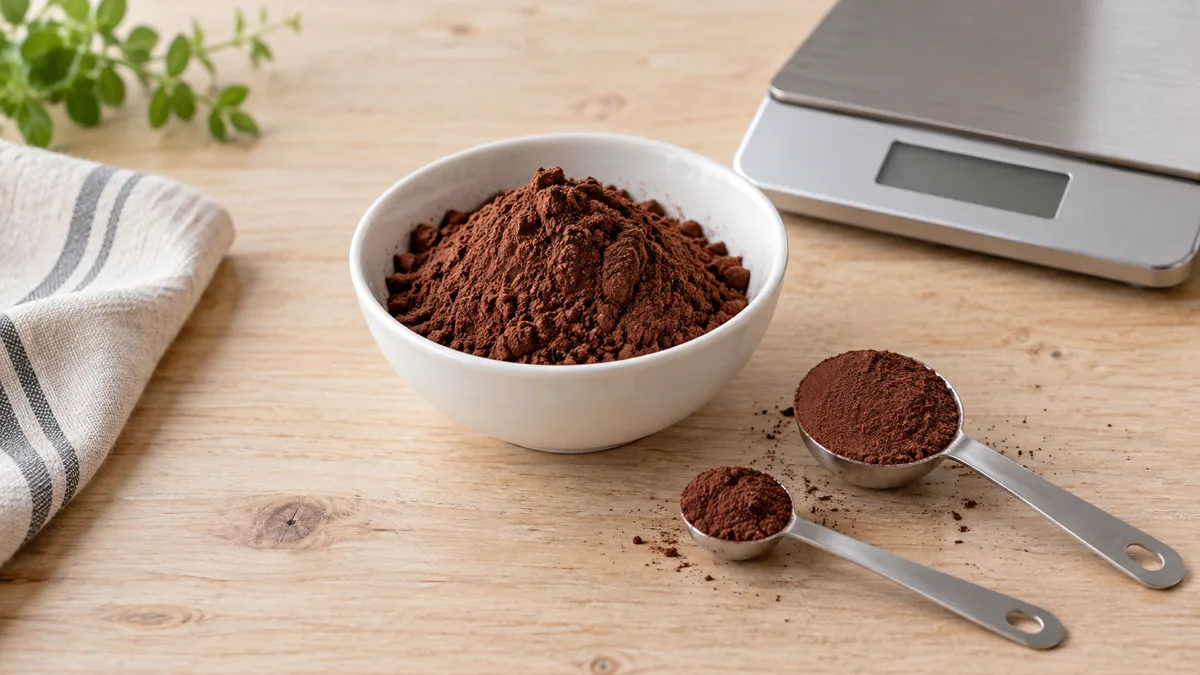
USDA lists 5.4 g for a tablespoon of dry unsweetened cocoa powder; a Hershey’s Cocoa label declares 5 g. These are examples for those sources, not a fixed weight for every heaped spoon. Weigh the powder when you need a closer count.
Tablespoon and teaspoon weights
The USDA table for dry unsweetened cocoa lists 5.4 g per tablespoon. Hershey’s Cocoa labels one tablespoon as 5 g. Either can serve as a rough estimate without a scale. Neither tells you how much cocoa sits above the rim of your spoon.
Neither source provides a separate measured teaspoon weight. The USDA kitchen conversion table puts three teaspoons in a tablespoon. Dividing the tablespoon examples into three equal volumes gives roughly 1.7–1.8 g per teaspoon, but that is an arithmetic estimate. To calibrate your spoon, tare a bowl on a scale, add several level spoonfuls, then divide the total grams by the number of spoonfuls.
Calories per spoon and per 100 grams
The USDA entry gives 228 kcal per 100 g. Its 5.4 g tablespoon therefore provides about 12 kcal (5.4 × 228 ÷ 100), and two provide about 25 kcal. The Hershey’s label declares 10 kcal per 5 g tablespoon. Use the numbers on your own package when available.
| Example | Weight | Energy |
|---|---|---|
| USDA tablespoon | 5.4 g | about 12 kcal, calculated from 228 kcal/100 g |
| Hershey’s Cocoa tablespoon | 5 g | 10 kcal on the label |
| Your measured portion | scale reading | grams × package kcal per 100 g ÷ 100 |
These are source-specific examples. The cocoa powder measurement card provides quick lookup values; this article explains how to calculate your own portion.
Logging cocoa in a drink or recipe
- Check whether the product is unsweetened cocoa or a drink mix. Hershey’s Cocoa lists cocoa as its ingredient; a mix with other ingredients needs its own label values.
- Weigh the dry powder before adding it. Without a scale, use a level measuring spoon and treat the package serving weight as an estimate.
- Multiply the grams used by calories per 100 g and divide by 100. If the label only gives calories per serving, use its serving weight.
- Count milk, sugar, and other additions separately. For baking, record all ingredients and divide the finished recipe into portions. See counting homemade food for the method.
For example, 8 g of the USDA cocoa works out to 8 × 228 ÷ 100 = 18.24 kcal, or about 18 kcal. That is the powder alone. For help matching per-100-g and serving figures, see the nutrition-label guide.
Frequently asked questions
- How many grams are in a tablespoon of cocoa powder?
- USDA lists 5.4 g for a tablespoon of dry unsweetened cocoa, while Hershey’s declares 5 g for its product. A heaped spoon should be weighed separately.
- How many calories are in one tablespoon of unsweetened cocoa?
- The USDA example works out to about 12 kcal in 5.4 g. Hershey’s labels its 5 g tablespoon as 10 kcal. Check your package for a different powder.
- How much cocoa powder is in a teaspoon?
- Those sources give no separately measured teaspoon weight. One-third of their tablespoon examples is about 1.7–1.8 g by calculation, but a scale gives the weight of your own spoonful.
- Do cocoa powder calories cover a cup of hot chocolate?
- No. The powder is one ingredient. Count milk, sugar, and other additions separately, or use the package label for a prepared drink mix.
Read next
- How to determine portion size without a scale — Portion weight is the most inaccurate variable in any calculation, including analysis by photo.
- Calories and macros on the label: why the numbers don't match reality — The same buckwheat in three different apps gives three different calorie counts, and the package shows a fourth.
- How to count calories in homemade food — Processed foods are counted by the label, and restaurant meals by a reference guide.
This article is for general information. It is not medical advice, a diagnosis, or a prescription for treatment or a diet, and it does not replace a consultation with your doctor. If you have a health condition, are pregnant, take medication, or follow a diet prescribed to you, decisions about food belong with your doctor.
Figures from regulations, guidelines and studies are given as they stood when this article was prepared and may since have changed; check them against the primary sources. This article is not advertising, an offer, or individual advice, and neither the author nor the site owner is responsible for decisions taken on the basis of it.