How much baking powder is in a teaspoon, tablespoon, or packet?
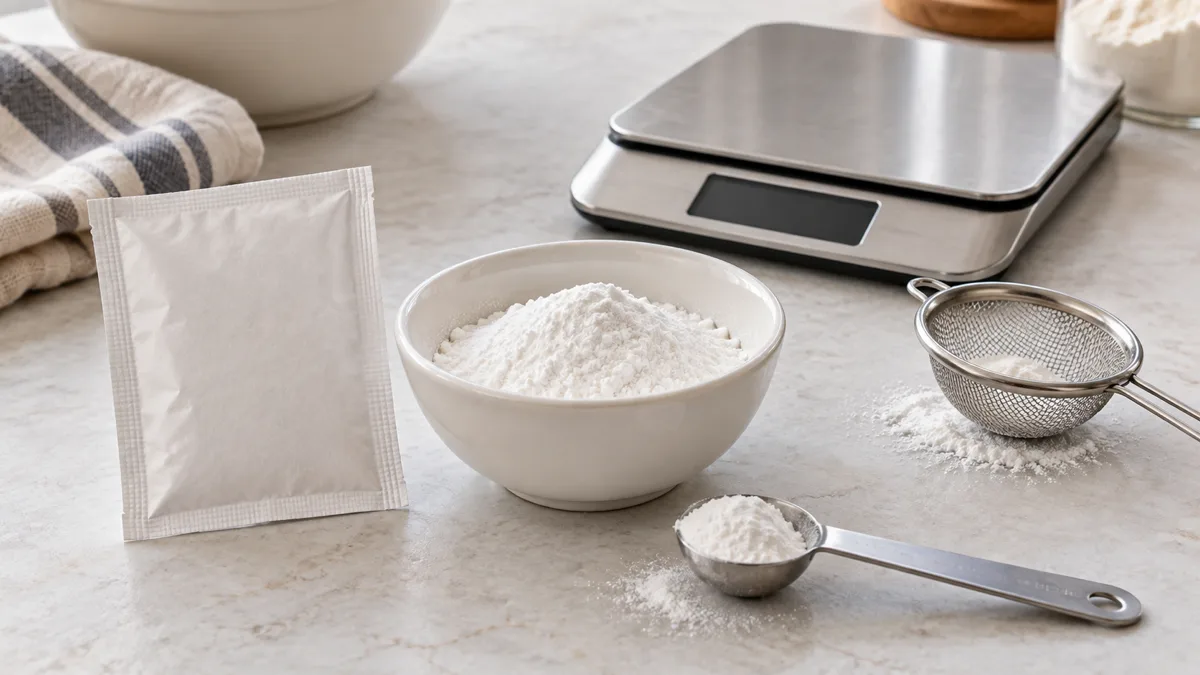
A level teaspoon of baking powder weighs about 4 g in King Arthur Baking’s chart. A level tablespoon is about 12 g. A 10 g Dr. Bakers packet is therefore roughly 2½ level teaspoons. A heaped spoon or another brand can weigh differently.
Grams in a teaspoon and tablespoon
King Arthur Baking’s ingredient weight chart gives 4 g for one teaspoon of baking powder. Three level teaspoons make one tablespoon by volume, or about 12 g. The chart does not give a weight for a heaped spoon; the extra powder depends on how high the heap is.
| Level measure | Estimated weight |
|---|---|
| ½ teaspoon | about 2 g |
| 1 teaspoon | about 4 g |
| 1 tablespoon | about 12 g |
| 1 standard 240 ml cup | about 192 g |
The cup figure is only a conversion from the teaspoon estimate: 48 level teaspoons × 4 g. A full cup of baking powder is not a normal recipe dose. Use scales for large batches or when the amount matters closely. The baking powder weights and measures card collects the conversions.
How many teaspoons are in a packet?
A Dr. Bakers packet contains 10 g, equivalent to about 2½ level teaspoons at 4 g each. Half that packet is 5 g; a quarter is 2.5 g. Check the net weight before applying those fractions to another packet.
Dr. Bakers gives a use amount of 10 g for 500 g of flour for this product. Follow your recipe or the directions for your own baking powder; that packet instruction does not set a universal dose for every batter.
Converting a recipe amount to spoons
Divide the requested grams by 4. Eight grams is about two level teaspoons; 6 g is about 1½. If a recipe calls for “1 tsp,” level the spoon. A heap adds an amount you cannot calculate from the level-spoon chart.
Table cutlery may differ in capacity from measuring spoons. For a baking powder you use often, weigh several equally filled level spoons together and divide by the spoon count. That gives a working conversion for your own product and spoon.
Logging baking powder in a homemade recipe
The Dr. Bakers product page lists 79.2 kcal per 100 g. By that label, its 10 g packet provides about 8 kcal and a 4 g teaspoon about 3 kcal. Use your own product’s nutrition label when available.
For a cake or batch of muffins, add the measured baking powder to the ingredient list, total the whole recipe, then divide by portions. Our guide to counting a homemade dish shows the full method. If you only need the powder’s weight, the table gives a practical estimate.
Frequently asked questions
- How many grams of baking powder are in a teaspoon?
- About 4 g in a level measuring teaspoon, according to King Arthur Baking’s chart. A heaped teaspoon has no fixed weight.
- How many grams are in a tablespoon of baking powder?
- About 12 g in a level measuring tablespoon, calculated from three level teaspoons of 4 g each.
- How many teaspoons are in a baking powder packet?
- A 10 g Dr. Bakers packet works out to roughly 2½ level teaspoons. Check the net weight for packets from other brands.
- How many calories are in 100 g of baking powder?
- Dr. Bakers lists 79.2 kcal per 100 g for its 10 g packet product. Nutrition values for another baking powder should come from that product’s label.
Read next
- How to count calories in homemade food — Processed foods are counted by the label, and restaurant meals by a reference guide.
- How to determine portion size without a scale — Portion weight is the most inaccurate variable in any calculation, including analysis by photo.
- Raw or cooked weight: how to count grains, pasta, and meat — "100 g of buckwheat" can mean 346 kcal or 92, depending on the state of the grain.
This article is for general information. It is not medical advice, a diagnosis, or a prescription for treatment or a diet, and it does not replace a consultation with your doctor. If you have a health condition, are pregnant, take medication, or follow a diet prescribed to you, decisions about food belong with your doctor.
Figures from regulations, guidelines and studies are given as they stood when this article was prepared and may since have changed; check them against the primary sources. This article is not advertising, an offer, or individual advice, and neither the author nor the site owner is responsible for decisions taken on the basis of it.