Cooking at home for a guest with a food allergy: what to ask and what to check
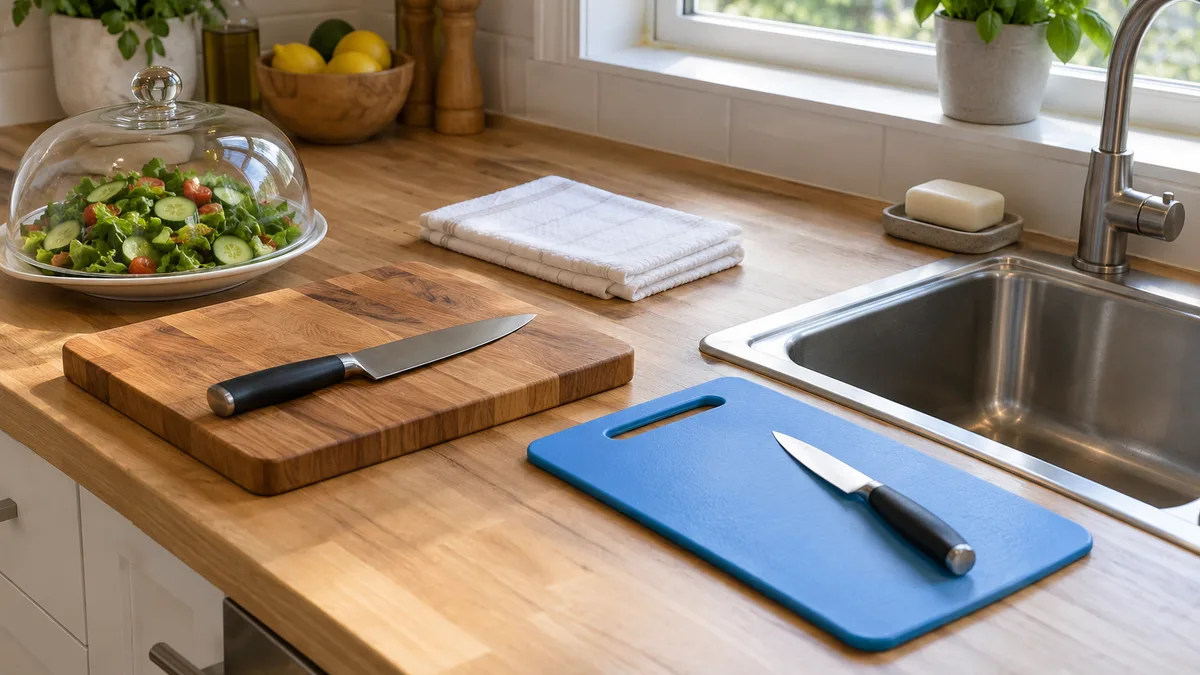
A host needs three things: find out from the guest what the allergy is and how they handle it, read the full ingredient list on every pack, and keep allergen from travelling on hands, boards and pans. What is safe for the guest is their call, not yours. You can show them the packs or let them bring their own dish.
Ask the guest first, plan the menu second
Ask ahead of time, by phone or message, not at a laid table. Four questions are enough.
- What exactly is the allergy. Peanut and tree nuts are different lines, covered in the article on peanuts and nuts. Milk and egg are worth naming separately too.
- How they deal with small amounts. For example, whether they eat food prepared on the same board as the allergen. Only the guest knows the answer.
- What they eat at other people's homes. Some eat whatever you show them with the packaging, others bring their own.
- Whether they carry emergency medication and where it is. You ask not out of distrust but so nobody has to search for a bag at the wrong moment.
Do not judge how serious the allergy is. You do not know the guest's medical history; they do. If the guest offers to bring their own dish, accept without persuading. If they call it an intolerance rather than an allergy, that is a different conversation: how the two differ.
Choose dishes whose ingredients you can see in full
The shorter the ingredient list, the fewer places an allergen can hide. Meat, vegetables, grains and fruit you cut yourself are easier to check than sauces, sausages, breading, sweets and spice mixes. Every ready-made ingredient is its own ingredient list that you will have to read.
Read the ingredient list on every pack, every time
Read the label before you cook, not from memory of the last purchase. That is the advice of FARE, the American food allergy organisation: confirm from the label that the allergen is absent, then start cooking.
In Russia, TR CU 022/2011 requires packaged food to list the components on its roster (peanuts, nuts, milk, eggs, fish, crustaceans, gluten-containing cereals, soy, sesame and others) regardless of quantity. Sulphites are the exception: they are listed above 10 mg per kilogram. Under which names allergens appear is covered in the article on mandatory allergen labelling. If the pack is foreign and the list is in another language, translate it first.
The rule has two limits.
- It covers ingredients, not traces. The text of the regulation has no requirement to declare accidental contact with an allergen at the factory. A "may contain traces" line is the manufacturer's own decision, and its absence guarantees nothing. More: what that line means. Whether to accept such a product is the guest's decision.
- It describes packaged food. Bread, deli items, cheese and sausage sold by weight may carry no ingredient list on the packaging. Ask the seller. If they cannot answer, that product does not go to the guest.
Do not carry allergen across from your kitchen
Moving allergen from one food to another is called cross-contact. FARE describes it like this: a knife, hand or table that has touched the allergen passes it to safe food. So anything that touched the allergen carries it: knife, spoon, board, pan, colander, your hands.
- Hands: soap and water. In a study by Perry and colleagues (J Allergy Clin Immunol, 2004), the peanut allergen Ara h 1 was undetectable on hands after liquid soap, bar soap or commercial wipes. After plain water it remained on 3 hands of 12, after antibacterial hand sanitizer on 6 of 12.
- Dishes, boards, knives, pans: soap and water, before cooking and after. For the safe dish FARE advises separate utensils and dishes.
- Counters: soapy water or a disinfectant cleaner with a disposable towel.
- Cook the guest's dish first, while the kitchen is clean and nothing else is in the pans yet.
- Cover the finished food at once. The guest's covered dish should not stand next to open nuts, a milk sauce or egg paste.
At the table, give every shared dish its own spoon. A spoon from the nut dish that ends up in the salad carries allergen just as a knife does. Serve the guest's dish separately. FARE's leaflet for restaurants advises carrying the safe dish by itself, since on a shared tray other food can spill onto it.
If you make a mistake
You cannot take allergen out of a finished dish. Picked-out nuts, scraped-off sauce and a wiped plate do not make it safe: FARE says even a trace of cross-contact makes a food unsafe and you must start again. So the dish is not served. Make a new one, or tell the guest there is no dish. An awkward pause is better than a risk.
What to do in a reaction: find out before the meal
A severe allergic reaction, anaphylaxis, develops fast. The European Academy of Allergy and Clinical Immunology (EAACI, 2021 guideline) names intramuscular adrenaline as first-line treatment and recommends that people at risk have an autoinjector to hand. Antihistamines and inhalers do not replace adrenaline, the American Academy of Allergy, Asthma and Immunology writes.
For the host that means three actions:
- call an ambulance: your local emergency number (in Russia 103 or 112, where the dispatcher will tell you what to do until help arrives);
- help the guest use their own autoinjector, if they have one;
- do not wait to see whether it passes.
If there is no autoinjector, the ambulance is called just as fast.
Frequently asked questions
- Is it enough to pick the nuts out of a finished dish or scrape off the sauce?
- No. According to FARE, allergen cannot be removed from a finished dish, and even a trace makes it unsafe. The dish has to be made again.
- Can hand sanitizer replace washing hands?
- No. In the Perry study, peanut allergen remained on 6 of 12 hands after sanitizer and 3 of 12 after plain water, and was not found after soap. Wash with soap.
- If the pack has no "may contain traces" line, are there no traces?
- Not necessarily. The text of TR CU 022/2011 has no requirement to declare accidental traces; the line is the manufacturer's own decision. Its absence guarantees nothing.
- The guest says "a little is fine". What should I do?
- That is their decision, and they know their reaction. Do not offer "a little" yourself and do not push. Show the ingredient list and prepare the dish as you agreed.
Read next
- Allergens that must be on the label — Manufacturers are required to disclose certain allergens at all times—even when their proportion is negligible and even when they entered the product as part of another ingredient.
- "May contain traces": what is behind this label — The label "may contain traces of nuts" is found on half the shelves, including products where nuts have no business being.
- Allergens in restaurants and delivery: how to ask for a helpful response — Packaging includes mandatory ingredient lists and warnings about traces.
- Allergy or intolerance: what is the difference and why it matters — Both conditions are described with the same words: "this makes me feel bad.
This article is for general information. It is not medical advice, a diagnosis, or a prescription for treatment or a diet, and it does not replace a consultation with your doctor. If you have a health condition, are pregnant, take medication, or follow a diet prescribed to you, decisions about food belong with your doctor.
Figures from regulations, guidelines and studies are given as they stood when this article was prepared and may since have changed; check them against the primary sources. This article is not advertising, an offer, or individual advice, and neither the author nor the site owner is responsible for decisions taken on the basis of it.