Cellulite and weight loss: what may change and what remains
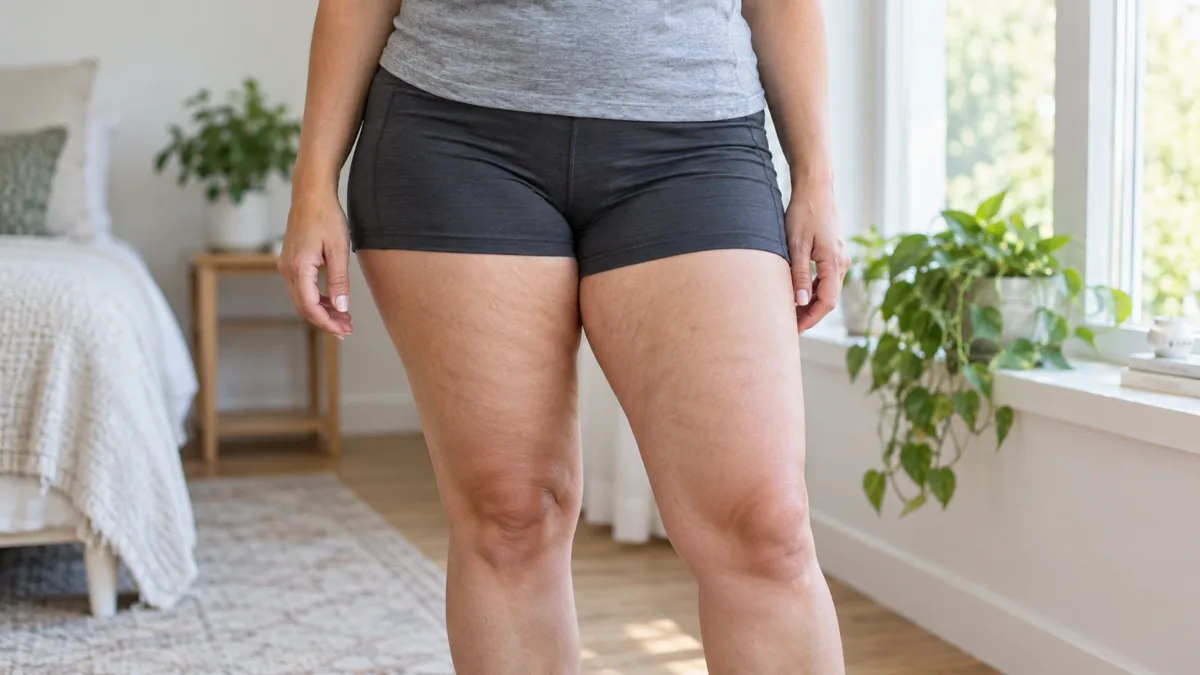
Weight loss sometimes makes cellulite less visible, but it cannot guarantee that the dimples will disappear. Their appearance depends on more than the amount of subcutaneous fat: connective-tissue bands and the properties of the skin also matter. Cellulite is very common and does not, by itself, mean anything is wrong with your body or habits.
Cellulite is skin topography, not a separate kind of fat
Under the skin of the thighs and buttocks, fat is arranged in lobules. Connective-tissue bands attach the skin to deeper tissue: they hold the skin inward at some points while neighboring fat lobules exert outward pressure. The interaction produces depressions and small raised areas.
An anatomical review of 38 relevant papers describes this area as a three-dimensional system of superficial and deep fat layers, fascia, and skin ligaments. An earlier investigation using biopsies, ultrasound, and blood-flow measurements included only seven adults, so it cannot estimate prevalence. It did show an important distinction: affected and unaffected sites did not differ in lipolytic response or blood flow; the observed differences involved connective-tissue structure.
This helps explain why cellulite occurs in people of different sizes and activity levels. It is not a measure of how well someone takes care of their body and is not a diagnosis. Medical reviews describe cellulite as an aesthetic feature seen most often in postpubertal women. The presence of dimples alone does not require treatment.
Weight loss can change the appearance in either direction
When the layer of subcutaneous fat becomes smaller, fat lobules may exert less outward pressure on the skin. The connective bands do not disappear with the lost fat, however, and skin may sit differently after a change in volume. A number on the scale therefore cannot predict the new surface appearance.
In a study of women enrolled in supervised weight-loss programs, researchers measured thigh roughness with three-dimensional laser scanning, tissue composition with dual-energy X-ray absorptiometry, structure with ultrasound, and elasticity with biomechanical tests. Cellulite improved in most participants but became more visible in others. Improvement was associated with larger reductions in weight and thigh-fat percentage, a higher starting BMI, and greater baseline severity. This was an observational study, not a randomized test of a treatment, so it cannot predict an individual's result.
A small three-month diet study offers another example of the uncertainty. Thirty-two healthy women aged 25–40 enrolled, but only 14 completed it. Weight and body-composition measures fell, yet the clinical cellulite grade did not change significantly. The small sample and high dropout rate prevent broad conclusions, but the study does not support promising that a calorie deficit will remove dimpling.
Exercise changes the body without offering a local guarantee
Resistance exercise can alter muscle size and shape, and movement supports health regardless of skin appearance. If body composition changes too, the surface may look different under a particular light. That is an indirect effect: squats and lunges do not release connective-tissue bands or let the body choose one place from which to use fat.
There is no high-quality evidence from which to prescribe an exercise program that removes cellulite. A 2023 review of pathogenesis and management notes a shortage of well-designed studies even for purpose-built procedures. Strength and routine activity can be evaluated separately: skin appearance does not measure the main outcomes of training.
Creams and massage have limited or temporary effects
| Approach | What the evidence suggests | What it does not establish |
|---|---|---|
| Creams | Some small trials report appearance changes for specific formulations. | One formulation's result does not apply to every cream. A cream does not selectively remove subcutaneous fat or release connective bands. |
| Manual or device-assisted massage | Pressure and vibration may temporarily change fluid distribution and surface appearance. | This is not a permanent anatomical change. Soreness and bruising can occur. |
| Radiofrequency, light, and other devices | Trials of some technologies report better appearance scores. | Effects depend on the technology and may be temporary; a procedure is not weight loss. |
A systematic review of 67 studies found that only 19 were randomized, placebo-controlled trials and found no clear evidence of good efficacy for any treatment. A newer review included 24 randomized trials with 2,084 participants and rated the overall quality of evidence as moderate. It described shock-wave and radiofrequency therapies as promising, but that does not make different devices interchangeable or guarantee a durable result for an individual.
The FDA makes a separate distinction: non-invasive body contouring does not treat obesity or produce the health benefits associated with weight loss. For massage, vibration, radiofrequency, and light devices, the agency describes temporary improvement in cellulite appearance and lists method-dependent risks ranging from pain and bruising to burns, skin-color changes, and scarring.
Ingredients matter with creams as well. The FDA flags products containing aminophylline because they can cause allergic reactions; it specifically advises people with asthma to consider the risk of sensitization. The word “cosmetic” on a label does not make a product suitable for every person's skin.
Weight loss solely for cellulite is an unreliable goal
If you are losing weight for other reasons, cellulite does not need to become another test. The same area can look different standing or sitting and under side or front lighting. If you want to observe it, compare photographs in the same position, lighting, and camera distance—and remember that a photograph measures appearance, not health.
You do not need to buy a procedure or change your body if the texture does not bother you. If it does, a useful question for a practitioner is not “will this remove cellulite forever?” but “what outcome was tested, how long were people followed, how many sessions are expected, and what are the risks of this specific device?” Discuss contraindications with a clinician trained in the chosen technology before an energy-based or invasive procedure.
Persistent pain, sudden one-sided swelling, marked redness, hot skin, or a rapidly developing tissue change should not automatically be labeled cellulite and massaged at home. Those symptoms need medical assessment.
Frequently asked questions
- Will cellulite go away if I lose weight?
- It may become less visible, but there is no guarantee. In a study of supervised weight-loss programs, cellulite improved in most women and worsened in some. Appearance depends on connective-tissue bands and skin properties as well as fat volume.
- Can thin women have cellulite?
- Yes. Cellulite reflects the arrangement of skin, subcutaneous fat, and connective tissue, so it occurs at different body weights and does not imply a lack of physical activity.
- Can squats get rid of cellulite?
- Squats strengthen muscles and may change body contour, but they do not guarantee a local change in skin texture. Research does not identify an exercise program that removes connective-tissue bands and permanently eliminates cellulite.
- Do cellulite creams and massage work?
- Some specific formulations and procedures have produced appearance changes in trials, but the evidence varies and the effects of massage and many devices may be temporary. Cream does not remove fat from one chosen area, and massage does not permanently change the anatomy.
Read next
- How to lose weight without counting calories — Counting calories is a tool, not a requirement.
- Weight loss plateau: why weight stalls and what to do about it — The weight has stayed at the same number for the third week in a row, even though the diet hasn't changed — and the first instinct is usually the same: to cut even more.
- Excess weight and health: what risks are confirmed — This topic is usually presented in a way meant to induce fear.
- Protein and muscle protein synthesis: dose, leucine and the anabolic window — Protein comes with its own arithmetic: thirty grams per meal, a leucine threshold, a window after training.
This article is for general information. It is not medical advice, a diagnosis, or a prescription for treatment or a diet, and it does not replace a consultation with your doctor. If you have a health condition, are pregnant, take medication, or follow a diet prescribed to you, decisions about food belong with your doctor.
Figures from regulations, guidelines and studies are given as they stood when this article was prepared and may since have changed; check them against the primary sources. This article is not advertising, an offer, or individual advice, and neither the author nor the site owner is responsible for decisions taken on the basis of it.