Sports supplements: creatine, glutamine, lecithin
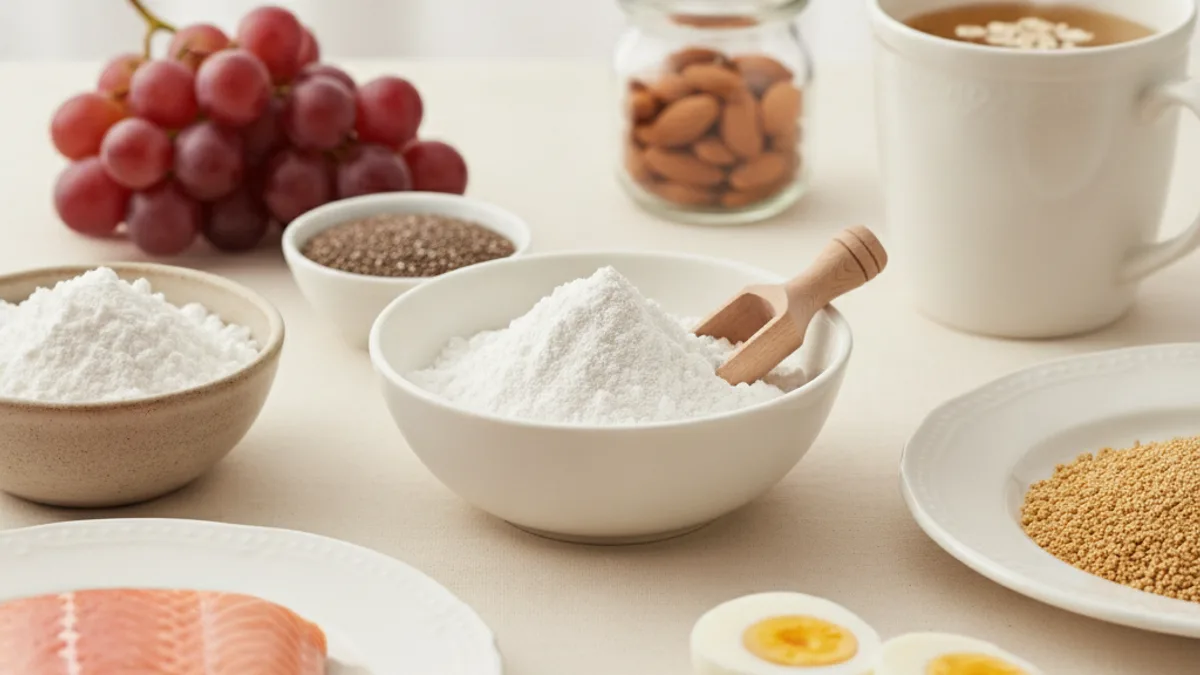
The sports nutrition shelf is arranged so that expensive and useless products stand next to cheap and effective ones. The difference is not visible on the packaging, but in how many studies a substance has withstood.
First, about the confusion in terms
A "food additive" in legal terms is a substance with an E-number that is added to a product during manufacturing: a preservative, coloring, or emulsifier. A tub of creatine has nothing to do with these: legally, it is a dietary supplement, and it is registered under different rules. The categories are different, the registries are different, but they are called the same thing in conversation—this is where half the misunderstandings come from.
The following text is about the second category. For the first, there is a guide to E-numbers, and for the difference between supplements, vitamins, and medications, there is a separate analysis.
Creatine: the most studied supplement on this shelf
Creatine participates in the regeneration of ATP—the energy reserve used in the first seconds of physical exertion. Supplementation increases its storage in muscles, which is noticeable in short, powerful sets: bench presses, sprints, and jumps. It does not affect endurance during prolonged activity.
The effective form is monohydrate, about 3–5 g per day, taken at any time with water. All other forms are more expensive and have not shown any advantage over it. A loading phase is not necessary: it only speeds up muscle saturation by a couple of weeks.
What is worth knowing in advance: in the first weeks, weight increases by a kilogram or two due to the water that creatine retains inside muscle cells. For someone tracking the number on the scale, this looks like a diet failure, even though no fat has been added. The second practical point is that creatine increases creatinine levels in blood tests, and a doctor who is unaware of the supplementation might interpret this as a kidney problem.
Glutamine: a case where popularity predates evidence
This is a conditionally essential amino acid: the body synthesizes it itself, and in a normal diet with sufficient protein, there is already plenty of it. The supplement is sold with promises of recovery and immune support for those who exercise, but studies on healthy people have not shown a consistent effect on strength, mass, or illness rates.
Clinical use is a separate matter: in severe conditions with massive protein breakdown, glutamine is prescribed, and this is a doctor's decision, not a purchase at a sports nutrition store.
Lecithin: the same thing as E322
Lecithin is a mixture of phospholipids, most often from soy or sunflower. In the food industry, it goes by the code E322 and acts as an emulsifier: it keeps chocolate uniform and prevents mayonnaise from separating. In a pharmacy, the same mixture costs significantly more and is sold as a remedy for the liver, memory, and nerves.
It has only one practical value—it is a source of choline, a substance the body needs. But choline is found in eggs, liver, and legumes, and the claimed effects on memory and liver recovery have not received convincing support in research.
The rest in brief
- Protein. This is not a medicine or a stimulant, but dry food: a way to reach your protein intake when there is no time to cook. It has no effect beyond what the same amount of protein from cottage cheese or chicken would provide.
- BCAA. Three amino acids out of the twenty that are already present in protein and regular food. If there is enough protein in the diet, there is no point in buying them separately.
- Omega-3. The only one on the list where the effect on blood triglyceride levels is clearly shown. Data on the impact on cardiovascular events are contradictory, and it is wiser to decide with a doctor than based on an internet review.
- L-carnitine and "fat burners". They sell better than all the others combined. No noticeable effect on body composition has been shown for them.
Why there is so much useless stuff on the shelf
Dietary supplements are registered as food products. Safety and compliance of the composition with the label are checked; the manufacturer is not required to prove that the supplement works—this requirement applies to medicines. Therefore, having a state registration certificate means that the powder will not poison you, but it says nothing about whether it will work.
The second consequence of this framework is the composition. Market checks of sports nutrition regularly find tubs where there is less of the declared substance than promised or where ingredients not listed on the label are present. For athletes undergoing doping control, this is a separate risk, which is why independent batch testing programs exist.
Where to start if you want results
With food. Supplements at best add a few percent to what is provided by sufficient protein, sleep, and regular exercise; none of them will compensate for the lack of these three things. A reasonable order is to first see how much protein and calories you get in a normal day, and only then decide what is actually missing from your diet.
Frequently asked questions
- Is creatine harmful to the kidneys?
- In healthy individuals, creatine has been studied more extensively than other supplements on this shelf, and research has not found any harm to the kidneys. An important practical point: it increases creatinine levels in blood tests, so you should inform the doctor who ordered the test about your intake; otherwise, the result might be interpreted as a sign of a health issue.
- Is glutamine necessary for training?
- The body synthesizes this amino acid on its own, and it is sufficiently present in a diet with adequate protein. Studies on healthy individuals who exercise have not shown a consistent effect on strength, muscle mass, or illness rates. Clinical use for severe conditions is a separate matter and a decision for a physician.
- How does pharmacy lecithin differ from the E322 emulsifier?
- There is no difference in composition: it is the same mixture of phospholipids, most often from soy or sunflower. The difference lies in the price and the claims on the packaging. The stated effects on memory and liver function have not received convincing support in research.
- Why are useless supplements sold freely?
- Dietary supplements are registered as food products: safety and compliance of the composition with the label are checked, but the manufacturer is not required to prove efficacy—this is a requirement for medications. A certificate of state registration confirms that the product will not cause harm, not that it will provide a benefit.
Read next
- How dietary supplements differ from vitamins and medications — In a pharmacy, two packages of vitamin D sit on the same shelf.
- What is KBZHU — KBZHU represents four numbers that describe food: caloric content and the three macronutrients that make it up.
- How to lose weight correctly — Weight loss is boring: a slight energy deficit, enough protein, strength training, and time.
- Creatine in women: what research has shown — Creatine is the most studied supplement on the shelf, but trials involving women make up a smaller portion of this research.
This article is for general information. It is not medical advice, a diagnosis, or a prescription for treatment or a diet, and it does not replace a consultation with your doctor. If you have a health condition, are pregnant, take medication, or follow a diet prescribed to you, decisions about food belong with your doctor.
Figures from regulations, guidelines and studies are given as they stood when this article was prepared and may since have changed; check them against the primary sources. This article is not advertising, an offer, or individual advice, and neither the author nor the site owner is responsible for decisions taken on the basis of it.