Fresh and dried persimmon: counting portions and desserts
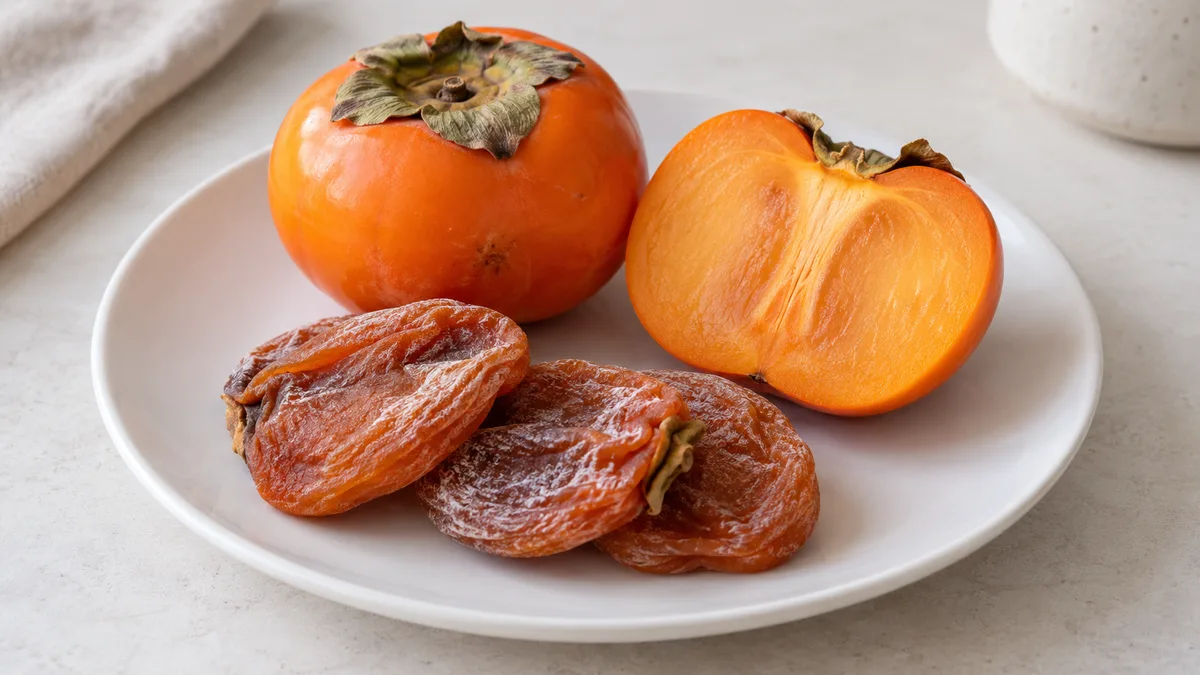
The USDA reference entry for fresh Japanese persimmon contains 70 calories per 100 g. If the edible part of your fruit weighs 180 g, that is about 126 calories. Weigh the fruit: one piece does not define a serving size.
Choose the entry for fresh or dried persimmon
The USDA FoodData Central entry for raw Japanese persimmon lists 70 calories, 0.58 g protein, 0.19 g fat and 18.59 g carbohydrates per 100 g edible portion. These are reference values for a particular entry, not a measurement of every fruit in a shop. For a food diary, they provide an estimate when combined with your actual portion weight.
The entry specifies the food and its state: fresh persimmon. That distinguishes it from dried fruit, sweetened purée or a prepared dessert. If an app offers several similar entries, open their details rather than choosing the first result containing the word persimmon. Use the manufacturer's label for a packaged processed product.
USDA lists carbohydrates calculated by difference. Values cannot always be transferred directly between databases that account for fibre differently. For a consistent diary, it is easier to use one selected entry for the food than to take calories from one database and macros from another.
Calories in one persimmon
Weigh the fruit, then subtract anything you did not eat: the stalk, seeds and skin if you peeled it. Alternatively, weigh the flesh ready to eat. Multiply the calories per 100 g by that weight and divide by 100.
| Edible weight, g | Calories | Protein, g | Fat, g | Carbohydrates, g |
|---|---|---|---|---|
| 120 | 84 | 0.7 | 0.2 | 22.3 |
| 180 | 126 | 1.0 | 0.3 | 33.5 |
| 250 | 175 | 1.5 | 0.5 | 46.5 |
These weights are illustrative calculations, not definitions of a small, medium or large persimmon. Your fruit may weigh differently. For 180 g of edible flesh, the calculation is 70 × 180 ÷ 100 = 126 calories.
If you ate half, record the weight of that half. With very soft fruit, tare a bowl on the scales and spoon the flesh into it. That avoids weighing the leftovers separately or estimating spoonfuls. Other approaches to servings are covered in our portion weight guide.
Fresh and dried persimmon need different diary entries
For dried Japanese persimmon, USDA lists 274 calories per 100 g, with 1.38 g protein, 0.59 g fat and 73.43 g carbohydrates. The fresh entry contains 70 calories for the same weight. This compares reference samples, not one measured fruit before and after drying.
| Example portion | Calories | Calculation |
|---|---|---|
| Fresh persimmon, 180 g | 126 | 70 × 1.8 |
| Dried persimmon, 30 g | 82 | 274 × 0.3 |
| Dried persimmon, 50 g | 137 | 274 × 0.5 |
Drying removes water, so comparing the same number of fruits is inconvenient. Weigh the finished dried portion and choose the corresponding entry. Use the label for packaged dried persimmon: its moisture and ingredients may differ from the reference sample. A product with added sugar or syrup also has its own nutritional values.
Frozen flesh without additions does not become dried persimmon. If you froze a portion you had already weighed and recorded, keep that entry. For purée made from several fruits, add the weights of the flesh used. Record syrup, honey or sugar separately.
Counting persimmon in yogurt, salads and desserts
Calculate the fruit separately from the other ingredients. For example, 150 g of persimmon provides 105 calories using the selected entry. Add yogurt, nuts and dressing by their weights. Calling a bowl a fruit dessert does not tell you its total calories.
Suppose you combine 150 g persimmon with 150 g yogurt whose label lists 60 calories per 100 g. The yogurt is hypothetical here; check the number on your own package. The bowl contains 105 + 90 = 195 calories. Recalculate after adding other ingredients rather than selecting somebody else's persimmon and yogurt recipe.
If you bake persimmon with a filling, record the ingredients before cooking. You can then divide the dessert into equal portions or weigh its finished yield and your serving. The process is described in our homemade food guide. The moisture remaining after baking changes the value per 100 g, so the entry for fresh fruit no longer describes the entire finished dessert.
What variety and softness tell you
If the seller names a particular variety, do not assign it a separate precise calorie value without a clear source. You can use the reference entry for fresh persimmon and note the variety in its name. Scales establish your serving weight; differences in nutritional values between specific varieties need separate data.
Softness is more useful for deciding how to serve the fruit: slice firm flesh, or spoon soft flesh into a bowl or purée. Appearance alone cannot tell you how many calories changed as it ripened. You do not need to change the diary entry solely because the persimmon softened overnight.
Keep the reference entry for your next purchase, but weigh the new serving. If recording food causes anxiety, each fruit does not need to become another check. Our guide to calorie counting mistakes considers where extra detail helps and where it adds work.
Frequently asked questions
- How many calories are in one persimmon?
- The example with 180 g edible flesh contains about 126 calories using the reference value of 70 calories per 100 g. Weigh your own fruit for its actual serving size.
- Should the skin be included in the weight?
- Count the part you ate. If you discarded the skin, exclude it together with the stalk and seeds.
- Does dried persimmon have the same calories?
- USDA lists 274 calories per 100 g for dried Japanese persimmon and 70 for fresh. Use the package label for your own dried product.
- How should I record persimmon with yogurt?
- Weigh the fruit and yogurt separately, calculate each ingredient and add the results. Count nuts, honey and other toppings too.
Read next
- How to determine portion size without a scale — Portion weight is the most inaccurate variable in any calculation, including analysis by photo.
- How to count calories in homemade food — Processed foods are counted by the label, and restaurant meals by a reference guide.
- Why the tracker shows a deficit but weight remains the same — The app has shown a deficit for four weeks, but the scale hasn't moved.
This article is for general information. It is not medical advice, a diagnosis, or a prescription for treatment or a diet, and it does not replace a consultation with your doctor. If you have a health condition, are pregnant, take medication, or follow a diet prescribed to you, decisions about food belong with your doctor.
Figures from regulations, guidelines and studies are given as they stood when this article was prepared and may since have changed; check them against the primary sources. This article is not advertising, an offer, or individual advice, and neither the author nor the site owner is responsible for decisions taken on the basis of it.