How to check dietary supplements or vitamins before purchase
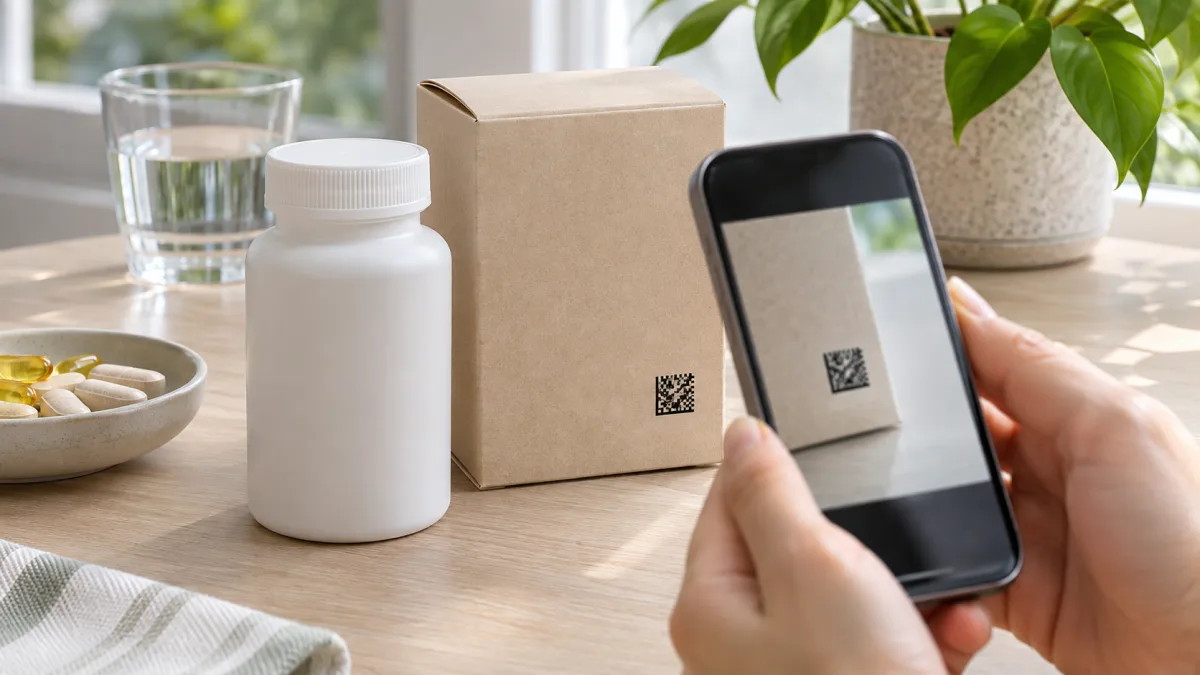
A standard barcode helps find a product card, but does not confirm that a specific jar was legally produced or has not already been sold. For dietary supplements and some vitamin products in Russia, another code—Data Matrix—is checked first, and then the data is compared with the packaging and registry.
First, determine the category
The word “vitamins” does not tell you what is in front of you. The same vitamin can be sold as a medicine or as a dietary supplement. Medicines and dietary supplements have different documents, and checking the composition or code does not turn one into the other. This distinction is covered in the article on dietary supplements, vitamins, and medicines.
This guide applies to food supplements. If you doubt the authenticity of a medicinal product, do not take it until you have checked with the pharmacy, manufacturer, or regulator.
Barcodes and Data Matrix answer different questions
| What is on the packaging | What it can tell you | What the code does not prove |
|---|---|---|
| EAN linear barcode | Which product item a database is looking up | That a specific pack is original or has not already been sold |
| Data Matrix | The status of a marked unit in the system, where the category and code are subject to labeling | That the supplement suits you or delivers the promised effect |
| State registration certificate or registration data | Whether the supplement has a record in the corresponding registry | The storage quality of a specific jar or its therapeutic effect |
A linear code consists of bars. It can be printed on similar packaging, so checking a country by its first digits or searching a catalog does not confirm authenticity. What EAN-13 actually encodes is explained in the article on barcodes on packaging.
Check Data Matrix in the official app
- Find the square two-dimensional Data Matrix code. It does not look like a long linear barcode.
- Scan it with the Chestny Znak consumer app.
- Compare the name, manufacturer, expiration date, and code status in the result with the jar or box.
- If the app reports an error, repeated withdrawal from circulation, or mismatching data, save the receipt and report the issue through the app or to the seller.
The labeling system publishes instructions for buyers and updates its lists of labeled product groups. The presence of a code and the verification method depend on the category and release date, not on how convincing the packaging looks.
Then check the jar, not only the screen
The code result and the packaging must describe the same product: name, form, manufacturer or importer, volume, and expiration date should match. Also inspect the seal, signs of tampering, and storage conditions. A code cannot tell whether a jar has been stored in heat or humidity.
If the product is sold as a dietary supplement, look for its state registration certificate number and check it in the registry. The registry addresses the document; Data Matrix addresses the marked unit. Neither replaces the other.
What this check does not do
- It does not determine the actual dosage in a capsule from a photo.
- It does not confirm that a dietary supplement treats disease or replaces prescribed medication.
- It does not evaluate drug interactions or contraindications.
- It does not make a supplement safe for a person with allergies, pregnancy, or a chronic condition.
If packaging or advertising promises to treat a specific disease, that is not proof of quality. When deciding whether to take a supplement, especially alongside medication, instructions and a doctor matter more than a scan result.
When FoodGPT is useful
FoodGPT can help read a food product’s barcode and label: ingredients, nutritional value, and listed additives. To verify a dietary supplement, use Data Matrix and the official labeling service. These are different tasks.
Frequently asked questions
- Can the authenticity of a dietary supplement be checked using a regular barcode?
- No. A linear barcode identifies a product item in the database, but it does not confirm the authenticity of a specific jar. For labeled dietary supplements, check the Data Matrix in the official app and compare the data with the packaging.
- What should I do if the Data Matrix cannot be scanned?
- Make sure the code is not covered by film or glare, and try again in good lighting. If the code cannot be read or the app shows a discrepancy, keep your receipt and report the issue through the app or contact the seller.
- Does the Data Matrix prove the quality of a supplement?
- No. It helps verify information about a labeled unit of goods. The code does not measure the composition of the capsule, evaluate storage conditions, or confirm therapeutic effects.
- Is a barcode needed to find out the ingredients of a product?
- No, you can take a picture of the ingredients from the label. A barcode is useful for finding a product card, but in case of a discrepancy, the information on the specific product's packaging takes priority.
Read next
- How dietary supplements differ from vitamins and medications — In a pharmacy, two packages of vitamin D sit on the same shelf.
- Barcode on packaging: what is encrypted in it and what is not — There is a persistent belief about barcodes: that you can supposedly tell the country where a product was made from the first digits, and verify its authenticity from the rest.
- Chestny Znak and the square code on the packaging: what it shows — Next to the familiar stripes on packaging, there is increasingly a small square made of dots.
- What ends up in a sports nutrition tub besides the powder — In Russia, sports nutrition is sold as dietary supplements, and this defines everything else: they are not tested for efficacy, and the composition on the label is a manufacturer's claim, not the result of an analysis.
This article is for general information. It is not medical advice, a diagnosis, or a prescription for treatment or a diet, and it does not replace a consultation with your doctor. If you have a health condition, are pregnant, take medication, or follow a diet prescribed to you, decisions about food belong with your doctor.
Figures from regulations, guidelines and studies are given as they stood when this article was prepared and may since have changed; check them against the primary sources. This article is not advertising, an offer, or individual advice, and neither the author nor the site owner is responsible for decisions taken on the basis of it.