Two cups of beans a day: what BeanTok promises and what the research shows
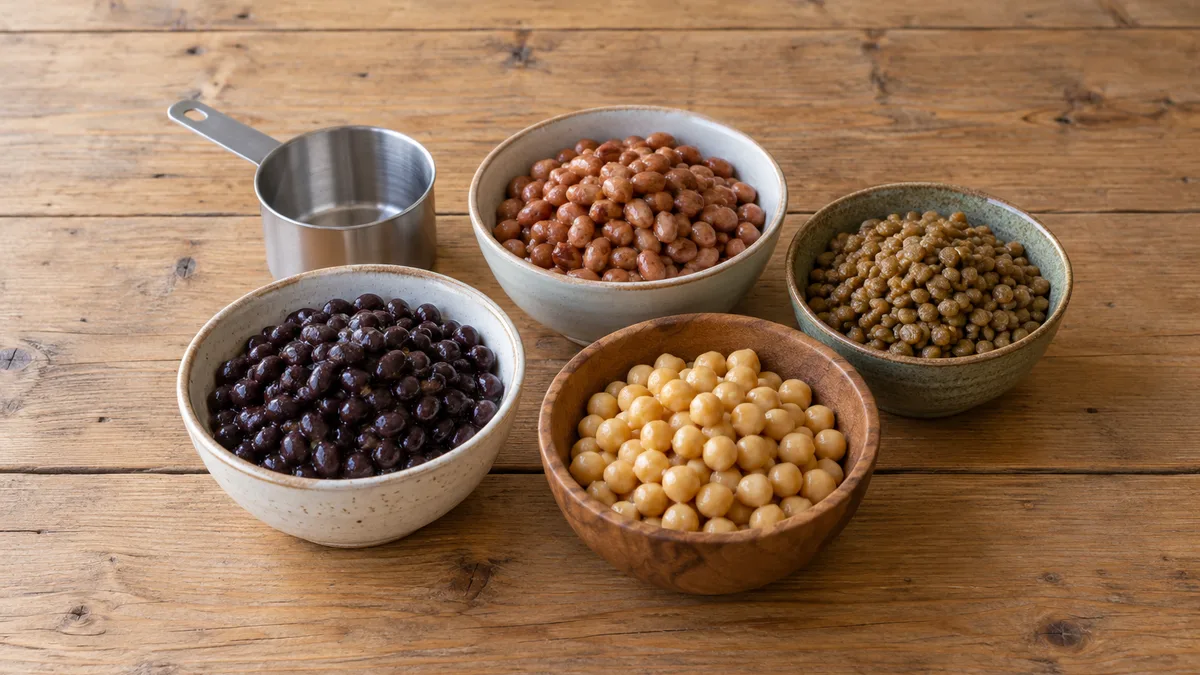
As of 5 October 2026, “BeanTok” is still running on TikTok and Instagram: creators eat two cups of beans a day and link it to gut health, weight loss and fewer sugar cravings. Beans are good food, but trials have not tested that dose. Participants in the meta-analyses below got roughly 130 g of cooked beans a day, about a third to two fifths of two cups.
Where the two cups come from
A review from the American Council on Science and Health dated 29 September 2026 describes the trend: creators eat two cups of beans a day and credit it with a healthier gut, weight loss and fewer sugar cravings. “Two cups” is a rule from videos, not a finding from trials. Here is what stands behind it.
The trend continues the conversation about fiber we covered in our article on fibermaxxing; beans have become its main character.
How many grams and calories
A “cup” in US videos is a measuring cup of about 240 ml. USDA FoodData Central lists a cup weight for each boiled, unsalted legume; doubling it and scaling the per-100 g values gives:
| Boiled, no salt | 2 cups, g | Energy, kcal | Fiber, g | Protein, g |
|---|---|---|---|---|
| Black beans | 344 | 454 | 29.9 | 30.5 |
| Pinto beans | 342 | 489 | 30.8 | 30.8 |
| Chickpeas | 328 | 538 | 24.9 | 29.1 |
| Lentils | 396 | 459 | 31.3 | 35.7 |
The calculation uses the cup weight from each entry (172, 171, 164 and 198 g), doubled. Canned beans, beans in sauce and beans cooked with salt will differ.
Two cups means 330–400 g of cooked food and 450–540 kcal. The fiber alone roughly equals the whole daily reference: EFSA considers 25 g of dietary fiber a day adequate for normal bowel function in adults. That is a reference point, not a ceiling or an assignment. Getting nearly all of it from one food suits a video and is not required for health.
What the research shows
Three of the promises can be checked against meta-analyses of randomized trials: fullness, weight and cholesterol.
Fullness. A pooled analysis of nine small trials with 126 participants found that meals with pulses produced 31% greater fullness over the following hours than comparable meals without them. It did not change how much people ate at the next meal. Participants were mostly young and healthy, and each trial was a single meal.
Weight. A meta-analysis of 21 trials with 940 participants found that diets containing pulses (median 132 g a day, median duration 6 weeks) ended 0.34 kg lighter than diets without them; the 95% confidence interval ran from 0.04 to 0.63 kg. That is statistically significant but small: a fraction of a kilogram over six weeks.
Cholesterol. A 2026 meta-analysis in the Journal of the American Heart Association covered 38 trials with 2,095 participants, a median of 130 g of pulses a day for 6 weeks. LDL cholesterol fell by 0.14 mmol/L. For beans, the dose-response is described up to one cup a day, with more beans giving a larger effect within that range.
The upshot: beans add fullness and slightly improve cholesterol, and over a few weeks they move body weight only a little.
Why the studied dose is smaller
The median in both analyses is about 130 g of cooked pulses, between half and two thirds of a cup. Two cups is two and a half to three times that. For beans the effect is described up to one cup a day; these analyses do not show what a second cup adds. A regular portion inside the tested range is closer to what was studied than the double dose from the videos.
If you rarely eat beans now
A large jump in fiber causes bloating and discomfort in many people. It is sensible to start with a small portion a couple of times a week and increase it as you tolerate it. If you have irritable bowel syndrome or a doctor-prescribed diet, discuss portions with your doctor: Monash University lists certain legumes among foods high in FODMAPs. More in our article on FODMAP.
Raw kidney beans are dangerous
Raw and undercooked beans contain the lectin phytohaemagglutinin. The FDA warns that at high levels, in raw beans, it causes nausea, severe vomiting and diarrhea. Soak dried beans for at least five hours, discard the water and boil them in fresh water for at least 30 minutes. Canned and properly cooked kidney beans contain too little to matter.
How to log beans
Dry and boiled beans are different entries with different calories per 100 g, because the beans absorb water as they cook. Weigh the food in the state you put on the plate and pick the matching entry. For canned beans use the label data and account for liquid and sauce. The conversion rules are in our article on weighing food raw or cooked.
Frequently asked questions
- How many grams are in two cups of beans?
- By USDA entries for boiled, unsalted legumes it is 328 to 396 g depending on the kind: a cup of black beans weighs 172 g, pinto 171 g, chickpeas 164 g, lentils 198 g.
- Do beans help with weight loss?
- A meta-analysis of 21 trials found diets with pulses ended about 0.34 kg lighter over 6 weeks. The effect is small and does not replace the overall diet.
- What portion of beans did the trials test?
- On average about 130 g of cooked pulses a day, between half and two thirds of a cup.
- Can I eat raw kidney beans?
- No. Soak dried beans for at least five hours, discard the water and boil in fresh water for at least 30 minutes. Canned beans are already processed.
Read next
- Fibermaxxing: what the high-fiber trend gets right—and where more is not better — Fibermaxxing is the 2026 search term for the idea of adding as much fiber to your diet as possible.
- Fiber: what it does in the gut and how much you need — We know that we "need more" fiber, but that is usually where the conversation ends: it is unclear what it physically does, why it causes bloating, and where the 25–30 grams per day recommendation comes from.
- High-fiber foods: a list and simple ways to add them to meals — You do not need bran or a specialty bar to get more fiber.
- FODMAP: what it is and who it is for — FODMAP is not a weight-loss diet or a list of harmful foods.
This article is for general information. It is not medical advice, a diagnosis, or a prescription for treatment or a diet, and it does not replace a consultation with your doctor. If you have a health condition, are pregnant, take medication, or follow a diet prescribed to you, decisions about food belong with your doctor.
Figures from regulations, guidelines and studies are given as they stood when this article was prepared and may since have changed; check them against the primary sources. This article is not advertising, an offer, or individual advice, and neither the author nor the site owner is responsible for decisions taken on the basis of it.