Diastasis or belly fat: why weight loss cannot solve every postpartum concern
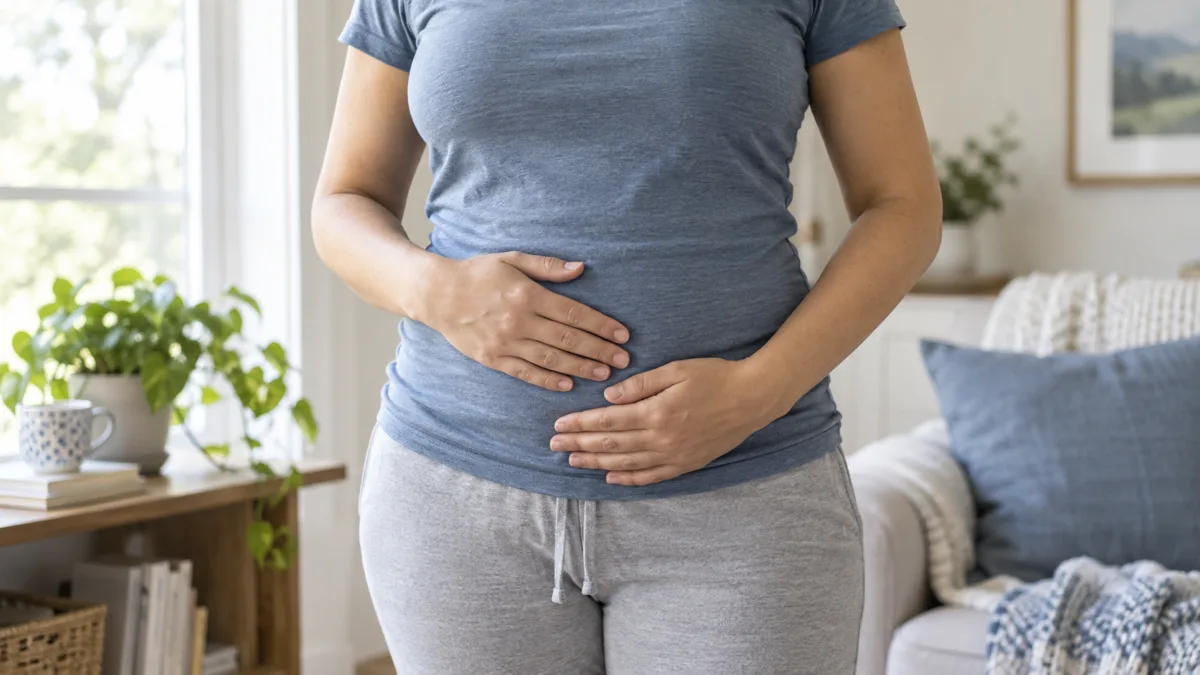
The shape of a postpartum abdomen does not reveal what is producing it. Under the skin may be fat, loose skin, and a changed abdominal wall; bloating can add volume, while a hernia can create a focal bulge. These causes may coexist and call for different responses. Weight loss can reduce fat, but it neither diagnoses nor by itself “closes” diastasis recti.
The same outline can come from different tissues
| What changes abdominal shape | What is happening | What weight loss changes |
|---|---|---|
| Subcutaneous and visceral fat | Stored energy lies beneath the skin and deeper inside the abdominal cavity | An overall energy deficit can reduce fat mass over time, but it cannot select where the change happens first |
| Diastasis recti | The linea alba between the rectus muscles widens and thins | Having less fat may change the outline, but it does not treat connective tissue |
| Skin | Skin may remain looser or form a different fold after stretching | A calorie deficit does not predictably remove excess skin |
| Bloating | Gas, bowel contents, or constipation change abdominal volume | Weight loss does not identify the cause; links with food, stool, and symptoms matter more |
| Hernia | Tissue passes through a defect in the abdominal wall, often making a focal bulge | Weight loss does not close the defect; it needs medical assessment |
A photograph or whether an abdomen feels “soft” or “firm” cannot reliably separate these conditions. Even a visible ridge along the midline during exertion does not establish its cause or size. Examination is not about judging appearance; it is about identifying anatomy and symptoms.
Diastasis is not a layer of fat and is not necessarily a hernia
The rectus muscles meet at a strip of connective tissue called the linea alba. It stretches during pregnancy and the distance between the muscles grows. The European Hernia Society (EHS) guideline proposes defining diastasis as a separation wider than 2 cm. The authors also stress that most of the evidence is low quality: the threshold gives clinicians a common language, but the measurement alone does not describe pain, function, or a need for surgery.
In diastasis, the linea alba is stretched but may have no hole through it. A hernia is a defect through which fat or part of an organ protrudes. The two can coexist, especially around the navel. A finger-width check at home may notice a reason to seek assessment, but it cannot rule out a hernia or choose treatment.
EHS considers clinical examination appropriate for diagnosis; calipers or ultrasound can measure the distance more precisely. Computed tomography is generally not used just to measure diastasis; a clinician may use it to assess a concurrent hernia or plan surgery.
The distance often decreases naturally during the first year
In a prospective study of 300 first-time pregnant women, researchers palpated the abdomen during pregnancy and after birth. Using a cutoff of at least two fingerbreadths, they found diastasis in 60.0% of those examined at 6 weeks, 45.4% at 6 months, and 32.6% at 12 months postpartum. At one year, nearly all cases in this sample were classed as mild.
Those percentages are not universal: 96% of participants were of European ethnicity, 178 of the original 300 attended the one-year examination, and finger palpation is not the same as a modern ultrasound criterion. The study shows a pattern of natural recovery but cannot predict one person's course. At one year, women with and without diastasis in this cohort reported lumbopelvic pain at similar rates, so the finding does not explain every postpartum pain.
What losing weight can and cannot do
If fat contributes to abdominal volume and a person wants to reduce it, the relevant process is loss of overall fat mass. Core exercise cannot instruct the body to take fat from the abdomen first; our guide to spot reduction and belly fat explains why. After childbirth, delivery method, healing, and complications determine when and how activity can resume; see our broader guide to postpartum weight changes.
A smaller waist does not prove that diastasis has resolved, and an unchanged outline does not prove someone is “failing” at weight loss. Fat, muscle tone, the linea alba, skin, and bowel contents can all change in the same abdomen. A scale combines them into one number and cannot identify which concern remains.
Bloating often varies within a day and may occur with gas, constipation, stool changes, or particular foods. That pattern can help someone describe the problem to a clinician, but it does not diagnose the cause. Recurrent pain, persistent distension, vomiting, blood in stool, or unexplained weight loss calls for medical assessment rather than a stricter diet.
Exercise may help function, but there is no universal program
A systematic review of exercise studies in the first postpartum year included 65 studies and 21,334 participants. Abdominal training produced a somewhat greater reduction in inter-rectus distance than no exercise, but the authors rated the certainty of this evidence as low. The studies used different exercises, schedules, and measurement methods, so the result does not identify one best program for everyone.
A narrower review of seven randomized trials involving 381 participants likewise rated the evidence for specific programs as low or very low. This does not mean movement is useless. It means a program should respond to function, pain, healing, breathing, and how the abdominal wall behaves under load—not to a promise to close a fixed number of centimeters within weeks.
EHS says physiotherapy may be considered before surgery but cannot recommend a specific regimen because evidence is limited. A pelvic-health or abdominal-wall physical therapist can assess the abdominal wall in movement and build a gradual program. A focal bulge, suspected hernia, marked pain, or substantial limits on daily activity also call for a medical assessment; a confirmed hernia or persistent functional symptoms may warrant an abdominal-wall surgeon's opinion.
When to seek urgent care
Diastasis itself is not usually an emergency. Urgency arises when a bulge could be a hernia and signs of strangulation or bowel obstruction appear. The NHS advises urgent help for pain around a hernia, nausea or vomiting, abdominal distension, constipation, or fever. Sudden severe pain, a firm tender bulge, skin color change over it, or inability to pass stool or gas needs emergency assessment.
Without emergency signs, the route is calmer: a clinician rules out a hernia and other causes of symptoms, a physical therapist assesses function, and any decision to reduce fat remains separate and voluntary. A postpartum abdomen does not have to meet a deadline or a target size to count as recovered.
Frequently asked questions
- Can you tell diastasis from belly fat by looking?
- No. Fat, a stretched linea alba, loose skin, bloating, and a hernia can create a similar outline and may coexist. Clinicians assess diastasis on examination and may use ultrasound or calipers for a more precise measurement.
- Will losing weight make diastasis go away?
- Reducing overall fat mass may change abdominal size and shape, but it does not treat a stretched linea alba. A change in appearance after weight loss proves neither resolution nor persistence of diastasis.
- Which exercises close diastasis recti?
- Research does not identify one universal program. Abdominal exercise may modestly reduce the distance, but certainty in the evidence is low. A program should be matched to function, symptoms, and stage of recovery with a qualified professional.
- When does an abdominal bulge need urgent care?
- Seek urgent assessment if it becomes firm or tender, the skin changes color, or it comes with sudden severe pain, nausea, vomiting, or inability to pass gas or stool. These can be signs of a trapped hernia or bowel obstruction.
Read next
- How to lose belly fat: what works and what doesn't — The search for "how to lose belly fat" almost always assumes that there is an exercise or product that targets this specific area.
- Postpartum weight: what goes away on its own and what requires effort — The first 5–7 kilograms are lost during childbirth and in the following weeks without any effort — this is the baby, amniotic fluid, placenta, and excess fluid.
- Visceral fat: why it matters and how to measure it — Two people at the same weight, with the same BMI, can carry very different metabolic risk.
- FODMAP: what it is and who it is for — FODMAP is not a weight-loss diet or a list of harmful foods.
This article is for general information. It is not medical advice, a diagnosis, or a prescription for treatment or a diet, and it does not replace a consultation with your doctor. If you have a health condition, are pregnant, take medication, or follow a diet prescribed to you, decisions about food belong with your doctor.
Figures from regulations, guidelines and studies are given as they stood when this article was prepared and may since have changed; check them against the primary sources. This article is not advertising, an offer, or individual advice, and neither the author nor the site owner is responsible for decisions taken on the basis of it.