Smoothie calories: count the glass and its add-ins
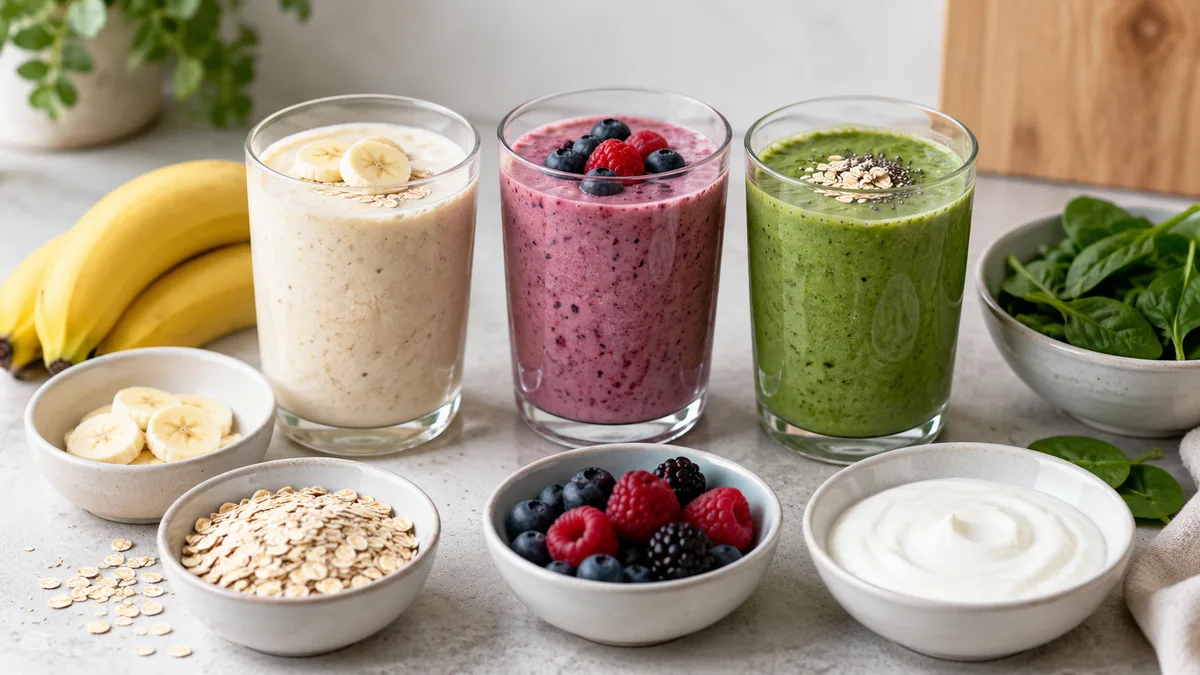
Count a smoothie from its ingredients and the portion you drink. Banana and berries with water, the same fruit with milk, and a mixture with oats and nuts have different totals, even when each looks like one glass.
Weigh the ingredients before blending
Put the blender jug on your scale, tare it, and add each ingredient separately. Weigh banana without its peel, strawberries without their stems, and nuts without shells. Record the edible parts that enter the jug. Water and ice change the mixture’s weight but add no calories.
Use the label on your milk, yogurt, plant drink or nut butter. Products with similar names can have different fat and added sugar contents. A label per 100 ml requires the volume you pour; a label per 100 g requires its weight. All quantities below are in grams, including the milk.
If you drink the entire mixture and leave nothing in the blender, record the sum of all ingredients. For a smaller serving, record the fraction you actually drink. The general method is explained in counting calories in home cooking.
Reference values for the three recipes
These values come from USDA FoodData Central SR Legacy records, accessed October 3, 2026. They describe the reference foods below, rather than your particular packaged products. Calories and grams of protein, fat and carbohydrate are per 100 g.
| Ingredient | kcal | Protein | Fat | Carbohydrate |
|---|---|---|---|---|
| Raw banana | 89 | 1.09 | 0.33 | 22.8 |
| Raw strawberries | 32 | 0.67 | 0.30 | 7.68 |
| Whole milk, 3.25% fat | 61 | 3.15 | 3.25 | 4.8 |
| Dry oats | 389 | 16.9 | 6.9 | 66.3 |
| Almonds | 579 | 21.2 | 49.9 | 21.6 |
The oat example uses the dry oats record. Replace it with your oat label when making the recipe. Energy comes directly from the source; there is no need to reconstruct it from rounded macros. USDA carbohydrate here is calculated by difference, which also limits direct comparisons with some Russian nutrition labels.
Strawberries, banana and water: 137 kcal
Use 100 g peeled banana, 150 g strawberries and 150 g drinking water. Wash and trim the berries, slice the banana, and blend until smooth. The assumed yield is 400 g if you transfer the whole mixture. This is a weight, not a promised glass volume.
Author’s calculation: 100 × 89 / 100 + 150 × 32 / 100 = 137 kcal. The whole mixture has about 2.1 g protein, 0.8 g fat and 34.3 g carbohydrate. Split evenly by weight into two 200 g servings and each has about 69 kcal.
More water leaves the 137 kcal total unchanged while reducing calories per 100 g. Compare recipes by the portion you drink: diluting a smoothie does not reduce its total energy when you drink all of it.
Banana and milk: 211 kcal
Blend 100 g peeled banana with 200 g milk, without other additions. The assumed yield is 300 g. The table gives 89 + 122 = 211 kcal, about 7.4 g protein, 6.8 g fat and 32.4 g carbohydrate.
Ice changes the temperature and weight while leaving the energy total unchanged. If you substitute yogurt or a plant drink, change that ingredient’s values rather than treating every pale drink as the milk in this table.
Banana, milk, oats and almonds: 415 kcal
Add 30 g dry oats and 15 g almonds to the previous recipe. Blend thoroughly and adjust the consistency with water. Without extra water, the assumed yield is 345 g. Count oats by their dry weight even if you soak them first.
Oats add 30 × 389 / 100 = 116.7 kcal and almonds add 15 × 579 / 100 = 86.85 kcal. The total is 414.55, rounded to 415 kcal. Macros for the whole mixture are about 15.6 g protein, 16.4 g fat and 55.5 g carbohydrate. Half contains about 207 kcal.
You can have this version as a meal if the portion suits you. Its calorie count does not predict exactly how long you will feel full. If you also eat breakfast afterwards, include that food instead of trying to endure hunger because of the recipe’s name.
Count honey, nut butter and partial servings
Record each addition separately. For example, if your honey label says 320 kcal per 100 g, 10 g adds 32 kcal. This is an illustrative label calculation, not a reference value for every honey. A heaped spoon and a level spoon have different weights.
For unequal portions, weigh the finished mixture and your share. If the batch weighs 600 g and you drink 240 g, your fraction is 240 / 600 = 0.4. Multiply the batch’s calories and each macro by that fraction. Stir before pouring so the thicker part does not remain at the bottom.
For a purchased smoothie, ask about size and ingredients. Syrup, juice and the dairy base may be invisible in a photo. A picture can help estimate the portion, but cannot recover hidden ingredients. See why AI makes numeric mistakes.
Frequently asked questions
- How many calories are in a banana smoothie?
- The example with 100 g banana and 200 g whole milk has 211 kcal for the entire mixture. A different drink or additions change the total.
- Can I have smoothies while losing weight?
- You can include them in your food intake. Calories depend on the recipe and serving; a smoothie is neither forbidden nor a promise of weight loss.
- Should I count water and ice?
- They add no calories but their weight matters when calculating per 100 g or dividing a batch by weight.
- How do I log half a smoothie?
- Divide calories and macros in half if portions are equal by weight. Otherwise multiply by your serving weight divided by the full mixture’s weight.
Read next
- How to count calories in homemade food — Processed foods are counted by the label, and restaurant meals by a reference guide.
- How to determine portion size without a scale — Portion weight is the most inaccurate variable in any calculation, including analysis by photo.
- Why AI confidently states incorrect figures — The unpleasant feature of machine responses is not that they can be incorrect—reference books and labels can be wrong too.
This article is for general information. It is not medical advice, a diagnosis, or a prescription for treatment or a diet, and it does not replace a consultation with your doctor. If you have a health condition, are pregnant, take medication, or follow a diet prescribed to you, decisions about food belong with your doctor.
Figures from regulations, guidelines and studies are given as they stood when this article was prepared and may since have changed; check them against the primary sources. This article is not advertising, an offer, or individual advice, and neither the author nor the site owner is responsible for decisions taken on the basis of it.