How many calories are in one, three or five khinkali?
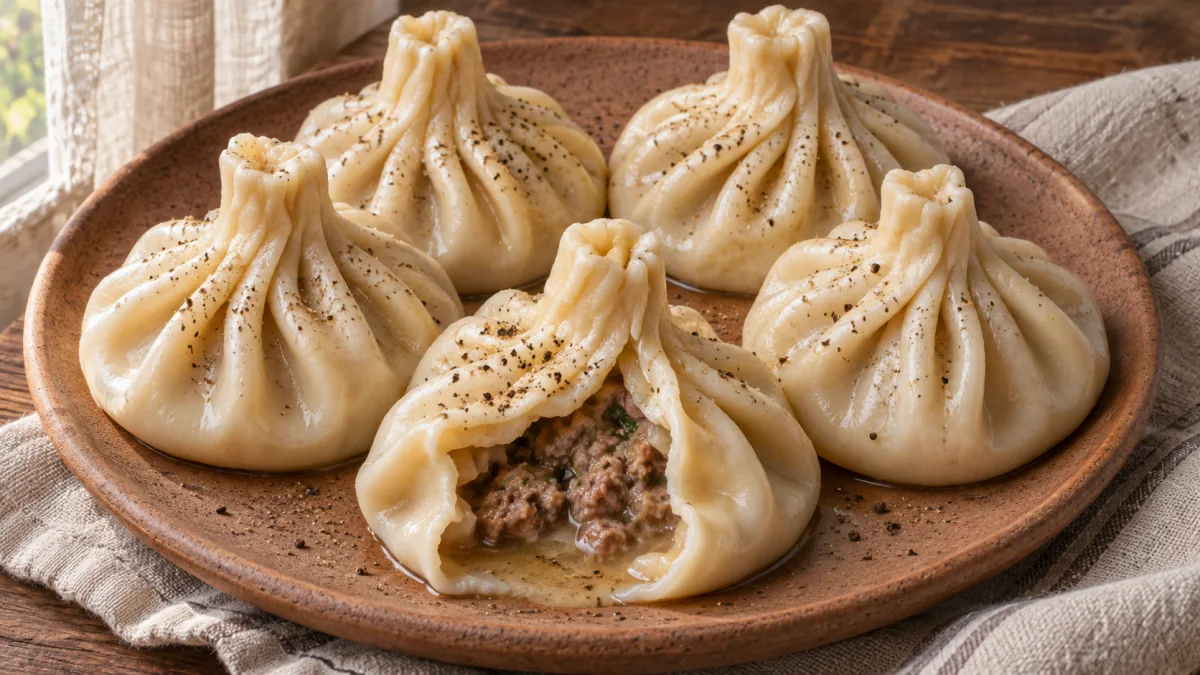
At 120 g apiece, a Tbilisi-style khinkali from Khinkali Club has about 244 kcal and a cheese dumpling has about 278 kcal. An order of five comes to about 1,218 or 1,392 kcal, respectively.
Calories by filling and number of dumplings
Khinkali Club’s nutrition guide lists calories per 100 g of cooked food. Tbilisi-style khinkali have 203 kcal per 100 g, cheese 232 and lamb 214. All three have a listed serving weight of 120 g. Multiply the figure for 100 g by 1.2, then by the number of servings. The table assumes one 120 g dumpling per serving and rounds only the final total.
| Filling | 1 dumpling, kcal | 3 dumplings, kcal | 5 dumplings, kcal |
|---|---|---|---|
| Tbilisi-style | 244 | 731 | 1,218 |
| Cheese | 278 | 835 | 1,392 |
| Lamb | 257 | 770 | 1,284 |
For a mixed plate, count each filling separately. Two Tbilisi-style dumplings and one cheese dumpling add up to (203 × 2 + 232) × 1.2 ≈ 766 kcal. When you split an order, you can log the fillings you actually ate.
How to use a menu with calories per 100 g
Find the weight of the whole order and the number of dumplings. Suppose four dumplings with the same filling weigh 320 g altogether. That makes the average weight 80 g. If this menu lists 220 kcal per 100 g, one dumpling has about 176 kcal and three have 528 kcal. For your own order, take both the weight and the calorie figure from the same menu.
If a menu lists calories for a whole plate, check how many dumplings it holds. Eating three of six identical dumplings gives you half the calories on that plate. If the sauce comes on the side, you can log your own share separately.
Broth, dipping sauce and leftover dough knots
The figure for a whole dumpling covers the wrapper, filling and broth inside it. If you finish the dumpling, the broth is already in your count. For a dipping sauce ordered on the side, count the amount you use.
If you leave the pinched knots of dough on the plate, the menu figure will slightly overestimate what you ate. The knots are all dough, so using the average calories per gram of a whole dumpling to subtract them would give only a rough adjustment. A simple food diary entry can record the number you ate and mention the leftover knots.
When a restaurant has no nutrition guide, use the khinkali reference entry as an estimate and scale it to your serving weight. The Georgian menu guide covers other dishes you might share with the table.
Frequently asked questions
- How many calories are in three meat khinkali?
- At 120 g per dumpling, three Tbilisi-style khinkali on the Khinkali Club menu have 731 kcal. Three lamb khinkali have 770 kcal. For another restaurant, check its serving weight and nutrition information.
- How do I count one khinkali from a frozen pack?
- Check whether the label describes the frozen or cooked product. If the values are for frozen khinkali, divide the net pack weight by the number of dumplings. Multiply that average weight in grams by the listed kcal per 100 g, then divide by 100.
- How many calories are in five cheese khinkali?
- Five 120 g cheese dumplings from this menu have 232 × 1.2 × 5 = 1,392 kcal. A different recipe or dumpling size will change the total.
Read next
- Menus in Georgia: what to order and how many calories it contains — Georgian menus are deceptive: half the items look like salads and appetizers but are closer to a main course in calories because of nuts and oil.
- How to count calories in a restaurant and with food delivery when there is no recipe — A home-cooked meal can be calculated by its ingredients, and packaged food can be checked on the label.
This article is for general information. It is not medical advice, a diagnosis, or a prescription for treatment or a diet, and it does not replace a consultation with your doctor. If you have a health condition, are pregnant, take medication, or follow a diet prescribed to you, decisions about food belong with your doctor.
Figures from regulations, guidelines and studies are given as they stood when this article was prepared and may since have changed; check them against the primary sources. This article is not advertising, an offer, or individual advice, and neither the author nor the site owner is responsible for decisions taken on the basis of it.