How many carbs do you need per day?
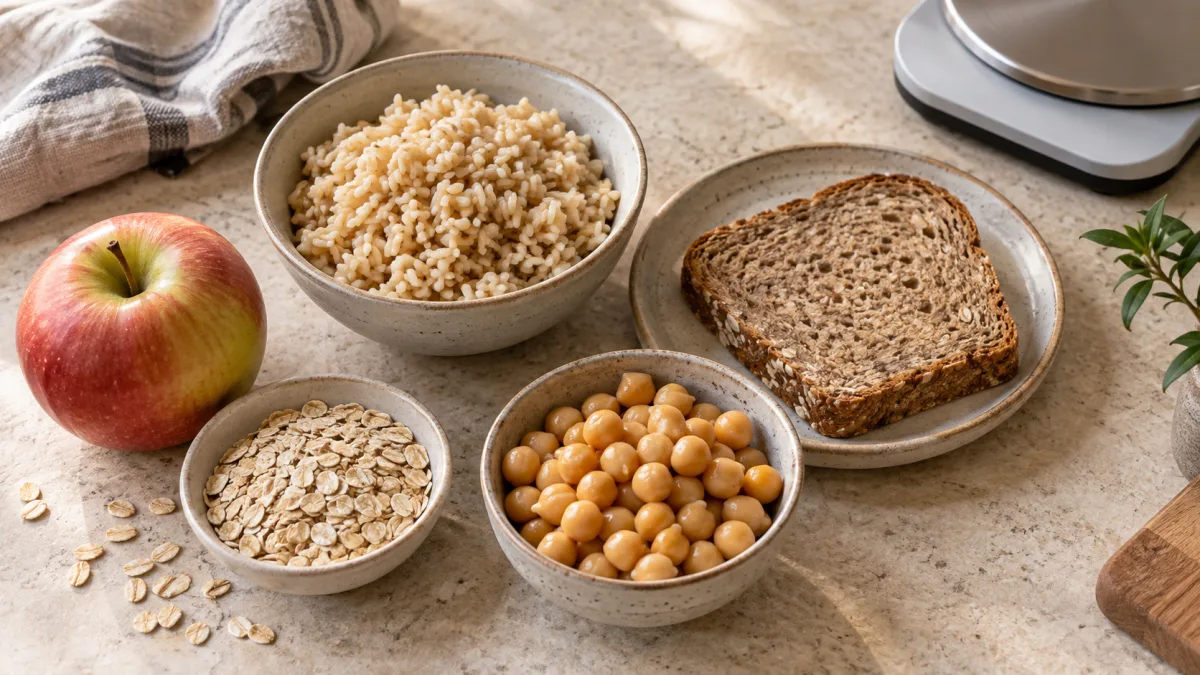
For an illustrative 2,000-calorie diet, the European reference range of 45–60% of energy works out to about 225–300 g of carbohydrates per day. For another calorie intake, multiply calories by the carbohydrate fraction and divide by four. The calculation is simple; choosing the right label entry takes a little more care.
Where the daily range comes from
EFSA sets a carbohydrate reference intake range of 45–60% of dietary energy for adults. This reference for healthy populations applies to the overall diet.
The North American Dietary Reference Intakes use a wider range, 45–65%, shown in Health Canada's reference table. This explains why otherwise credible guides can show different upper figures. The examples below use the EFSA range.
To estimate a personal amount, you first need an estimate of daily calorie needs. The same percentage produces different gram totals at different energy intakes. Our macro ratio guide covers the broader balance between protein, fat and carbohydrate. Here, the focus is converting a percentage into grams and counting those grams in food.
Convert a percentage into grams
The formula is carbohydrate grams = daily calories × carbohydrate fraction ÷ 4. Use 0.5 for 50%. Annex XIV of EU Regulation 1169/2011 assigns 4 kcal per gram to carbohydrate other than polyols. Fibre and polyols have different energy factors, so this planning calculation will not reproduce the calorie total on every label exactly.
| Illustrative calorie intake | 45% of energy | 50% of energy | 60% of energy |
|---|---|---|---|
| 1,800 kcal | 202.5 g | 225 g | 270 g |
| 2,000 kcal | 225 g | 250 g | 300 g |
| 2,200 kcal | 247.5 g | 275 g | 330 g |
| 2,400 kcal | 270 g | 300 g | 360 g |
These rows demonstrate the arithmetic; they do not prescribe a calorie intake. Decimal places let you check the calculations. For everyday planning, rounding 202.5 g to about 200 g is reasonable: an approximate estimate of energy needs does not justify adjusting a meal by a few crumbs.
For example, at 2,000 kcal and 50% carbohydrate: 2,000 × 0.5 = 1,000 kcal from carbohydrate; 1,000 ÷ 4 = 250 g. An app displaying 250 g means grams of carbohydrate across all the day's foods, not 250 g of rice or bread.
Calculate the carbs in your portion
Find the carbohydrate amount per 100 g on the label, then multiply it by your portion weight divided by 100. The following figures are hypothetical label values for a worked example. Substitute the figures on your own packaging when logging food.
| Example food | Assumed carbs per 100 g | Portion weight | Carbs in portion |
|---|---|---|---|
| Dry oats | 60 g | 50 g | 30 g |
| Bread | 40 g | 75 g | 30 g |
| Yogurt | 8 g | 150 g | 12 g |
| Packaged cooked rice | 28 g | 150 g | 42 g |
These four portions add up to 114 g of carbohydrate: 30 + 30 + 12 + 42. They demonstrate addition, rather than forming a day's meal plan. Other foods, drinks and additions to dishes also belong in the daily total.
Match the condition of the food to the database entry. If you weighed oats dry, use the dry-oat entry. For cooked porridge, use a matching prepared-food entry or calculate the ingredients. Count milk, fruit and sugar separately unless the selected entry already includes them.
Check the label's unit, too. In the FDA's sample lasagna label, one serving contains 34 g of carbohydrate and two servings contain 68 g. A per-serving figure only describes the whole package if that package contains exactly one serving.
Why the 275 g Daily Value is not a personal target
The FDA uses a Daily Value of 275 g for total carbohydrate on US labels. It provides the basis for the printed percentages, using a reference intake of 2,000 calories. That fixed figure helps people interpret labels; it does not account for an individual's energy needs.
The contents of the carbohydrate line also matter. US Total Carbohydrate includes dietary fibre, as shown in the FDA guide to Nutrition Facts. European labels distinguish carbohydrate and fibre under the definitions in Annex I of Regulation 1169/2011. Check which convention a tracking app uses before transferring a food from an imported package.
Do not automatically subtract fibre from every carbohydrate figure: the entry may already exclude it. Likewise, do not add the sugars line to total carbohydrate when sugars are listed as part of that total. You would count the same grams twice.
Use the result with your usual meals
Start with a familiar breakfast or lunch. Identify its carbohydrate sources, check the portion weights and choose matching entries. Practising on one meal makes it easier to spot confusion between a serving and a per-100-g value before calculating a whole day.
The gram total does not describe everything about the food. The same carbohydrate amount can come from different ingredients, so consider fibre and variety separately. Our guide to fast and slow carbohydrates explains sugars, starch and what those everyday labels mean.
The formula cannot produce a separate mandatory target for weight loss or for women. It converts a calorie intake and a percentage into grams. It also does not determine fuelling during prolonged exercise; that has its own guide to carbohydrates during exercise.
If you have diabetes, are pregnant, have an eating disorder or follow prescribed dietary treatment, discuss carbohydrate intake with your clinician. Do not use this adult table as an individual plan for a child. If tracking makes you anxious around food, ask a qualified professional about a more suitable way to manage meals.
Frequently asked questions
- How many carbs per day does a 2,000-calorie diet contain?
- Using the EFSA range of 45–60% of energy gives about 225–300 g. Calculate the ends as 2,000 × 0.45 ÷ 4 and 2,000 × 0.60 ÷ 4. This is a reference range, not a personal prescription.
- How do I calculate daily carbohydrate grams?
- Multiply daily calories by the carbohydrate fraction and divide by four. For example, 2,200 kcal × 0.5 ÷ 4 = 275 g.
- Does 250 g of carbs mean 250 g of food?
- No. It means the carbohydrate contained within all the foods you eat. If a hypothetical bread label lists 40 g of carbohydrate per 100 g, a 75 g portion of that bread provides 30 g of carbohydrate.
- Should I subtract fibre from carbohydrate?
- Check the label convention and your tracking field first. US Total Carbohydrate includes fibre, while European labels list it separately from carbohydrate. Automatic subtraction can produce an incorrect entry.
- Why do guides give both 45–60% and 45–65%?
- They refer to different systems: EFSA uses 45–60%, while North American Dietary Reference Intakes use 45–65%. Check which source a guide is using.
Read next
- Macro ratio: where percentages come from and what to change first — Proportions like "30/30/40" look like an optimal formula someone has discovered.
- Fast and slow carbohydrates: what lies behind this classification — The classification of carbohydrates into fast and slow is older than the data it is supposed to be based on.
- Carbohydrates during long workouts: when food is needed during exercise — Gels, isotonic drinks, and bars on the course solve one problem — preventing fuel from running out where it is truly needed.
This article is for general information. It is not medical advice, a diagnosis, or a prescription for treatment or a diet, and it does not replace a consultation with your doctor. If you have a health condition, are pregnant, take medication, or follow a diet prescribed to you, decisions about food belong with your doctor.
Figures from regulations, guidelines and studies are given as they stood when this article was prepared and may since have changed; check them against the primary sources. This article is not advertising, an offer, or individual advice, and neither the author nor the site owner is responsible for decisions taken on the basis of it.