Red light and photobiomodulation: where the trials are, and where it's just a lamp
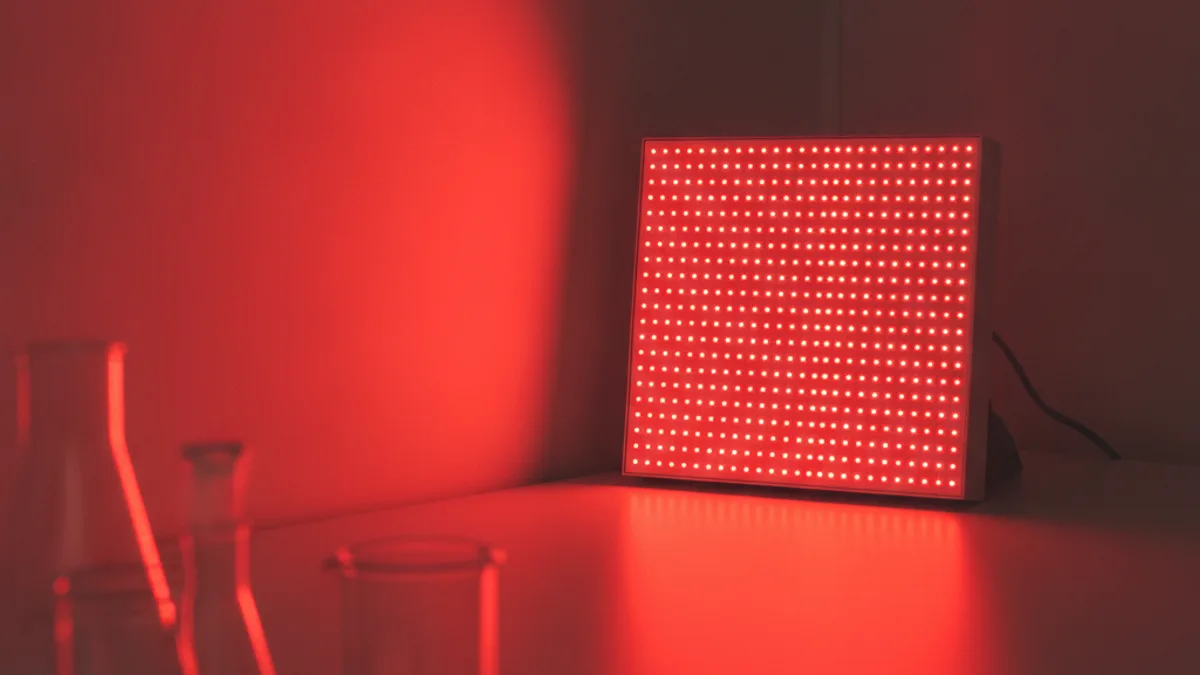
Photobiomodulation is the application of red and near-infrared light. The method has randomized trials, which distinguishes it from most topics in this section. However, these trials were conducted for specific conditions, with specific wavelengths and doses, while home panels are sold under the general promise of "cellular energy".
What the mechanism is assumed to be
The main hypothesis: light in the range of approximately 600–1000 nanometers is absorbed by cytochrome c oxidase, an enzyme in the mitochondrial respiratory chain. Subsequent descriptions involve shifts in ATP production and signaling pathways.
The hypothesis is well-developed, but it explains why an effect is possible, not that it exists. What actually lies behind the word "mitochondria" in such advertising is covered in the article on mitochondria and cellular energy.
Where the trials actually exist
The most well-developed area is not sports or aging, but ophthalmology. A multicenter randomized trial in children with myopia compared repeated sessions of low-intensity red light with standard glasses. Out of 264 randomized participants, 246 were analyzed. Over 12 months, axial elongation was 0.13 mm in the light group versus 0.38 mm in the control group, and refractive progression was −0.20 versus −0.79 diopters. Publication in Ophthalmology.
The second area is healing. A randomized controlled trial of photobiomodulation with red and infrared LED light for diabetic foot ulcers describes an effect on healing — Lasers in Medical Science.
Note the nature of the indications: a specific condition, a specific device, a controlled dose, and medical supervision.
What is known about safety
Even in the most studied area, the question is not closed. A systematic review of the safety of repeated red light sessions for myopia included 20 studies and 2,380 participants aged 3 to 18, of whom 1,436 received the procedure. No irreversible vision loss or structural damage was identified; two reports of reversible decreased visual acuity with changes on optical coherence tomography were described, which completely disappeared four months after cessation. The most common effect is temporary afterimages in the visual field.
The authors separately point to the need for fundus examination and tomography before and during therapy, and that long-term safety requires larger and longer studies. The median duration of the included works was 9 months. Review in Asia-Pacific Journal of Ophthalmology.
Later, JAMA Ophthalmology published a study on changes in cone density after such treatment in children — publication here. In other words, even where efficacy is shown, safety continues to be studied.
How a home panel differs from a research device
In three ways, and each one breaks the transfer of results.
- Wavelength. In studies, it is set and verified. In a consumer device, it is claimed by the seller.
- Dose. The effect in this field is described as biphasic: too little has no effect, too much may have the opposite effect. The dose is calculated in joules per square centimeter and depends on power, distance, and time. On a home panel, all three values are unknown.
- Indication. Trials were conducted for myopia, ulcers, and specific skin conditions. "Recovery" and "energy" are not on this list.
Why it is especially easy to mix layers here
Photobiomodulation is a rare case for this section where the method is not made up: it has a mechanism, randomized trials, and regulatory-approved applications. But that is precisely why it is important not to mix the layers. The existence of trials for myopia in children says nothing about a panel in the bedroom bought for post-workout recovery.
A general way to analyze such claims — one by one, rather than as a package — is described in the article on biohacking in general.
Frequently asked questions
- What is photobiomodulation?
- Exposure to red and near-infrared light, approximately 600–1000 nanometers. The primary hypothesis for the mechanism is the absorption of light by cytochrome c oxidase in the mitochondria.
- For which indications are there randomized trials?
- Ophthalmology is the most well-studied area: in a multicenter trial involving children with myopia, eye elongation over 12 months was 0.13 mm compared to 0.38 mm in the control group. There are also trials regarding wound healing, specifically for diabetic foot ulcers.
- Is red light safe?
- A systematic review of 20 studies with 2,380 participants found no irreversible vision loss or structural damage. Two reports of reversible visual acuity reduction have been described. The authors note that long-term safety requires larger and longer-term studies.
- Does a home panel work the same way as a device used in a study?
- Extrapolating the results is not justified: the wavelength of a consumer device is claimed by the seller, the dose in joules per square centimeter is unknown, and the indications in the trials were specific—myopia, ulcers, and certain skin conditions.
- Can too much light harm the effect?
- In this field, the effect is described as biphasic: an insufficient dose has no effect, while an excessive dose may have the opposite effect. The dose depends on the device's power, distance, and session duration.
Read next
- Mitochondria: what lies behind the term "cellular energy" in supplement marketing — Mitochondria are organelles where oxygen and nutrients are converted into ATP.
- Biohacking: separating what has been tested from what is being sold — There is no definition of biohacking that two people would both sign.
- Testing it on yourself: telling an effect apart from noise — Trying something on yourself is the only available way to find out whether it works for you specifically.
This article is for general information. It is not medical advice, a diagnosis, or a prescription for treatment or a diet, and it does not replace a consultation with your doctor. If you have a health condition, are pregnant, take medication, or follow a diet prescribed to you, decisions about food belong with your doctor.
Figures from regulations, guidelines and studies are given as they stood when this article was prepared and may since have changed; check them against the primary sources. This article is not advertising, an offer, or individual advice, and neither the author nor the site owner is responsible for decisions taken on the basis of it.