The microbiome and food: what a diet actually changes
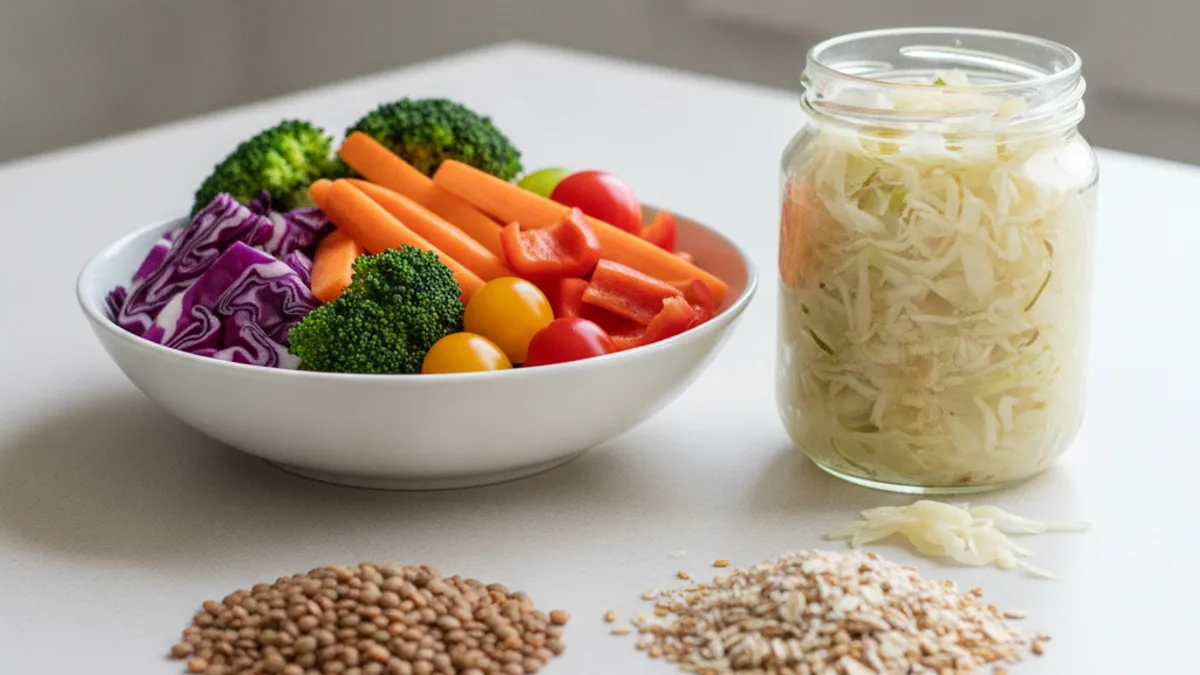
Gut bacteria respond to a change of diet within days. That is measured and not in dispute. The gap opens afterwards: between "the community shifted" and "the person is better off" lies a distance the research has not yet crossed and the market already has.
What is there to change
The large intestine hosts a community of hundreds of bacterial species, individual enough that no two people match. Its main job from a nutritional standpoint is digesting what human enzymes cannot — plant fibres above all.
The products of that digestion are short-chain fatty acids, butyrate in particular. Some are used by the cells lining the gut, some enter the bloodstream. This is the one link in the topic described in enough detail to lean on.
How fast it responds
Fast. In a study switching participants to entirely animal-based or entirely plant-based diets, the community changed within days and returned to its previous state after the experiment ended.
Two things follow, and usually only the first gets quoted. First: diet genuinely shapes the microbiome. Second: the shaping is reversible and lasts exactly as long as the diet does. The idea of "seeding good bacteria once" does not fit that dynamic.
Fibre and fermented foods
The most informative work of recent years compared two approaches head to head: a diet high in plant fibre against one high in fermented foods. The result was asymmetric: community diversity increased in the fermented-food group along with a drop in several inflammatory markers, while the fibre group showed a more complicated picture that depended on the microbiome each participant started with.
That is what a real finding looks like in this area: not "eat this" but "the response depends on where you started". The standard caveats apply — around forty participants per group, several weeks, markers rather than disease rates.
The general case for fibre is unaffected and rests on other grounds, set out in fibre and digestion. Variety of plant sources matters more here than any single product: the community eats what arrives, and a monotonous diet feeds it monotonously.
Probiotics: what they do and what they do not
A probiotic is live microorganisms in a capsule or a food. The key fact is that they generally do not colonise. They pass through, may influence the community and the gut lining while they keep arriving, and disappear once the supply stops.
The evidence base is uneven and strain-specific: a result obtained for one strain in one condition does not transfer to another strain in another condition. "Probiotics are good for you" is about as informative as "medicines help".
Prebiotics are not bacteria but food for them: certain fibres and oligosaccharides. The logic there is cleaner and the side effect predictable — increase the amount suddenly and gas production rises, because the community is handed more substrate than it is used to.
Where the selling starts
| Claim | What sits behind it |
|---|---|
| "Diet changes your microbiome" | Demonstrated; the changes are reversible |
| "Diversity is a marker of health" | An association; cause and effect are unresolved |
| "A test will tell you your foods" | The step from composition to advice has not been made |
| "This probiotic will colonise your gut" | Colonisation generally does not occur |
| "The microbiome determines body weight" | Differences are described; the direction is unknown |
The third row is about consumer tests and is covered separately in how accurate microbiome tests are: two samples from one person often disagree, and the science has not reached the point of turning a composition into personal food advice.
The last row is the most-quoted part of the topic. Differences in community composition between people of different body weight are real. But a person carrying excess weight eats differently, and diet shapes the microbiome — so the observation reads equally well in both directions.
What can be taken from this
A modest residue that requires no purchases: more plant sources of fibre and more variety among them, fermented foods as a reasonable addition, changes introduced gradually. All of it makes sense without invoking the microbiome at all — such a diet is simply better for other reasons.
What cannot be taken from it is a personalised food list "for your microbiome" or a promise about body weight delivered through bacteria. The science here is still describing the picture rather than issuing instructions; sellers are working ahead of it.
Frequently asked questions
- How quickly does diet change gut bacteria?
- Within days. In a controlled study, switching to an entirely animal-based or plant-based diet changed the community almost immediately, and it returned to its previous state once the experiment ended.
- Do probiotics colonise the gut?
- Generally not. They pass through and may influence the community while they keep arriving, then disappear after intake stops. Effects are strain-specific and do not transfer between products.
- Which is better, fibre or fermented foods?
- In the trial that compared them, diversity increased in the fermented-food group, while the response to fibre depended on the microbiome each participant started with. No single answer for everyone follows from that.
- Does the microbiome determine body weight?
- Differences in composition between people of different body weight are described, but the direction of the relationship is unresolved: diet shapes the microbiome, and diets differ between those groups.
- Is a microbiome test worth taking?
- As a source of personalised food recommendations, no: reproducibility is limited and the step from community composition to advice has not been made.
Read next
- Fiber: what it does in the gut and how much you need — We know that we "need more" fiber, but that is usually where the conversation ends: it is unclear what it physically does, why it causes bloating, and where the 25–30 grams per day recommendation comes from.
- Microbiome tests: why two samples give different answers — An at-home microbiome test looks like a standard lab analysis: a test tube, a laboratory, and a report with percentages and a list of foods.
- Ultra-processed food: what lies behind the NOVA classification — There is a lot of writing about ultra-processed food right now as if the matter is settled: there is bad industrial food and good homemade food.
This article is for general information. It is not medical advice, a diagnosis, or a prescription for treatment or a diet, and it does not replace a consultation with your doctor. If you have a health condition, are pregnant, take medication, or follow a diet prescribed to you, decisions about food belong with your doctor.
Figures from regulations, guidelines and studies are given as they stood when this article was prepared and may since have changed; check them against the primary sources. This article is not advertising, an offer, or individual advice, and neither the author nor the site owner is responsible for decisions taken on the basis of it.