Microbiome tests: why two samples give different answers
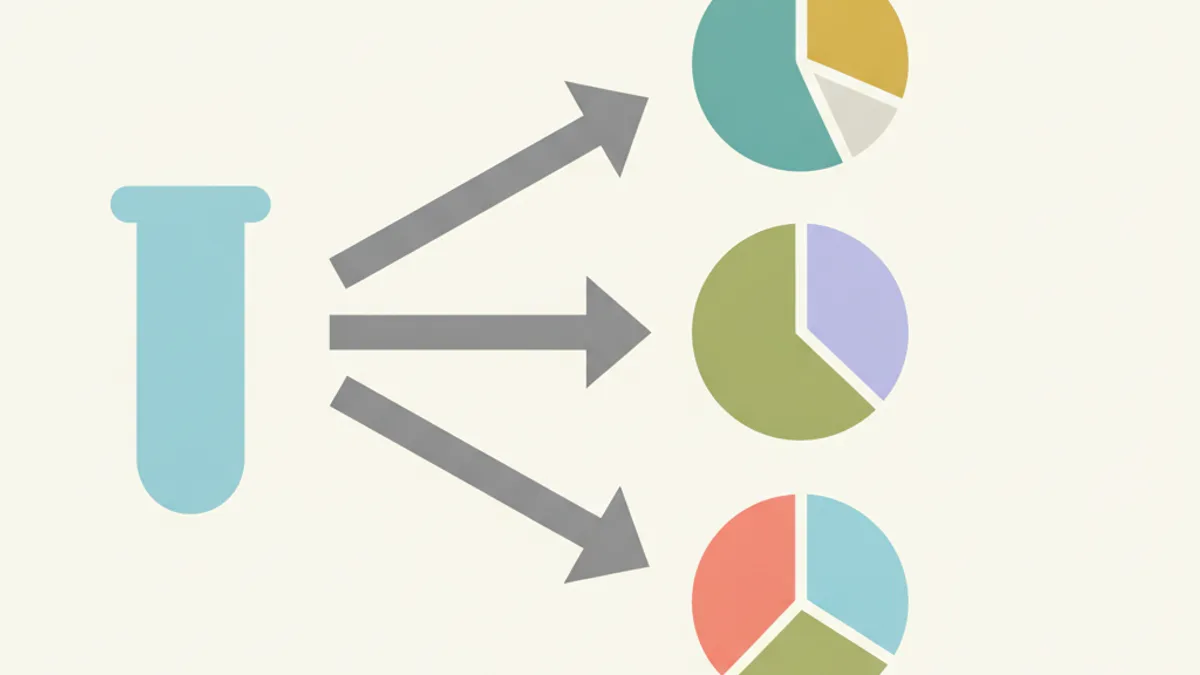
An at-home microbiome test looks like a standard lab analysis: a test tube, a laboratory, and a report with percentages and a list of foods. Testing these services has revealed an inconvenient truth — the discrepancy between companies for the same sample is comparable to the difference between different people. Understanding where this comes from is more useful than arguing about the benefits of probiotics.
What happens to the sample
The process is roughly the same for all services: DNA is extracted from the sample, specific segments are amplified, read by a sequencer, and the resulting sequences are compared against a database of microorganisms. A picture of "who is there and how many" is then constructed.
Differences between services begin at every step. You can read one short gene segment common to bacteria—this is cheap, but it mainly distinguishes large groups rather than individual species. You can read everything—this is more expensive and detailed. The databases used for comparison also differ, as do the algorithms for calculating proportions.
From this comes the first practical conclusion: the "microbiome composition" is not a measurement like body weight, but the result of a pipeline. Changing any link in the chain changes the numbers.
How much results diverge
This has been tested directly by sending comparable samples to different consumer services. An evaluation of the analytical characteristics of such services found significant discrepancies both within a single service and between services, with the variation between providers being comparable to the biological differences between different people. The authors attribute this to differences in methodology and a lack of quality control.
Natural variability also adds to this. An analysis of microbiome variability lists factors that shift the composition on their own: diet, medications, time of day, and environment. The picture changes both between people and within the same person from day to day.
Furthermore, the collection of material itself differs: the same study noted that services define differently what to collect, how to collect it, and in what solution to transport it. This is not a minor detail—the method of collection determines which microorganisms arrive alive and in what proportion.
Why it is difficult to derive advice from composition
Suppose the composition is determined correctly. To turn it into a recommendation, you need to know two things: what composition to consider good and exactly how to shift it through diet. Both are less understood than the report implies.
There is no standard. Healthy people vary greatly in composition, and a single "correct" microbiome has not been described. The claim that "you have low levels of bacteria X" is based on a comparison with the company's own sample set, not a standard norm.
The direction of causality is unclear. Many links between composition and health status are observational: it is unclear whether the composition affects health or vice versa.
Shifting composition through diet is poorly predictable. The reaction of the composition to a specific food is individual, and it is often impossible to replicate it in another person.
However, one recommendation from these reports has a reliable basis, though it is not personalized: a diverse plant-based diet and sufficient fiber. This holds true even without a test—the mechanism is explained in the article on fiber.
How to distinguish research from marketing
- The report labels bacteria as "bad" or "good." This classification is oversimplified: the role of many species depends on the context and neighboring organisms.
- The report leads to the purchase of a supplement from the same brand. A test that leads to a sale should be read with this in mind.
- Diagnoses and risks are named. A consumer test is not a diagnostic tool; gastrointestinal complaints are a reason to see a doctor, not to change your yogurt.
- A "personalized list of foods" is promised. Ask what study the correlation between "this composition" and "this list" is based on.
- There is no mention of repeatability. A reputable report will state that the result changes from day to day.
Who might find the test useful
As a research tool, microbiome sequencing works and provides a lot of data. As a consumer service, it is useful in two cases: if you are interested in it for its own sake, with the understanding that it is a snapshot of one day using one method, and if the result is used as a motivation to eat more plant-based foods—though that same motivation is available for free.
For practical tasks regarding weight and nutrition, the foundation is different: the amount consumed, the composition of the diet, and consistency. For how this looks without the exotic elements, see the articles on dietary habits and the impact of diet on health.
And the same limitation applies as with any home test: in the case of persistent symptoms—pain, weight loss, changes in bowel habits—you need a doctor and standard medical tests, not an extended report on bacteria.
Frequently asked questions
- How accurate are at-home microbiome tests?
- Testing consumer services revealed significant discrepancies both within a single service and between different ones: the variation between providers proved comparable to the biological differences between different people. The reason lies in differences in methodology and a lack of quality control.
- Why does a repeat test give a different result?
- The composition of the microbiome changes on its own—due to diet, medications, time of day, and environment. Added to this are differences in the method of collection and transport of the sample, which determine which microorganisms reach the laboratory and in what proportions.
- Is there a "correct" microbiome composition?
- No single standard has been described: healthy people differ significantly from one another. The statement "you have low levels of such-and-such bacteria" is based on a comparison with the company's own sample group, not with an established norm.
- Can a test be used to create a personal diet?
- There is little basis for this: the reaction of the composition to a specific product is individual and poorly reproducible. The only reliable recommendation from such reports—a varied plant-based diet and sufficient fiber—is true even without a test.
- When should you see a doctor for intestinal complaints instead of taking a test?
- In the case of persistent symptoms—pain, weight loss, changes in bowel habits, blood—standard tests and an examination are necessary. A consumer microbiome test is not a diagnostic tool and does not identify such conditions.
Read next
- DNA test "tailored to your genome": what is known about nutrition based on genes — The promise sounds convincing: a saliva sample, two weeks of waiting, and a diet tailored to your heredity.
- Fiber: what it does in the gut and how much you need — We know that we "need more" fiber, but that is usually where the conversation ends: it is unclear what it physically does, why it causes bloating, and where the 25–30 grams per day recommendation comes from.
- Glucose monitoring without diabetes: what the sensor on your arm shows — A coin-sized sensor on the shoulder and a blood sugar graph on a phone are no longer exclusive to diabetes: people without a diagnosis are using them to "understand their reaction to food.
This article is for general information. It is not medical advice, a diagnosis, or a prescription for treatment or a diet, and it does not replace a consultation with your doctor. If you have a health condition, are pregnant, take medication, or follow a diet prescribed to you, decisions about food belong with your doctor.
Figures from regulations, guidelines and studies are given as they stood when this article was prepared and may since have changed; check them against the primary sources. This article is not advertising, an offer, or individual advice, and neither the author nor the site owner is responsible for decisions taken on the basis of it.