Crab sticks: what surimi means and how to read the label
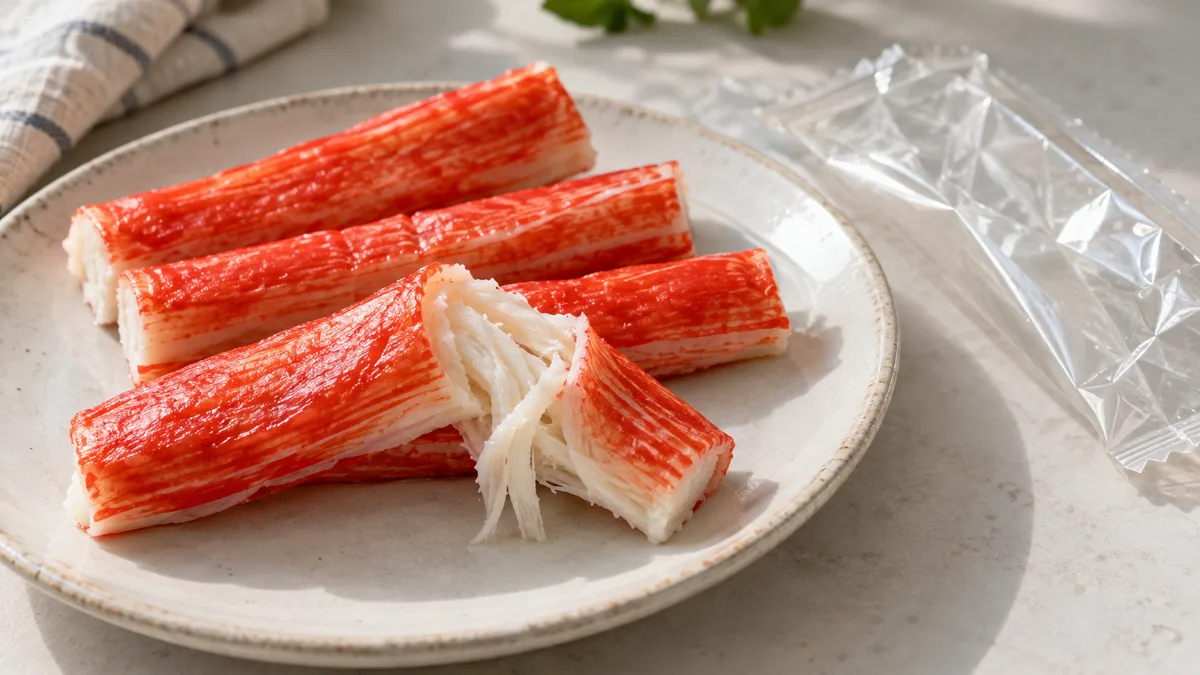
Choose crab sticks using the label on the particular pack: the fish base, its proportion, the other ingredients and the nutrition information. The word “crab” alone does not tell you whether crab meat is inside.
Surimi is the fish base, not the finished stick
Manufacturer VIČI describes surimi as a product made from minced white fish fillets. Manufacturers use this base with other ingredients to make finished products. “Surimi”, “fish mince” and the protein entry in the nutrition table therefore answer different questions: what the product is made from and how much of each nutrient it contains.
First find the full product name near the ingredients. If you specifically want crab meat, look for it in the ingredient list. A picture of a crab, a range name and flavour claims are not enough for that choice. For a salad using familiar seafood sticks, check the fish base and the additions listed on your pack.
How to read the surimi percentage
The VIČI catalogue, checked on 9 October 2026, lists Classic products with 28% surimi, Classic with 41%, and sticks with 50%. These are examples of specific products for different markets, not a range covering all crab sticks. Do not assign a website figure to a similar pack: check the exact name and label.
| Label entry | What it tells you | What it does not tell you |
|---|---|---|
| “Surimi 41%” | The declared proportion of that ingredient | 41 g of protein per 100 g |
| Protein, g per 100 g | Protein in the finished product | The exact proportion of fish mince |
| “Crab flavour” | The declared flavour | The amount of crab meat |
If no percentage is given, do not calculate it from the ingredient's position. Under EAEU food labelling regulation TR TS 022/2011, part 4.4, ingredients generally appear in descending order of their weight at manufacture. First place gives an order, not an exact figure. The order inside brackets describes the compound ingredient rather than the whole pack.
What an actual ingredient list shows
The manufacturer's specification for VICI frozen surimi chunks S CHU 025, dated 9 March 2023, lists 41% surimi, water, rehydrated egg white, starch containing wheat, vegetable oil and soy protein. Sugar, salt, flavouring containing crustaceans, modified starch and food additives follow.
This document covers surimi chunks for the Benelux market, not every stick sold under this brand. It shows why the full list matters: a fish product can contain other protein ingredients, and flavouring can contain crustaceans. The word “imitation” does not establish that those ingredients are absent.
Compare the same characteristics. If you want a larger declared proportion of surimi, compare percentages. If you want protein in your serving, use the nutrition table. If you are choosing a product without a particular ingredient, check the whole list and the notes after it. A single “good ingredients” score cannot answer all these questions.
Check allergens before buying
The specification above identifies fish, crustaceans, egg, soy and cereals containing gluten. This list applies to that particular product. If you have a food allergy, check your entire pack, including possible traces, and follow your doctor's advice.
TR TS 022/2011 requires the allergenic ingredients listed in the regulation to be declared regardless of their amount. Food additives are identified by their technological function and name or index. “Colour” and “stabiliser” therefore help explain the function; counting E numbers alone does not tell you whether a product suits you. See the article on E numbers in ingredients.
How to compare two packs at the shelf
- Check the product type: plain sticks, chunks, a filled product or one with sauce.
- Read the fish base and its proportion, if stated.
- Check the ingredients that matter to you and the allergen information.
- Compare protein, fat, carbohydrate and calories for the same weight.
- Check the expiry date and storage instructions, including those after opening.
For a diary entry, use the weight of the sticks you ate without their wrappers. The calculation is: value per 100 g × serving weight / 100. If your label says 120 kcal and 8 g protein per 100 g, a 75 g serving gives 90 kcal and 6 g protein. This is a worked example, not the category average.
Count the other salad ingredients and dressing separately. Keep a photo of the ingredients and nutrition before discarding the pack so you can check the entry. The article on comparing two products by label explains the comparison process in more detail.
Frequently asked questions
- What is surimi in crab sticks?
- It is a fish base made from minced fillets. The finished product may also contain water, starch, protein ingredients, oil, salt and other components. Check the exact ingredients on your pack.
- Do crab sticks contain crab meat?
- Check the ingredient list for the specific product. The name and picture do not state an amount. Flavouring can contain crustaceans even in a surimi product.
- Does 41% surimi mean 41% protein?
- No. It is the proportion of an ingredient. Protein in the finished product is listed separately in the nutrition information.
- Can I find the surimi percentage if it is not stated?
- The ingredient order does not give an exact percentage. Compare the information the manufacturer actually provides: ingredients and nutrition.
- How do I calculate the calories in the sticks I ate?
- Multiply the calories per 100 g on your pack by the serving weight without wrappers, then divide by 100. Count other salad ingredients and dressing separately.
Read next
- How to compare two products by their labels: six steps with a worked example — Two nutrition tables are comparable only when they describe the same weight, the same state of the product and the same units.
- How to read the ingredients list on a label: the rules governing its writing — A label looks like a list of words from which everyone reads something different: one person considers a long list of ingredients a red flag, another looks for E numbers.
- E-numbers in ingredients: how the code is structured and what it means — An ingredient list contains E330, and it is impossible to tell from this code whether it is citric acid or something better to avoid.
- Barcode ingredient scanners: what they show and how to check a product — An ingredient scanner looks up a product by barcode and displays information found in its sources or read from the label.
This article is for general information. It is not medical advice, a diagnosis, or a prescription for treatment or a diet, and it does not replace a consultation with your doctor. If you have a health condition, are pregnant, take medication, or follow a diet prescribed to you, decisions about food belong with your doctor.
Figures from regulations, guidelines and studies are given as they stood when this article was prepared and may since have changed; check them against the primary sources. This article is not advertising, an offer, or individual advice, and neither the author nor the site owner is responsible for decisions taken on the basis of it.