School lunchbox: what to pack
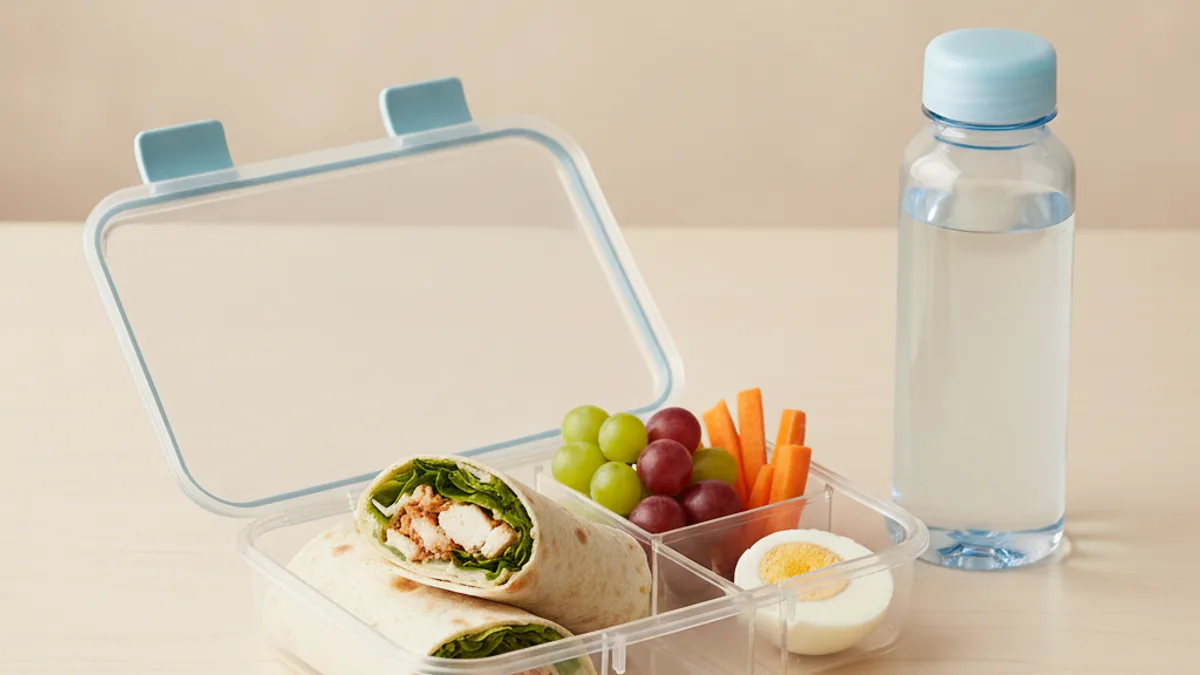
A lunchbox is tested not at home, but during the break: the child has ten to fifteen minutes, there is no refrigerator, no knife or fork, and the backpack has already fallen twice. Everything else is secondary.
Three requirements that everything follows
Stays fresh without a refrigerator until lunch. A lunchbox spends four to five hours at room temperature in the morning, sometimes near a heater. This is exactly the range where bacteria multiply the fastest.
Eaten in ten minutes with one hand. The break is short, and half of it is spent walking to the cafeteria and back. Anything that requires utensils, a plate, and focus will come home untouched.
Does not leak. Sauce, sour cream, and wet vegetables in the same compartment as bread will result in something inedible by the third period.
Assembly scheme
Four slots; fill them with whatever you have at home.
| Slot | Options | Purpose |
|---|---|---|
| Protein | Boiled egg, pieces of baked chicken, cheese, cream cheese, tuna, chickpeas | Keeps you full until the end of classes |
| Carbohydrate | Whole-grain bread, lavash, pasta, rice, crispbread | Main source of calories |
| Vegetable or fruit | Carrot sticks, cucumber, bell pepper, grapes, apple, mandarin | Volume, fiber, water |
| Water | Bottle of water | Juice and soda provide sugar without satiety |
The order of the slots is not accidental. If you start packing with a bun, the protein won't fit in the box; if you start with the protein, the rest falls into place on its own.
Four ready-made sets
Chicken wrap. Lavash, 80 g of baked chicken breast, lettuce leaf, cucumber strips, a spoonful of cream cheese instead of sauce. Roll it up, cut in half, and wrap each half in paper. About 380 kcal, around 30 g of protein. It doesn't leak because cream cheese is thick.
Eggs and crispbread. Two boiled eggs, three whole-grain crispbreads, carrot sticks, a slice of cheese. About 400 kcal, around 25 g of protein. Assembles in three minutes if the eggs were boiled the night before.
Tuna pasta. 60 g of dry pasta, a can of tuna in its own juice, cherry tomatoes, a teaspoon of olive oil. About 450 kcal, around 32 g of protein. Eaten cold — check at home to make sure your child likes it this way.
Cottage cheese breakfast-lunch. 150 g of 5% cottage cheese in a container with a lid, a handful of grapes, a spoonful of nuts separately, two crispbreads. About 400 kcal, around 28 g of protein. Cottage cheese requires cold — only with an ice pack.
What not to pack
- Salads with mayonnaise and dressing. Warm emulsion by the third period is a bad idea.
- Soft sandwiches with moist fillings. Tomato on bread gets soggy in an hour.
- Dairy without cold storage. Cottage cheese, yogurt, and milk — only with an ice pack in an insulated bag.
- Homemade dishes with rice and chicken prepared the night before and not cooled quickly. Regarding the two-hour rule and rapid cooling — how to store food at home.
- Anything new. The first time a child tries an unfamiliar dish should be at home, not during a break.
- Chocolate in warm weather. For obvious reasons.
About safety
The rule is simple: between 5 and 60 degrees Celsius, bacteria multiply the fastest, and time in this range accumulates. The lunchbox spends the whole morning there.
What this changes in practice:
- Cool finished food quickly — distribute it into containers rather than letting it cool in a large pot.
- An ice pack turns a regular box into a refrigerator for several hours and costs very little.
- Uneaten food should not be returned to the refrigerator "for later": it has already spent its hours in the danger zone. This is not about being stingy, but about arithmetic.
- In summer and hot weather, the list is reduced to items that do not spoil at all: crispbread, nuts, fruit, hard cheese.
If the child has an allergy
Then the lunchbox ceases to be a matter of taste. Three things to agree on in advance: how their box is labeled, what happens at parties and birthdays where food comes from home outside the menu, and whether they have a backup supply in case treats are shared with everyone. Order and documentation are discussed separately — allergies in children in kindergarten and school.
What not to do with a lunchbox
Do not count calories in it or monitor the child's intake. A growing body needs energy, not a deficit, and numerical weight goals at this age are linked to consequences no one wants — analysis here. The approximate values above are provided for the adult packing the box to understand the scale of the portion, not for the child eating it.
And a separate note on uneaten food. An empty lunchbox is not a metric, and a full one is not a reason for a lecture: breaks are noisy, friends call, and not everyone wants to eat in front of others. It is more useful to ask what they are willing to take again and pack the next one based on their answers.
Frequently asked questions
- What can I pack for a child's school lunch that won't spoil?
- Hard-boiled eggs, baked chicken, hard cheese, crispbread, nuts, whole fruits, and vegetable sticks can stay safe until lunch without a refrigerator. Cottage cheese and yogurt should only be packed with an ice pack.
- How should I assemble a school lunchbox?
- Use four slots: protein, carbohydrate, vegetable or fruit, and water. Start with the protein—if you start with a bun, there won't be any room left for protein.
- Is it okay to eat food that was brought back from school?
- Prepared food, no. It has spent several hours at room temperature, and the time spent in the 5 to 60 degree Celsius range adds up. Whole fruits, nuts, and crispbread can be put back in the cupboard.
Read next
- Child allergies in kindergarten and school — Nutrition in kindergartens and schools is governed by official regulations, not by informal agreements with staff.
- Snack instead of a bar: what to bring so you don't have to buy — People buy a bar not because it's delicious, but because it's at the checkout and there's nothing in their bag.
- How to store food at home — The expiration date on the package refers to an unopened pack under the specified conditions.
This article is for general information. It is not medical advice, a diagnosis, or a prescription for treatment or a diet, and it does not replace a consultation with your doctor. If you have a health condition, are pregnant, take medication, or follow a diet prescribed to you, decisions about food belong with your doctor.
Figures from regulations, guidelines and studies are given as they stood when this article was prepared and may since have changed; check them against the primary sources. This article is not advertising, an offer, or individual advice, and neither the author nor the site owner is responsible for decisions taken on the basis of it.