Chia seed water: what soaking does and whether it has benefits
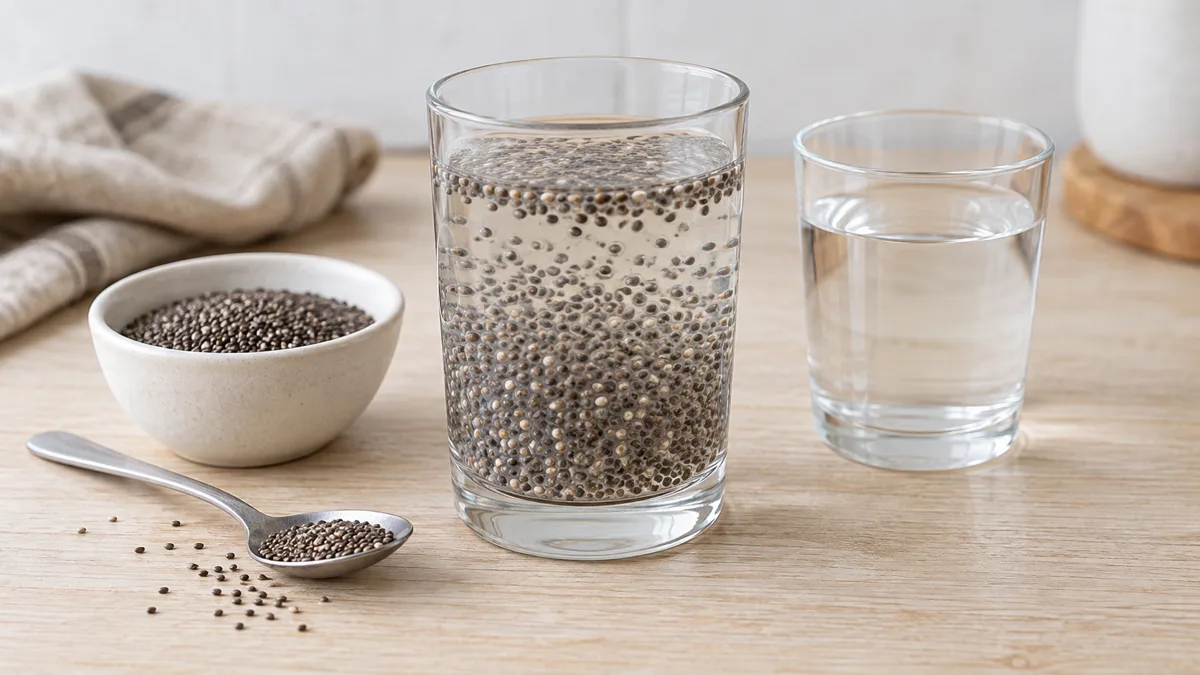
Chia seeds develop a clear gel in water, but they do not turn the drink into a calorie-free “super hydrator.” The calories and fiber remain in the seeds: a glass made with 15 g of chia provides about 74 kcal and 5.2 g of dietary fiber. Its benefits are straightforward—a serving of water and seeds, without promises of detox or weight loss.
Soaking forms a gel around each seed
The outer layers of a chia seed contain mucilage, a mixture of polysaccharides. In contact with water, it leaves the cells and forms a clear capsule around the seed. Light and electron microscopy documented this process in a study of chia structure and hydration.
The gel appears quickly. In a laboratory study of whole seeds in water at 25 °C, swelling was fastest during the first five minutes and continued for about 30 minutes. The researchers measured how the sample held water and expanded; they did not test health effects in people. The experiment was published in Food & Function.
The visible gel therefore confirms a physical property of the seed. It does not show that the water has become “living,” that the body will retain it for longer, or that the drink starts a special metabolic process.
Soaking does not remove the calories
The seeds draw some water into their coating, but their dry matter remains in the glass. In the current USDA FoodData Central entry for dry, raw chia seeds, calculation with Atwater specific factors gives 490.1 kcal per 100 g. A separate USDA entry for dried seeds gives 34.4 g of dietary fiber per 100 g.
For a drink made with 15 g of seeds and 300 ml of water, the calculation is:
| Ingredient | Calories | Fiber |
|---|---|---|
| 15 g chia seeds | 490.1 × 15 / 100 = 73.5 kcal | 34.4 × 15 / 100 = 5.16 g |
| 300 ml water | 0 kcal | 0 g |
| Entire basic drink | about 74 kcal | about 5.2 g |
The volume and texture change, but the seeds' energy value does not. Count lemon juice, honey, syrup, juice, or milk separately from the amount used and the product label. If you drink the liquid but leave seeds at the bottom, the total for the full recipe no longer describes what you consumed.
It is a drink containing water, not a special hydration method
The water in the glass contributes to overall fluid intake. EFSA counts total water from drinks and food and notes that needs change with temperature, activity, diet, and health.
The seed coating's ability to hold water has been measured in food laboratories. That does not establish that chia water replaces fluid better than plain water: the experiments examined gel structure, not hydration in people. The seeds do not create extra water; they bind some of what was poured into the glass.
The practical effect is simpler. Some people find that the texture and flavor help them drink water regularly, while others dislike a thick drink. Chia can stay in the first case; in the second, there is no reason to force it for a supposed advantage.
The fiber remains useful, but tolerance varies
Five grams of fiber is a meaningful addition to a diet, but it does not make chia water essential. Fiber also comes from pulses, grains, vegetables, fruit, nuts, and other seeds. Our guide to high-fiber foods compares these sources.
If seeds and other fiber-rich foods have not been a regular part of your diet, a large serving may cause gas, bloating, or cramps. NIDDK advises adding fiber a little at a time and drinking enough liquid. You can start with fewer seeds and judge your own tolerance instead of immediately copying someone else's daily routine.
Stop the experiment and seek medical advice for persistent pain, marked bloating, vomiting, constipation, or a sudden change in bowel habits. If you have a bowel condition or already follow a prescribed diet, discuss the amount and source of fiber with your treating team.
Do not swallow a spoonful of dry seeds and chase it with water
In a published case report, dry chia seeds became lodged in the esophagus of a person with likely eosinophilic esophagitis. A single case cannot show how often this occurs, but it demonstrates a plausible mechanism: the seeds swell after they are swallowed. The case was published in Case Reports in Internal Medicine.
The American College of Gastroenterology specifically cautions people with dysphagia or an esophageal stricture to let chia expand fully in liquid before eating it. If you cannot swallow even your own saliva after eating, seek urgent medical care rather than trying to push the seeds down with another glass.
How to prepare and count one glass
- Weigh the seeds. The example above uses 15 g; a package value or kitchen scale is more precise than a spoon of variable volume.
- Add 300 ml of water, stir well immediately, then stir again after a few minutes to break up clumps.
- Leave it for 20–30 minutes, until gel coats the seeds evenly. If the drink is too thick, add more water—it adds no calories.
- For tracking, enter 15 g of dry seeds plus every caloric addition separately. There is no need to enter plain water.
This glass is one way to eat seeds and drink water. Soaking lets the seeds expand before swallowing, as ACG recommends for people at risk of swallowing problems. It does not cancel their calories or turn the drink into a weight-loss treatment.
Frequently asked questions
- How many calories are in chia seed water?
- Water has no calories, so the total depends on the weight of the seeds and any additions. USDA data put 15 g of dry chia at about 74 kcal. Count honey, syrup, juice, or milk separately.
- Do chia seeds need to be soaked before eating?
- For a drink, yes: 20–30 minutes in water produces an even gel. Do not swallow a spoonful of dry seeds and chase it with water, especially if you have dysphagia or an esophageal stricture.
- Does chia water hydrate better than plain water?
- Gel studies cannot establish that. The drink supplies the water poured into it, but the seed coating's laboratory water-holding capacity does not prove better hydration in people.
- Can chia water cause weight loss?
- Soaking does not trigger weight loss or remove calories from the seeds. Chia water can be an ordinary part of a diet, but it should not be expected to have a separate effect on body weight.
Read next
- Fiber: what it does in the gut and how much you need — We know that we "need more" fiber, but that is usually where the conversation ends: it is unclear what it physically does, why it causes bloating, and where the 25–30 grams per day recommendation comes from.
- High-fiber foods: a list and simple ways to add them to meals — You do not need bran or a specialty bar to get more fiber.
- How much water to drink per day and where the two liters came from — Everyone knows the "two liters a day" rule, but almost no one knows where this figure came from.
- Eating habits: what works and what doesn't — Almost all nutrition plans fail not because of a lack of knowledge, but because of execution.
This article is for general information. It is not medical advice, a diagnosis, or a prescription for treatment or a diet, and it does not replace a consultation with your doctor. If you have a health condition, are pregnant, take medication, or follow a diet prescribed to you, decisions about food belong with your doctor.
Figures from regulations, guidelines and studies are given as they stood when this article was prepared and may since have changed; check them against the primary sources. This article is not advertising, an offer, or individual advice, and neither the author nor the site owner is responsible for decisions taken on the basis of it.