E435 and E492: what kind of emulsifiers these are
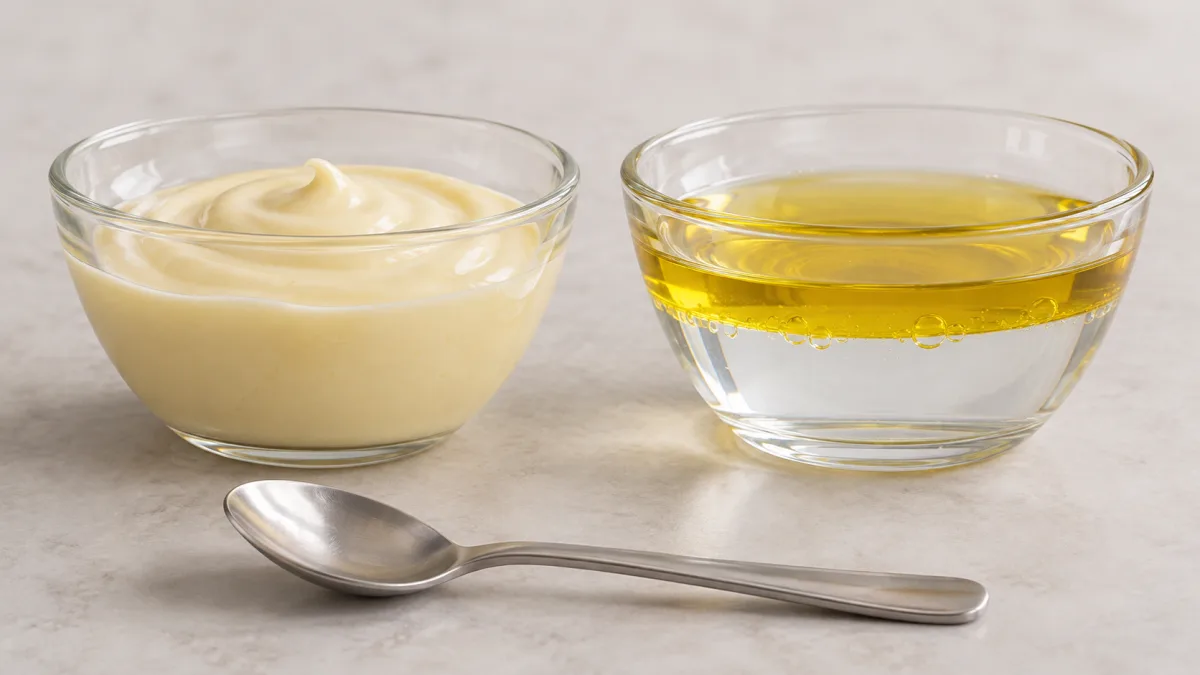
E435 and E492 are not names of two "harmful ingredients", but emulsifiers from different groups. They help mix fat and water, and maintain the uniformity of a cream, sauce, or dessert. A product cannot be evaluated as a whole based on a single code.
Do not confuse two adjacent groups
| Code | Name | Group | Purpose |
|---|---|---|---|
| E435 | Polysorbate 60 | Polysorbates E432–E436 | Helps water and fat remain a homogeneous mixture |
| E492 | Sorbitan tristearate | Sorbitans E491–E495 | Stabilizes fat and water phases, affects texture |
The names are similar because the groups are chemically related, but this is not the same ingredient. E435 belongs to polysorbates, while E492 belongs to sorbitans. Their commonality is functional: both help make a mixture stable where water and fat would otherwise separate on their own.
Where they can be found
Emulsifiers are especially useful in products that require a smooth texture: creams, glazes, desserts, ice cream, baked goods, sauces, and fat fillings. Specific formulation is more important than a list of "where it is found": the presence of a code on the package does not mean it is present in all products of that category.
Other common emulsifiers include lecithin, E471, and E472. Their role in food and the difference between an additive's function and its name are discussed in the article on emulsifiers.
What safety assessment means
The European Food Safety Authority (EFSA) assessed polysorbates E432–E436 as a group and in 2015 established a group acceptable daily intake of 25 mg per kilogram of body weight per day. This is an estimate for the total intake of substances in the group, rather than permission to independently calculate an “E435 limit” from a package of dessert.
For sorbitans E491–E495, which include E492, EFSA issued a separate reassessment in 2017. The expert evaluation pertains to declared uses and estimated intake levels, rather than the healthfulness of a product or an individual person’s diet.
Regulatory assessment does not make a product entirely "healthy" or "harmful". It answers a narrower question: is there a reason to anticipate a risk from a specific substance given approved methods of use and estimated intake. Lists of approved additives and conditions for their use vary between countries and change over time.
How to read E435 or E492 on the label
- Read the entire ingredient list, not just the familiar code. Ingredients are listed in descending order of mass.
- Check why the product needs a uniform texture: cream, glaze, or sauce usually explains the presence of an emulsifier.
- Check allergenic ingredients and nutritional value separately: E435 and E492 do not show this on their own.
- Do not replace the question about diet with a question about a single code. A sweet dessert remains a dessert regardless of which emulsifier stabilizes its texture.
How to quickly read an ingredient list at the store is shown in six steps for checking a product. The general logic of codes is covered in the guide to E-numbers.
What is not visible from the code
The code does not disclose the dose of the substance in a specific portion, the source of fat in the recipe, total sugar, salt, or calorie content. It also does not replace medical advice for a confirmed allergy, intestinal disorder, or prescribed diet. In such cases, one should rely on personal restrictions and the composition of the entire product.
Frequently asked questions
- What is E435?
- E435 is polysorbate 60, an emulsifier from the E432–E436 polysorbate group. It helps hold water and fat together in foods with complex textures.
- What is E492?
- E492 is sorbitan tristearate, an emulsifier from the E491–E495 sorbitan group. It is not equivalent to E435, although both additives perform a similar technological task.
- Are E435 and E492 dangerous?
- A single code cannot be used to evaluate an entire product and diet. EFSA has published separate group assessments for polysorbates and sorbitans for declared uses; a regulatory assessment does not mean an additive has therapeutic properties or that a product automatically becomes healthy.
- Where are E435 and E492 found?
- Emulsifiers are used wherever a mixture of water and fat needs to be stabilized: in some creams, desserts, icings, sauces, baked goods, and ice cream. Check the ingredient list on the specific package.
Read next
- Emulsifiers: what they do in food and what is known about them — Water and fat do not mix—this is a basic fact, and it is the source of half the problems in food technology.
- E-numbers in ingredients: how the code is structured and what it means — An ingredient list contains E330, and it is impossible to tell from this code whether it is citric acid or something better to avoid.
- How manufacturers hide additives in the ingredient list — A short ingredient list sells better than a long one, and manufacturers know it.
- What to look for in an ingredient list in ten seconds — Reading an entire ingredient list at the shelf is impossible: the print is small, and there is no time.
This article is for general information. It is not medical advice, a diagnosis, or a prescription for treatment or a diet, and it does not replace a consultation with your doctor. If you have a health condition, are pregnant, take medication, or follow a diet prescribed to you, decisions about food belong with your doctor.
Figures from regulations, guidelines and studies are given as they stood when this article was prepared and may since have changed; check them against the primary sources. This article is not advertising, an offer, or individual advice, and neither the author nor the site owner is responsible for decisions taken on the basis of it.