Home exercise equipment: do treadmills and stationary bikes help
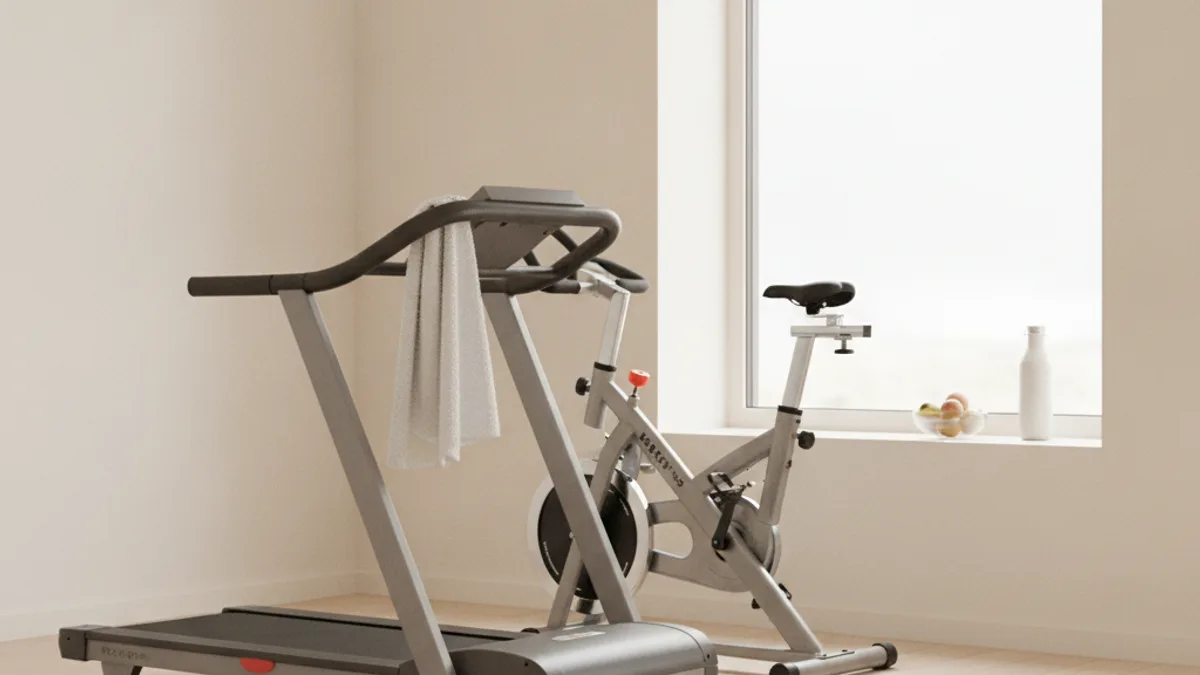
A treadmill does not create a calorie deficit. It makes movement accessible by default, and that is its real, quite significant benefit—it is simply different from what is stated in advertisements.
How many calories it actually is
The order of magnitude for an average-weight person:
| Activity | Hour |
|---|---|
| Treadmill walking, 5 km/h | 200–250 kcal |
| Brisk walking with incline | 300–400 kcal |
| Jogging, 8–9 km/h | 500–600 kcal |
| Stationary bike, moderate | 300–450 kcal |
A comparison worth keeping in mind: a chocolate bar is about an hour of running. It is eaten in five minutes and worked off in an hour, and that is the entire arithmetic of the "burn off what you ate" idea.
The figure on the equipment panel should be divided by about two, especially if it didn't ask for your weight. Many models show total expenditure, including what would occur at rest, and almost all overestimate walking when a person holds onto the handrails: the support removes a significant portion of the work.
What is the benefit then
The equipment removes obstacles, not calories. Rain, darkness, freezing temperatures, the trip to the gym, the need to change clothes and coordinate with someone—each of these obstacles is small individually, but together they are the reason why plans for jogging don't survive November.
Second: it allows you to tie movement to things that are already happening. A TV series, a call, a podcast—forty minutes of walking a day that otherwise wouldn't have happened at all. For a person with a sedentary job, this is exactly the missing volume of daily activity.
Why they turn into a clothes rack
The scenario is predictable: a purchase during a burst of motivation, a month of use, then half a year in the corner and a "for sale" ad. You can verify how common this is in a minute on any classifieds site: almost new treadmills are sold there constantly and are noticeably cheaper than in stores.
What distinguishes those for whom the equipment works:
- It is located where you live. A treadmill on the balcony or in a back room requires a decision twice: to go there and to exercise. A treadmill in front of the TV requires only the second.
- It is tied to an existing habit, not to an abstract "I will exercise three times a week."
- Started small. The "one hour a day starting tomorrow" program breaks on the fourth day.
- Bought for what the person will actually do. If you don't feel like running, a treadmill won't force you; a stationary bike while watching a show has better chances.
What to choose for your goal
- Treadmill. Versatile, expensive, heavy, and noisy—the neighbors downstairs will hear it. Look at motor power and user weight limits, not the number of programs.
- Stationary bike. Cheaper, quieter, more compact, and easier on the joints. Suitable if the goal is to accumulate exercise volume while watching a movie.
- Elliptical trainer. A compromise: full-body workout, less impact on joints than running, but takes up a lot of space.
- Rowing machine. Provides the most work per unit of time and requires technique: with poor back form, it quickly becomes a source of problems.
- Under-desk treadmill. Slow walking while working. Modest in terms of calories, but it accumulates on its own without dedicated time.
What cardio equipment does not do
It does not preserve muscle mass during a deficit—that is the job of strength training. When losing weight without it, a larger share of the loss comes from muscle rather than fat, and the final result at the same number on the scale looks worse. Adjustable dumbbells, resistance bands, and a pull-up bar cost less than any cardio machine, take up a corner, and cover exactly the task that a treadmill does not.
And most importantly: a calorie deficit is created in the kitchen. The equipment helps maintain health and muscle, adds a few hundred kilocalories of expenditure per week, and turns movement into a habit. No one will be able to replace counting what they eat with it.
Frequently asked questions
- Can you lose weight on a treadmill?
- Only in combination with dietary changes. An hour of walking burns 200–250 kcal, an hour of running 500–600, which is less than the difference between two dinner options. A treadmill helps maintain muscle and health and adds movement, but a calorie deficit is created in the kitchen.
- Why does the machine show more calories than I actually burn?
- Many models do not know your weight and show total expenditure, including what you would burn at rest. Plus, almost all of them overestimate walking when a person holds onto the handrails: the support removes a significant portion of the work. You should divide the readings by about two.
- Which is better for home use: a treadmill or an exercise bike?
- The one you will actually use. A treadmill is more versatile but more expensive, heavier, and noisier. An exercise bike is cheaper, quieter, more compact, and easier on the joints, which is important if you have a high body weight or knee problems.
- Does a cardio machine replace strength training?
- No. Strength training preserves muscle during a deficit, and without it, a large portion of weight loss will come from muscle rather than fat. Adjustable dumbbells, resistance bands, and a pull-up bar cost less than any cardio machine and fulfill this need.
Read next
- Why a sedentary lifestyle is harmful — Sedentary work affects health not because a person doesn't exercise enough, but because they barely move during the other fifteen hours of the day.
- How many steps should you walk per day — Everyone knows the number 10,000, but almost no one knows its origin.
- Calorie deficit: how to calculate it and how to hold it — A calorie deficit is the one thing without which weight does not come down.
This article is for general information. It is not medical advice, a diagnosis, or a prescription for treatment or a diet, and it does not replace a consultation with your doctor. If you have a health condition, are pregnant, take medication, or follow a diet prescribed to you, decisions about food belong with your doctor.
Figures from regulations, guidelines and studies are given as they stood when this article was prepared and may since have changed; check them against the primary sources. This article is not advertising, an offer, or individual advice, and neither the author nor the site owner is responsible for decisions taken on the basis of it.