How much does a spoonful of instant coffee weigh?
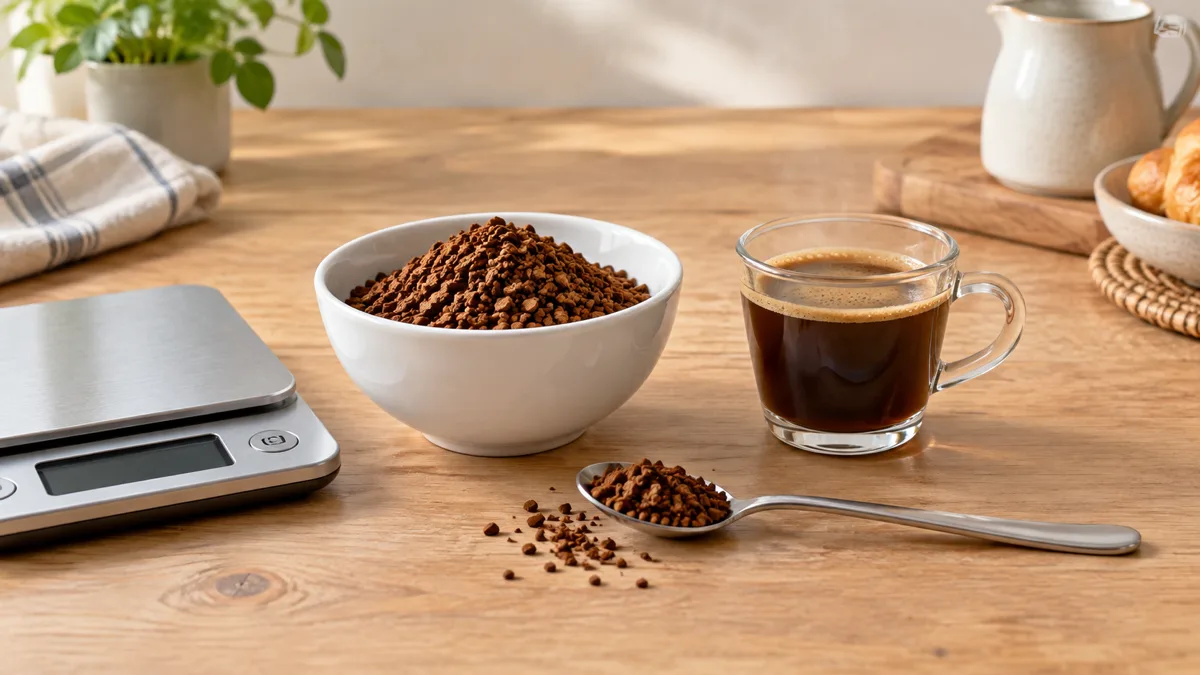
NESCAFÉ lists 1.8 g for a teaspoon of its instant coffee. That is a guide for a particular product and serving method, not the weight of every spoonful. Granule size and a heaped spoon change the amount. Weigh your usual serving if you need a closer figure.
One manufacturer gives 1.8 g per teaspoon
NESCAFÉ’s serving guide uses 1.8 g, about one teaspoon, for a mug made with 200 ml of water. It also describes the measure as a heaped teaspoon. This is the maker’s preparation guide, not a standard conversion for every instant coffee.
A spoon measures volume. The weight changes with fine powder versus larger granules, how full the spoon is, and how firmly the coffee sits in it. Even spoonfuls from one jar need not match exactly. The serving weight on your own jar is a useful estimate; a scale gives you the weight of your serving.
Weigh the spoonful you actually use
- Put a dry cup on a kitchen scale and tare it.
- Scoop the coffee as you normally do, tip it into the cup, and note the weight of the dry granules.
- If the scale displays only whole grams, weigh several similar spoonfuls together and divide by their number.
Save that result for the same jar and spoon. Measure again if you switch coffee or change how you fill the spoon. The instant coffee measures card gives a quick household-measure reference.
Convert calories per 100 g to your spoonful
Check whether the label describes dry coffee, coffee mixed with water, or a prepared mix. The NESCAFÉ Original Decaf product page lists 118 kcal per 100 g of dry coffee. Using its 1.8 g serving weight gives 118 × 1.8 ÷ 100 = 2.1 kcal, or about 2 kcal by calculation. The maker also lists 2 kcal for a mug without additions.
| Label basis | Calculation |
|---|---|
| Calories per 100 g of dry coffee | Multiply by grams of granules and divide by 100 |
| Calories per prepared mug | Use only for the stated mug size and recipe |
| Calories per 100 ml of drink | Multiply by drink volume in ml and divide by 100 |
Water adds no calories; milk, sugar, and powdered creamer contribute their own. Log those separately. A “3 in 1” sachet has a different ingredient list, so use its own nutrition panel. Our nutrition-label guide explains what the printed numbers refer to.
Spoon weight does not tell you the caffeine dose
Grams tell you how much coffee went into the mug, but they do not give an exact number of milligrams of caffeine. NESCAFÉ US cites about 113 mg of caffeine for a typical 12-fl-oz serving of instant coffee and notes that the amount varies by beans and preparation. That figure describes a whole drink, not one teaspoon of granules.
If you track caffeine, look for a milligram value for your particular product and serving. Decaf is not necessarily caffeine-free; see our guide to decaf coffee. Questions about total caffeine intake are covered in the coffee intake guide.
What to enter in a food log
For black coffee from the same jar, record the dry weight of your usual spoonful and use that jar’s nutrition data. Add milk or sugar as separate entries. For an instant coffee mix in a sachet, use the nutrition information for the entire mix.
Frequently asked questions
- How many grams are in a teaspoon of instant coffee?
- NESCAFÉ gives 1.8 g as a serving of about one teaspoon. Another product, spoon, or heap can weigh differently, so weigh your own portion for a closer result.
- How many calories are in a spoonful of instant coffee?
- At 118 kcal per 100 g of dry NESCAFÉ Original Decaf, a 1.8 g serving works out to about 2 kcal. For your product, multiply its per-100-g value by the grams you use and divide by 100. Count additions separately.
- Can I calculate caffeine from the spoon weight?
- Not accurately. You need caffeine information for that product and serving; equal weights of different instant coffees need not have equal caffeine content.
- Does the same figure apply to a 3-in-1 coffee mix?
- No. Sachets can include sugar and other ingredients. Use the nutrition panel for the whole mix.
Read next
- Calories and macros on the label: why the numbers don't match reality — The same buckwheat in three different apps gives three different calorie counts, and the package shows a fourth.
- Coffee: how much you can drink and what adds calories — There are three questions about coffee, and they are different: how much caffeine is safe, does coffee harm your health, and why a latte with syrup costs as much as a full meal.
- Decaf: how caffeine is removed from coffee and how much is left — Decaffeinated coffee is not coffee without caffeine, but coffee where it makes up no more than 0.
- Calorie content of coffee shop drinks: where the difference hides — In a coffee shop, calories are often hidden in the cup rather than in the food next to it.
This article is for general information. It is not medical advice, a diagnosis, or a prescription for treatment or a diet, and it does not replace a consultation with your doctor. If you have a health condition, are pregnant, take medication, or follow a diet prescribed to you, decisions about food belong with your doctor.
Figures from regulations, guidelines and studies are given as they stood when this article was prepared and may since have changed; check them against the primary sources. This article is not advertising, an offer, or individual advice, and neither the author nor the site owner is responsible for decisions taken on the basis of it.