Cold exposure and brown fat: how many calories an ice bath actually costs
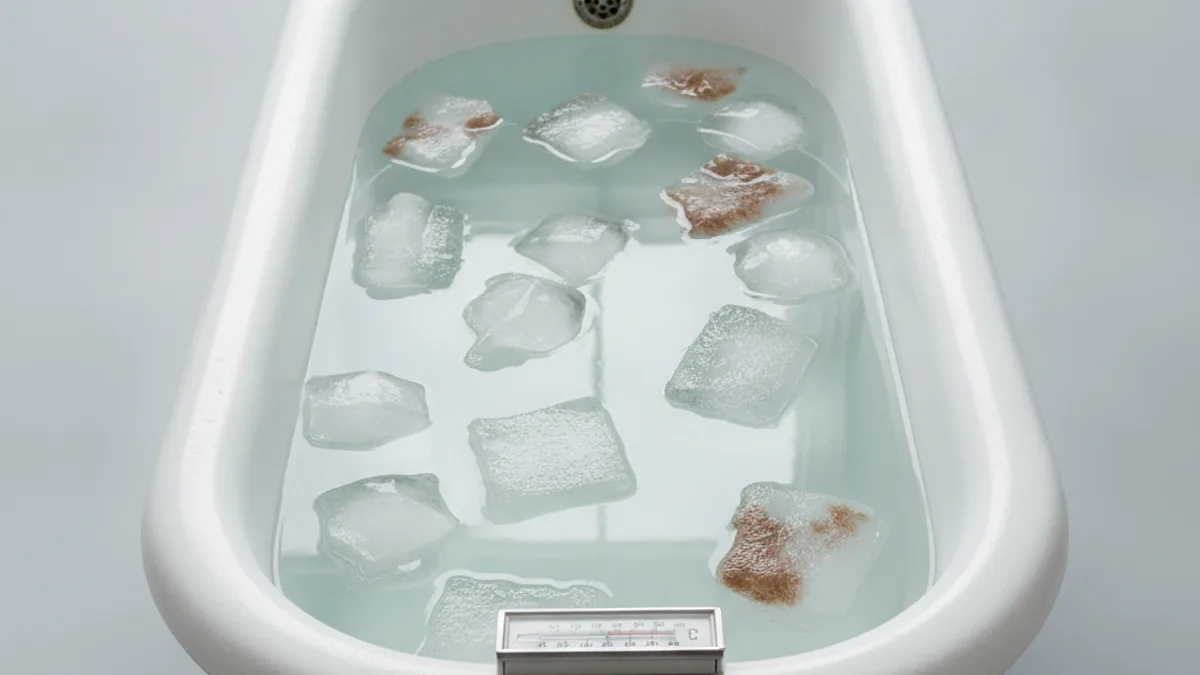
Brown fat is one of the rare cases where the elegant mechanism turns out to be real: the tissue genuinely converts fat into heat, bypassing the usual route. The argument is not about whether the mechanism exists but about its size — and size is exactly what gets lost between the laboratory and the ice bath.
How brown tissue differs
A white fat cell is a warehouse: one large droplet, few mitochondria, storage as the job. A brown one is built differently — many droplets, many mitochondria, and inside them a protein that lets the energy of oxidation go straight to heat instead of being stored in chemical form. The colour comes from the mitochondrial density.
Newborns carry a fair amount of it, because it warms a body that cannot yet shiver. Adults were assumed to lose it. That was overturned in 2009, when active brown tissue was found in healthy men exposed to cold, mostly around the neck and above the collarbones. That paper started the current interest.
How much an adult has
Not much. Tens of grams — a quantity that only became visible at all through labelled-glucose imaging during cooling. The amount varies widely between people, falls with age and with body mass, and is higher in those regularly exposed to cold.
This is the first place the popular retelling breaks. "The tissue exists and it burns fat" does not imply "there is enough of it to show up on a scale". Between having a mechanism and it mattering to a daily energy balance sits a question of quantity, and the answer is modest.
How far expenditure rises
It helps to separate two heat sources. One is brown tissue itself. The other is shivering, which is ordinary muscle work, and at meaningful cold exposure it supplies most of the increase.
The orders of magnitude look like this: cooling to just above the shivering threshold raises daily expenditure by low single-digit percentages; shivering raises it more, but nobody shivers for hours on purpose. A two- or three-minute ice bath spends so little that the figure disappears into the error bars of any measurement.
For scale, consider how badly much longer efforts are overestimated: calories burned in exercise are routinely inflated several-fold, and negative-calorie foods turn out to be an arithmetic error of the same family. Cold belongs in that category — a real mechanism with a small contribution.
And then there is appetite
A complication almost never raised: cold increases appetite. A body that has spent energy warming itself tends to take it back, and more readily than after physical exertion. So even a modest rise in expenditure is easily matched on the intake side — the same mechanics described in the weight-loss plateau.
The practical conclusion is dull: if the goal is losing weight, cold is not a tool. Its effect is smaller than the error with which anyone estimates a day's eating.
The other claims
| Claim | What is known |
|---|---|
| Cold activates brown fat | Yes, shown by direct measurement |
| Regular cold increases the amount of brown tissue | Supported by small studies |
| Ice baths help with weight loss | Not supported: the contribution is small and appetite rises |
| Cold improves recovery after training | Mixed; some work shows blunted adaptation to resistance training |
| Cold improves mood and alertness | Subjective effects are described, but such a study cannot be blinded |
That last row explains much of the popularity. Immersion in ice water cannot be concealed from a participant, so expectation cannot be separated from effect in principle. It does not mean the sensations are invented. It means attributing them to a specific physiological mechanism is premature.
On safety
Sudden immersion in cold water triggers a reflex gasp and a jump in blood pressure and heart rate. For someone with cardiovascular disease that is not a harmless procedure, and the question belongs with a doctor rather than with a video. A separate risk is going in alone: losing control of breathing in the first seconds is dangerous regardless of how conditioned you are.
The verdict
Brown fat is a good example of an honest mechanism given the wrong scale. The tissue is there, cold activates it, energy expenditure does rise — by an amount that does not matter for body weight. If cold exposure is enjoyable, that is reason enough to do it. As a way to lose weight it does not work, and no amount of protocol tuning changes that.
Frequently asked questions
- Do adults really have brown fat?
- Yes, shown by direct measurement: active brown tissue is detectable during cold exposure, mostly around the neck and above the collarbones. The amount is measured in tens of grams and varies widely between people.
- How many calories does a cold plunge burn?
- Cooling short of shivering raises daily expenditure by low single-digit percentages. A two- or three-minute immersion spends so little that the figure is lost within measurement error.
- Do ice baths help with weight loss?
- That does not follow from the available data. The increase in expenditure is small, and cold additionally raises appetite, so the effect is easily offset by what gets eaten.
- Does cold improve recovery after training?
- Evidence is mixed. Some studies describe reduced soreness, others report blunted adaptation to resistance training when cooling is applied regularly right after a session.
- Who should avoid cold immersion?
- Sudden immersion triggers a reflex gasp and a sharp rise in blood pressure and heart rate, so with cardiovascular disease the question belongs with a doctor. Going in alone is unsafe regardless of conditioning.
Read next
- How many calories are burned during a workout: running, cycling, swimming, gym — An hour of running at a moderate pace for a 70 kg person is about 550–700 kcal, cycling at a leisurely pace is 350–450, swimming is 400–600, and strength training is 200–350.
- Negative calorie foods: is celery really more expensive to digest than it is worth? — Celery is the food people name when they want an example of negative calories: eat it and you end the day lower than you started, because digesting it supposedly costs more than it delivers.
- Metabolism: is it true that it can be "boosted" and that it can "break" — One person is promised a metabolism boost through spices and frequent small meals, another explains weight plateaus by claiming their metabolism is broken from dieting.
- Breathing practices: what has been measured in the Wim Hof method, hyperventilation, box breathing, and slow rhythm techniques — The term "breathing practices" usually refers to four different things: slow rhythm, equal phases of inhalation and exhalation, conscious hyperventilation, and the Wim Hof protocol, where breathing is combined with cold exposure and meditation.
This article is for general information. It is not medical advice, a diagnosis, or a prescription for treatment or a diet, and it does not replace a consultation with your doctor. If you have a health condition, are pregnant, take medication, or follow a diet prescribed to you, decisions about food belong with your doctor.
Figures from regulations, guidelines and studies are given as they stood when this article was prepared and may since have changed; check them against the primary sources. This article is not advertising, an offer, or individual advice, and neither the author nor the site owner is responsible for decisions taken on the basis of it.