How much does it cost to count calories
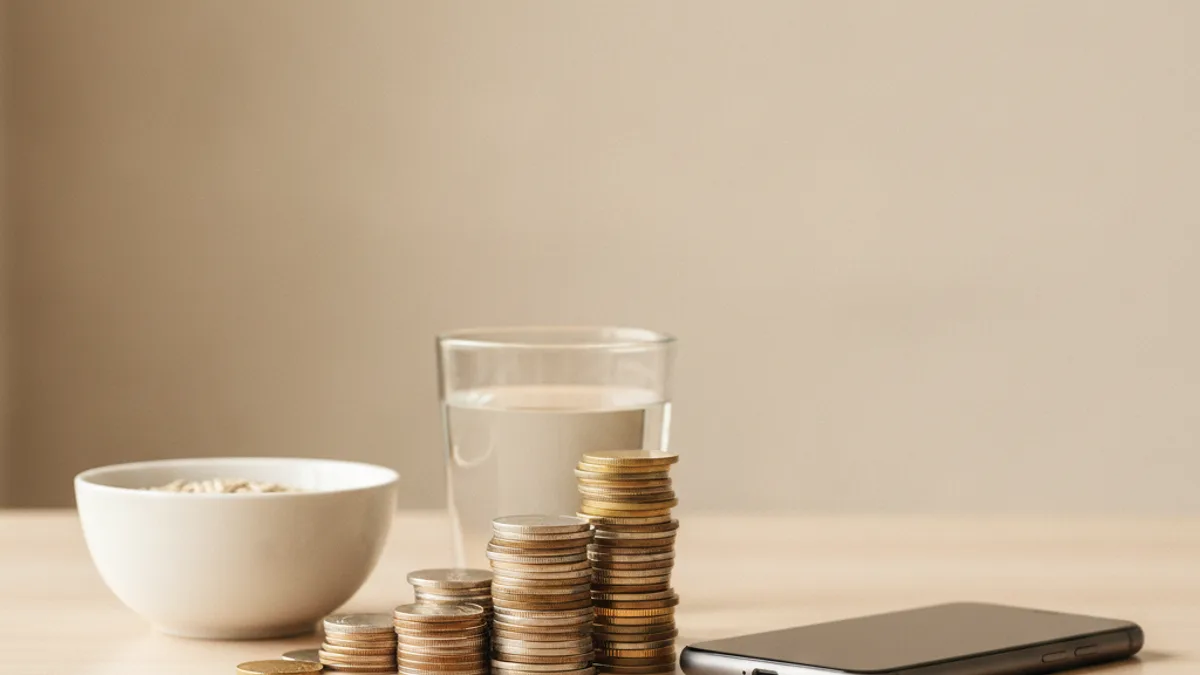
You can count calories for free—it costs nothing to do it on paper or in a spreadsheet. Costs arise where something is done for you: searching for a product in a database, identifying a dish from a photo, or storing your history.
What actually costs money in a calorie tracker
The price difference between two apps is not due to greed, but rather which of these cost items they incur.
| Item | How it is calculated |
|---|---|
| Food database | One-time costs for collection and verification plus ongoing maintenance |
| Photo recognition | Fee per model request — the only item that grows linearly with the number of users |
| Servers and storage | Low, unless there is heavy data like photos |
| Development and support | Fixed costs that do not depend on the number of users |
The second row explains almost everything. An app where you search for a product manually in a list serves an extra user almost for free: a database query costs a fraction of a cent. An app that recognizes a dish from a photo pays an external provider for each analysis — and this is a per-item fee, not a monthly one.
This leads to a pattern seen across the entire market: database search is often free without limits, while photo recognition almost never is.
What a free-tier user pays with
Free access in this category comes in four types, and they are not equivalent.
Limited quota. A few analyses per day or a few dozen in total. An honest option: you pay with inconvenience, not anything else.
Advertising. Displaying ads within the app. It is important to understand that the ad network receives information about your behavior — usually anonymized, but it does receive it.
Sale of anonymized data. Aggregated nutrition statistics have commercial value for food manufacturers. This is legal with proper anonymization and is almost never displayed on the first screen.
Crippled features as bait. What is cheap to provide (diary, reference book) is free, while what costs money per request is paid.
You can check which of the four applies to you in the privacy policy: the section on sharing with third parties shows both the ad network and data buyers, if any exist. What else is worth reading there — in our breakdown of the fate of food photos.
Subscription or one-time package
Two ways to sell the same thing, and they suit different people.
Subscription is profitable for those who use it regularly: the price per analysis drops the more often you use it. It is disadvantageous in two cases — if you forget to cancel and if you only count for one month a year.
Request package remains valid until every request is used and does not renew itself. It is more expensive per analysis but does not require remembering to cancel. A reasonable choice for someone who counts sporadically — for example, checking their diet once every six months.
Here, for example, both are available: a monthly subscription for 199 ₽ and a package of 100 requests for 199 ₽, plus a free limit of three analyses per day for registered users. Prices are current as of September 2026; valid ones are on the pricing page.
What to check before paying
- Does the subscription renew automatically and where to cancel it. This should be stated before payment, not in an email afterward.
- What happens to the diary after payment ends. Entries should remain accessible: they are yours, not part of the service.
- Can you retrieve your data. Exporting the diary to a file is a sign that you are not being held captive.
- Refund policy. For digital services, these can be strict, and that is legal, but it must be stated.
- Who is the provider. Under Russian jurisdiction, the seller's details are mandatory information, not a courtesy.
Russian specifics: how to pay
A significant portion of popular trackers are foreign, and subscriptions in them are paid through the app store. This generally does not work with a Russian card, and workarounds — third-party accounts, gift codes, intermediaries — mean that if any problem arises, you are not a party to the contract and have nowhere to turn.
This is not an argument for or against a specific app, but a factor to consider before incorporating a tool into your daily habit.
How much it costs if you don't pay at all
The honest answer: the same amount, but in a different currency. Counting using tables and a paper diary works — it is exactly the same arithmetic, and it produced results long before apps existed. You pay with time: fifteen minutes a day for searching values and adding them up versus fifteen seconds.
The point of paying appears at one juncture — when saving time turns counting from a project that is abandoned after a week into a habit that sticks. If you are already keeping a diary manually and it is not falling apart, an app will add convenience, but not results.
There is a separate article on where counting begins and how much time it takes in the first week: how to start counting calories and macros.
Frequently asked questions
- Why is database searching sometimes free, while photo recognition is not?
- A database query costs a fraction of a cent and barely increases with the number of users. Photo analysis is paid to an external AI provider for each request, so costs grow in proportion to usage.
- What does a user pay with in a free calorie counting app?
- One of four things: limited access, exposure to ads, sharing anonymized nutrition data, or access only to features that are inexpensive for the owner to maintain.
- Which is more cost-effective — a subscription or a request bundle?
- A subscription is cheaper per analysis for regular use. A bundle does not renew automatically and does not expire on a calendar basis, making it suitable for those who track sporadically.
Read next
- Calorie counting apps: how they work and where they go wrong — A calorie counter looks like a calculator, and people expect calculator-like precision from it.
- What happens to a food photo after it is uploaded — A photo of a plate seems harmless, and usually it is.
- How to start tracking calories and macros: what happens in the first week — The first week of tracking rarely ends with numbers you can trust.
This article is for general information. It is not medical advice, a diagnosis, or a prescription for treatment or a diet, and it does not replace a consultation with your doctor. If you have a health condition, are pregnant, take medication, or follow a diet prescribed to you, decisions about food belong with your doctor.
Figures from regulations, guidelines and studies are given as they stood when this article was prepared and may since have changed; check them against the primary sources. This article is not advertising, an offer, or individual advice, and neither the author nor the site owner is responsible for decisions taken on the basis of it.